Published: 16 October 2026 | Author: Karl Huang
Most people arrive at the Tarim poplar forest expecting a park. What they walk into is a river system that happens to grow trees. I have made the drive out of Korla three times now, twice in late October when every branch was lit, and once in the second week of the month when the grove was still half green and I stopped trusting generic best-month advice for good. This guide is built around the one thing that decides your trip: the Tarim River, and whether the water and the first cold nights have done their work yet. I am not selling a tour. I want you to know the place well enough to choose your own day.
The Tarim poplar forest and the river that builds it
There is no mystery about why the Tarim poplar forest stands where it does. It follows the Tarim, the longest inland river in China, which carries snowmelt off the Tianshan and Kunlun ranges eastward along the northern rim of the Taklamakan. Remove the river and the trees follow it out; that is close to what happened downstream during the twentieth century, and what decades of engineered water releases have been slowly reversing. The Luntai grove survives on the river’s middle reaches, where the channel still spreads across its floodplain in summer. On a map the forest reads as a green ribbon pinned between two deserts, the Taklamakan on one side and the Kumtag on the other. That ribbon is not decoration. More than sixty percent of the world’s desert poplars grow in China, and more than ninety percent of those stand in the Tarim basin, which puts this stretch of Luntai near the centre of the species’ range.
Tarim poplar forest at a glance
| Item | Detail |
|---|---|
| Where | Luntai County, Bayingolin Prefecture, northern edge of the Tarim Basin |
| What | A protected Populus euphratica grove, about 100 square kilometres inside the ticketed park |
| From Korla | About 170 km to Luntai town, then roughly 70 km south to the park gate |
| From Urumqi | Around 600 km on the G3012 expressway |
| Best time | Mid-October to early November; the peak often lands near 20 October |
| Entry | Roughly ¥40–45 in autumn, plus a shuttle ticket and an optional sightseeing train |
| Hours | Usually 10:00 to 18:00 in season, so confirm before you drive out |
| Time needed | A long half-day, or a full day if you add the desert highway |
What Populus euphratica actually is
Populus euphratica, the desert poplar, is the only broadleaf tree that can build a whole forest in country like this. It shrugs off salt, drought and thin soil, and it survives flooding that would drown most trees. Its roots chase the water table, so when the channel shifts the grove shifts with it, which is why the woodland has a ragged, organic edge instead of a neat boundary. Guides will quote the local saying that a poplar lives a thousand years, stands dead for a thousand, then lies unrotted for a thousand more. I would not call that botany, but standing among the grey skeletons at the back of the park, it stops sounding like a stretch. One tree here, the so-called Poplar King, is said to be more than three thousand two hundred years old. What stayed with me was the mixture: living gold, fading orange and pale dead trunks holding the same ground in a single frame.
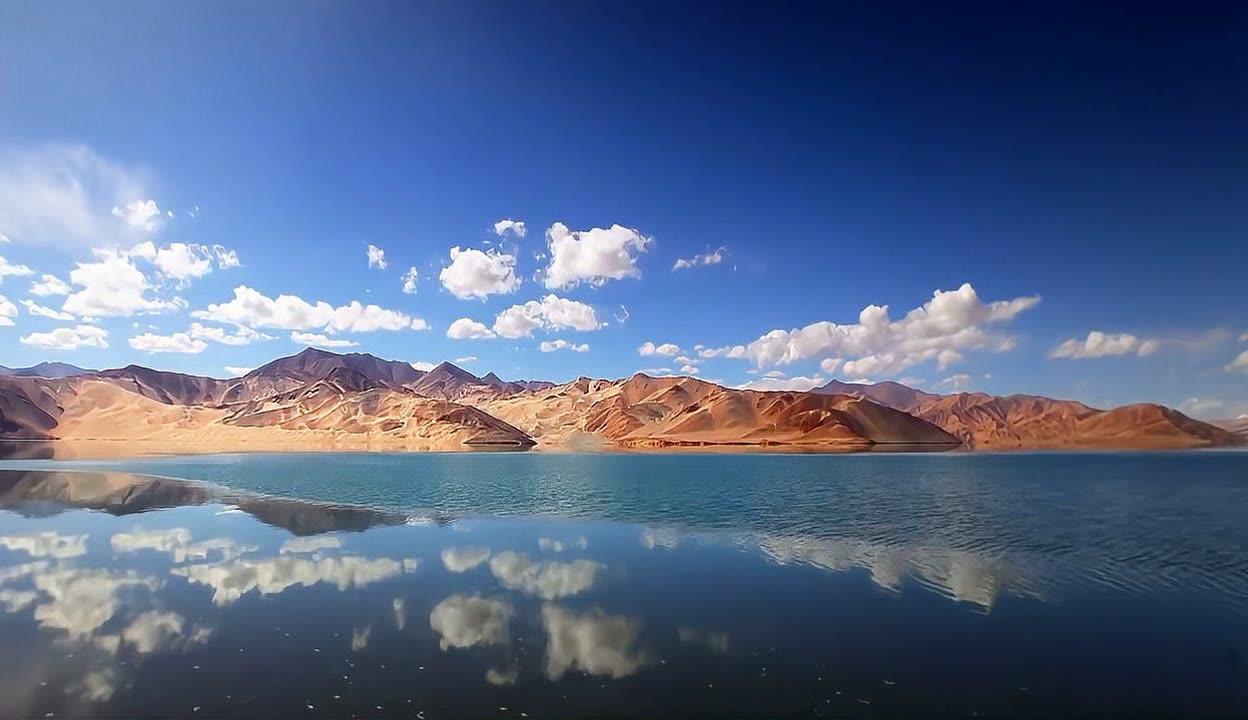
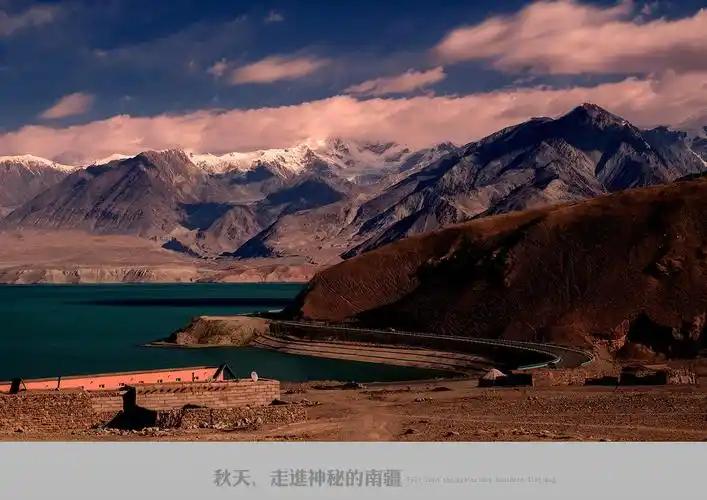
The dry interior of southern Xinjiang: open water and bare ridges, the country the Tarim thread of green runs through.
What three hours inside the grove felt like
The park opens at ten, and the queue at the gate starts forming half an hour before. Inside, a shuttle takes you to the Qiaoyang River stop, where a retro-styled mini-train waits on a loop that runs 13.14 km through the trees. Buy the full route, not the short one, or you will spend most of your ticket looking at the same bend. The first time the little train slid into the long avenue of branches, everyone in the carriage went quiet and pointed their phones up. Above the open carriages the canopy closes into a tunnel of yellow, and the light comes through in slices.
The train makes a few stops. Get off at the lake they call Thousand Birds, where the water lies flat enough to double the grove, and at the boardwalk where you can walk among the oldest trunks instead of filing past them. A lookout tower stands about 24 metres up, and from the top the whole thing finally makes sense: a wide gold carpet, the grey line of the Tarim bending through it, and bare dunes pressing in from beyond. I spent longer than I meant to at the dead-tree section at the back, a stand of bleached trunks that photographers call the ghost forest. It is the most honest part of the park. Then the cold caught up with me, because October mornings here start near freezing even when the afternoon reaches the high teens.
Reaching Luntai from Korla, Urumqi and the rail line
Almost everyone comes through Korla, which has the nearest airport and a rail station on the southern line. From Korla it is about 170 km to Luntai town and then roughly 70 km south along the desert-highway corridor to the gate, so allow two and a half to three hours each way. If you would rather not drive, a direct shuttle now runs from Korla’s Xinshizhou bus station to the park: about ¥80 one way or ¥150 return, leaving at nine in the morning and heading back at five. From Urumqi the drive is around 600 km on the G3012. One thing to plan for: the park is enormous and the inner shuttle is effectively compulsory, so do not count on walking the whole grove. I have written separately about Korla as a base and about the wider Xinjiang rail network, both useful if you are building the trip from scratch.
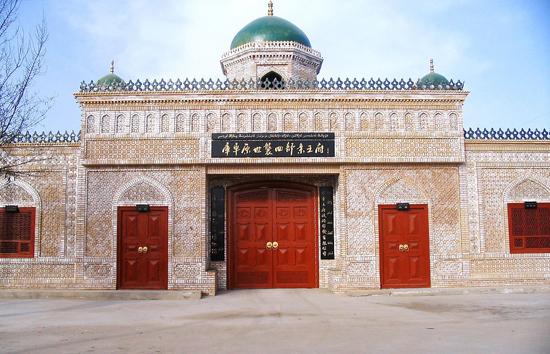
Kuqa, an old oasis town west of Luntai on the same northern Tarim road, makes an easy second night.
Timing the gold: a three-week window that slides each year
The reliable span is the middle of October to the first days of November, with the colour usually peaking somewhere around the twentieth. But the exact week moves with the weather, and I have watched it move by ten days between two consecutive years. Early October, with its national-holiday crowds, is almost always too soon. Late September is still green. Push past the first week of November and you risk bare branches after a hard frost. If your dates are fixed, aim for a weekday and accept that the light is the real variable: the low sun at opening time and again in the last hour before closing does more for the trees than any filter. My own autumn foliage calendar lists how the peak differs across Xinjiang if you are chasing several groves in one trip.
Sleeping in Korla, Luntai or at the grove’s edge
Most visitors sleep in Korla, where the hotels are newer, the food is better and there is a real choice of price points. Luntai town is closer, about an hour from the gate, and its guesthouses and small hotels are cheaper but plainer. A handful of simple lodges sit near the park itself, and in late October they book out early, so if you want to be inside for a sunrise or the last light, reserve well ahead. I have done both and now lean toward Korla for comfort with one early start, unless I am specifically after the light.
Eating on the Tarim rim
This is apricot country. Luntai is known across Xinjiang as the home of the white apricot, and in autumn the roadside stalls sell them dried, pressed into cakes or stewed. Otherwise the food is the dependable oasis cooking of the north Tarim rim: hand-pulled noodles under a heavy lamb sauce, steamed rice pilaf with carrot and raisin, mutton skewers, thin-skinned baked buns, melons that taste like sugar water and flatbread that keeps for a long drive. Nothing is fancy and that is the point. If you extend west to Kuqa, its old-town market is worth a slow morning, and I have written about what is actually sold there.
The desert highway, the oil wells and other practical notes
South of Luntai, at a place called Lunnan, the Tarim desert highway begins its 522 km run across the Taklamakan to Minfeng, opened in 1995 and still the longest road of its kind through moving dunes. It starts as an oil road, and the first stretch is lined with pump jacks and pipelines before the sand takes over. If you have time, a short run south onto the tarmac gives you a sense of the emptiness the grove is holding back. Practical points: fill the tank before you leave the towns, because stations thin out fast; carry more water than feels necessary; pack layers, since mornings sit near freezing while afternoons can reach the high teens; take a little cash for small stalls; and download offline maps, because signal drops past Luntai. For a wider sense of how the basin fits together, see my notes on crossing the Tarim Basin.
A half-day plan that fits a Korla road trip
Leave Korla by seven. Reach the park gate around half past nine so you are near the front when it opens at ten. Ride the shuttle to Qiaoyang River and take the full mini-train loop, getting off at the lake and the boardwalk. Climb the lookout tower while the light is still low, walk the dead-tree section, then loop back to the Tarim bank for the reflections. Head into Luntai for a late lunch, and if the afternoon is clear, drive a few kilometres down the desert highway before turning back. You will be in Korla again before dark. With a second day, sleep near the park and repeat the morning, which is when the grove is at its quietest.
Questions I keep getting asked
Is this the same place as Tarim Huyanglin?
Yes. Huyanglin simply means poplar forest, and the names point to the same grove along the river.
Can I visit outside autumn?
You can, and you will have it to yourself, but summer is uniformly green and winter is bare grey. The gold is the reason to make the drive.
Do I need a guide?
Not inside the park, where the shuttle and train explain themselves. You do need a car and driver, or the shuttle, to reach the gate.
How long should I allow?
A long half-day from Korla is realistic; a full day lets you add the desert highway without rushing.
Is it crowded?
Weekends and the national holiday are busy. A weekday in the third week of October is the sweet spot I keep returning to.
A note on accuracy and change
This reflects visits made over three autumns and information available at the time of writing in October 2026. Ticket prices, opening hours, the shuttle schedule and the colour window all move with the season and the weather, and the park has been running upgrades during the autumn peak. Treat every figure here as a starting point and confirm current details with the park or your hotel before you travel. The author accepts no responsibility for changes beyond his control.
About the author
Karl Huang writes about travel in northwest China and has driven the northern Tarim rim across several autumns, from the Luntai groves to the desert highway south of Lunnan. He covers the practical side of the region for independent travellers rather than tour groups.
Questions travelers ask about Tarim Poplar Forest
When is the best time to see the Tarim Poplar Forest?
Late October to early November, when the Populus euphratica trees turn brilliant gold for a short window before the leaves drop for winter.
How do I get to the Tarim Poplar Forest?
From Luntai by road, roughly 70 km to the protected forest park along the Tarim River; many visitors pair it with a desert-highway drive.
Is there an entrance fee?
Yes, the forest park charges an entrance and shuttle fee; confirm the current rate on arrival, as prices change by season.