By Karl Huang · XinjiangAttractions Editorial Team · Last updated October 2026
Most visitors to China know the Forbidden City in Beijing, but few realize there is a second, older imperial palace that seeded it. The Shenyang Imperial Palace (Shěnyáng Gǔgchéng) — also called the Mukden Palace — was the home and headquarters of the early Qing court before the dynasty conquered the south and moved the capital to Beijing in 1644. Smaller and rougher than its famous southern cousin, it is in many ways the more interesting of the two: here you can read the Manchu, Mongol, and Han cultural strands that the Qing wove together before they became the rulers of all China.
The Palace That Came First
Nurhaci, the Jurchen chief who united the Manchurian tribes, ordered construction in 1625; his son Hong Taiji completed and expanded it and declared the Qing dynasty here in 1636. When the Qing took Beijing, Shenyang kept the status of “secondary capital,” and later emperors — Kangxi, Qianlong, Jiaqing, and Daoguang — each returned north to enlarge it, often staying in the very rooms their grandfathers had built. The result is a compact 60,000-square-meter complex of more than 300 rooms, laid out on an east-west axis rather than the strict north-south grid of Beijing, a choice that reflects its origin as a mobile steppe camp rather than a settled bureaucratic seat.
UNESCO listed it as a World Heritage Site in 2004, jointly with the three Mukden tombs, as an extension of the Imperial Tombs of the Ming and Qing. That inscription is what finally put Shenyang on the international heritage map, though Chinese visitors had long known it as the “former palace.”
| Detail | Information |
|---|---|
| Built | 1625 by Nurhaci; expanded by Hong Taiji and later emperors |
| Scale | About 60,000 m², over 300 rooms |
| UNESCO | World Heritage Site since 2004 |
| Ticket | Around RMB 50–60 in peak season |
| Time needed | 2 to 3 hours |
| Combo | Same pass covers nearby Zhao and Fu Mausoleums |
What Makes It Different from Beijing
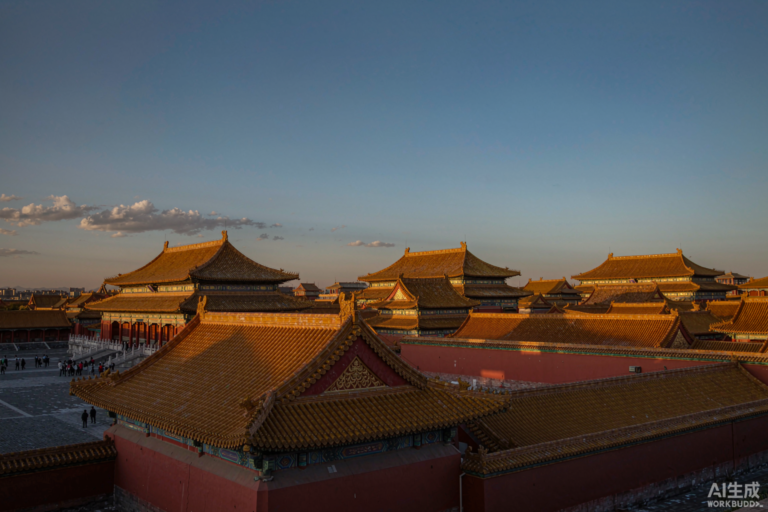
Two things jump out. First, the octagonal Da Zheng Hall (Hall of Great Affairs), raised on a platform and ringed by the Ten Kings Pavilions — a tent-like camp layout carried over from steppe military tradition, nothing like the rectangular throne halls of the south. Second, the profuse use of yellow glazed tiles edged with green, and the Manchu-language name boards beside the Chinese ones. The complex splits into three parts: the eastern section with the octagonal hall (oldest), the central section mirroring Beijing’s ceremonial axis, and the western gardens added by Qianlong as a private retreat.
Compared with the Forbidden City in Beijing, Shenyang feels intimate and unfinished by design — you can stand in a courtyard and imagine a tented court rather than a settled bureaucracy, and the Manchu inscriptions remind you that the Qing were outsiders who conquered a civilization they then absorbed.
A Visitor’s Memory of the Octagonal Hall
On my autumn visit the light fell sideways through the yellow tiles and lit the empty dais where Nurhaci once received his chiefs. A tour group had skipped the eastern section entirely, so I had the octagonal hall to myself for a few minutes — just the wind in the courtyard trees and the smell of pine from the garden. That solitude is the palace’s secret advantage: unlike Beijing’s relentless crowds, here you can actually hear the place. I sat on a low wall and watched a caretaker sweep leaves into a pile, the most ordinary and most grounding moment of the trip.
Getting There
The palace sits in the heart of old Shenyang, a short walk east of the Middle Street (Zhongjie) shopping artery. Shenyang is a major rail hub: high-speed trains from Beijing take roughly four hours, and the city connects easily to Dalian, Changchun, and Harbin. From Shenyang North Railway Station, a taxi reaches the palace in 20 minutes; the metro stops at Zhongjie on Line 1, a five-minute walk south. If you fly in, Taoxian Airport is 25 km southeast, reachable by metro Line 2 then a transfer, or a 40-minute taxi.
When to Go
Spring (April to May) and autumn (September to October) are ideal — cool, clear, and good for the outdoor courtyards, with the ginkgo trees in the western garden turning gold in October. Winters are brutally cold but the palace dusted in snow is spectacular and nearly empty, and you will have the pavilions to yourself. Summer is hot and humid, so start early and use the shaded galleries. The annual temple fair around the Lunar New Year fills the square with lanterns and stalls, a lively but crowded time to come.
Where to Stay
Zhongjie and the adjacent Shenyang station area put you within walking distance of the palace and the city’s best noodles. Heritage-minded travelers can pick a courtyard-style hotel in the old district; budget and business chains cluster around the two railway stations. Shenyang is a transit city, so rooms are plentiful and cheaper than in first-tier hubs, and even mid-range properties tend to be clean and well run. Book a place with subway access if you plan day trips to the mausoleums.
Eating Around the Palace
Shenyang’s signature snack is laobian dumplings, a century-old brand whose pork-and-vegetable jiaozi are a ritual first stop — order a basket and a side of garlic for the full effect. Try the sweet-and-sour fried dough sticks, the smoky barbecue skewers of the northeast, and the hearty sauerkraut stew (suancai) that Russian and Korean neighbors left in the local larder. A bowl of knife-cut noodles after a morning in the courtyards hits the spot, and the night market on Zhongjie turns the street into a carnival of grilled treats after dark.
Tips for a Better Visit
- Buy the combined ticket if you plan to see the Zhao and Fu Mausoleums — it saves money and links three UNESCO sites.
- Rent the audio guide; the Manchu-Han contrasts make far more sense with commentary.
- The eastern octagonal hall is the photographic must; shoot from the front plaza early before tour groups arrive.
- Allow the western garden a slow loop — it is where Qianlong relaxed and the crowds thin out.
- Wear layers; the unheated halls are cold in spring and autumn mornings.
Suggested Half-Day Plan
Enter at 9 a.m. through the central gate, work east to the Da Zheng Hall, return along the central axis to the Hall of Preserving Harmony, then drift west to Qianlong’s garden. Lunch on Zhongjie, and, if your ticket allows, taxi to the Zhao Mausoleum park in the afternoon. If you only have two hours, skip the mausoleums and spend them entirely in the palace’s eastern and central courts.
The Wider Shenyang Story
The palace is only the oldest layer of a city with a turbulent modern life. After the Qing, Shenyang — still called Mukden in the West — became the industrial heart of Manchuria and, later, a flashpoint of the twentieth century: the 1931 Mukden Incident that preluded the Japanese occupation began at a railway near the city, and the September 18th History Museum on the eastern edge documents that turning point in unflinching detail. Post-1949 Shenyang was a pillar of heavy industry, its smokestacks earning it the label “the Republic’s eldest son,” and the rusted cranes of the old factories still frame the skyline. None of this diminishes the palace; rather, standing in the serene courtyards after a morning at the industrial museums gives you the full arc of how a steppe camp became an imperial capital and then a socialist steel city.
Pairing the Palace with the Tombs
The two Mukden imperial tombs — the Zhao Mausoleum (north of the city, in a public park) and the Fu Mausoleum (east, against the hills) — are where Nurhaci and Hong Taiji are buried, and both are included on the combined ticket. The Zhao Mausoleum in particular makes a pleasant half-day: a tree-lined approach, a spirit way lined with stone beasts, and a tumulus you can climb for a view over the modern city. Visiting all three sites in two days lets you trace the dynasty from its living court to its buried founders, and the contrast between the busy palace and the quiet tomb parks is its own quiet lesson in how empires memorialize themselves.
FAQ
Is Shenyang Palace worth it if I’ve seen Beijing’s Forbidden City?
Yes. It is smaller but shows the Manchu roots and steppe layout that the Beijing palace edited out, and you can often tour it in peace.
How long does a visit take?
Two to three hours for the palace alone; a half day with a mausoleum.
Can I use one ticket for all three sites?
The combined pass covers the palace plus the Zhao and Fu Mausoleums, but they are in different parts of the city and need separate trips.
Is English signage available?
Major halls have bilingual panels, and an audio guide in English is rented at the entrance.
Why is it called Mukden Palace?
Mukden was the Manchu name for Shenyang; older Western books still use it, which is why you may see both names.
Disclaimer: Ticket prices and opening hours vary by season and are subject to change. Verify with the official site or your hotel before you go.
Karl Huang is a travel writer for the XinjiangAttractions Editorial Team, covering China’s imperial and cultural heritage for international readers.