Published: September 11, 2026 | Author: Karl Huang | Last updated: September 2026
Hongshan Lake in Karamay is the only city park I have found in Xinjiang that spent most of its life as a sewage reservoir. I walked its shore twice before writing this, once in October 2024 and again in January when the surface was frozen solid. Both visits left me with one thought: the water matters less as scenery than as evidence that an oil town solved a problem nobody expected it to solve.
The numbers here come from Karamay municipal documents and Xinjiang government reporting, the geology from a 2026 paper in the Journal of Palaeogeography, and the travel details from schedules rechecked in September 2026.
Hongshan Lake Karamay: The Numbers First
Two facts explain this page. The lake is free and open, and visitor guides barely mention it.
| Item | Details |
|---|---|
| Location | Karamay District, west of Shengli Road and south of the East Ring Road, inside the university-town block |
| Former names | Donggou sewage reservoir; on older maps, Nanhu |
| Rebuild timeline | Work began early 2012; effluent drained and sludge cleared by September 2012; intake and pipes finished April 2013; 12,000 trees and 60,000 shrubs planted around the rim in October 2013 |
| Size today | About 540,000 sq m of water, storage of 1.99 million cubic metres, 250,000 sq m of planting |
| Office open to the public | Reported as a finished landscape by Tianshan Net in August 2014 |
| What it does | Irrigation storage, greenbelt supply for the university town, local microclimate |
| Nearest campus | China University of Petroleum (Beijing) Karamay Campus, 7,200 mu, first students in 2016 |
| Entry | No ticket gate and no fee that I could find on either visit |
| Main bus | City line 14 to University Town North, flat fare of 1 yuan |
Before It Was a Lake: The Donggou Sewage Reservoir
Until 2012 this was a pond on the eastern edge of town that people called Donggou, the east ditch. On older maps it appears as Nanhu, the south lake. Runoff and effluent from the surrounding districts drained into it and stayed there. Nobody walked the bank on purpose.
The turnaround was bureaucratic and unglamorous. The rebuild started in early 2012. By September of that year the effluent had been pumped out and the silt cleared. Crews completed the intake and pipe work in April 2013, then planted that autumn, 12,000 trees and 60,000 shrubs around the rim. Tianshan Net reported the finished lake in August 2014.
The climate figures explain why anyone bothered. Karamay district averages about 109 mm of rain a year and loses roughly 2,692 mm to evaporation, close to twenty five times what falls. Water reaches this city by pipe and canal, never from the sky. The district draws on reservoirs on the Baiyang River, groundwater at Baijianquan, and the canal that carries Irtysh water across the prefecture. A rebuilt pond was never decoration. It was storage, a supply for the greenbelt, and a small brake on the local climate, all at once. It fits a wider pattern of water engineering covered in Xinjiang reservoirs and dams.
Two Mornings on the Shore
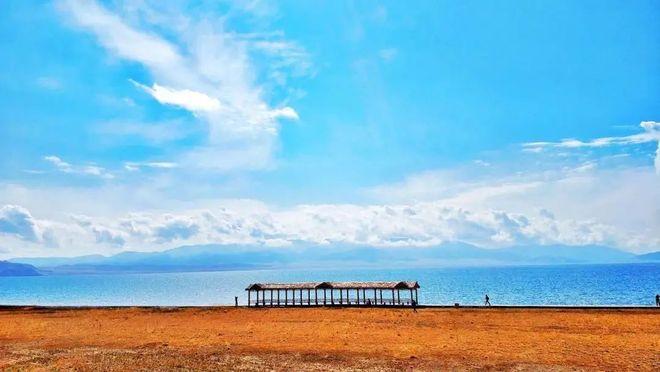
On the October visit I took line 14 from the centre and got off at University Town North, then walked west until the buildings gave way to water. What struck me first was the quiet. This is a city of pumping units and diesel traffic, and here were reeds, a low stone parapet, and a handful of students doing laps in cotton jackets, clearly dressed for a warmer city than the one they were running in.
The bird life is modest. Mallards, coots, magpies, and gulls in the last hour of light. On the western arm a crew was cutting reeds and stacking bundles on a truck, the only heavy work I saw all morning.
January made it a different place. The lake was frozen to a dull grey, the poplars were bare, and the food street beyond the campus gate was half shuttered. I passed one man in an oil-field jacket carrying a thermos. I still liked it. Standing on a frozen reservoir in a city with 109 mm of annual rain makes the engineering story obvious in a way that reading about it does not.
Getting There: Trains, Flights and City Buses
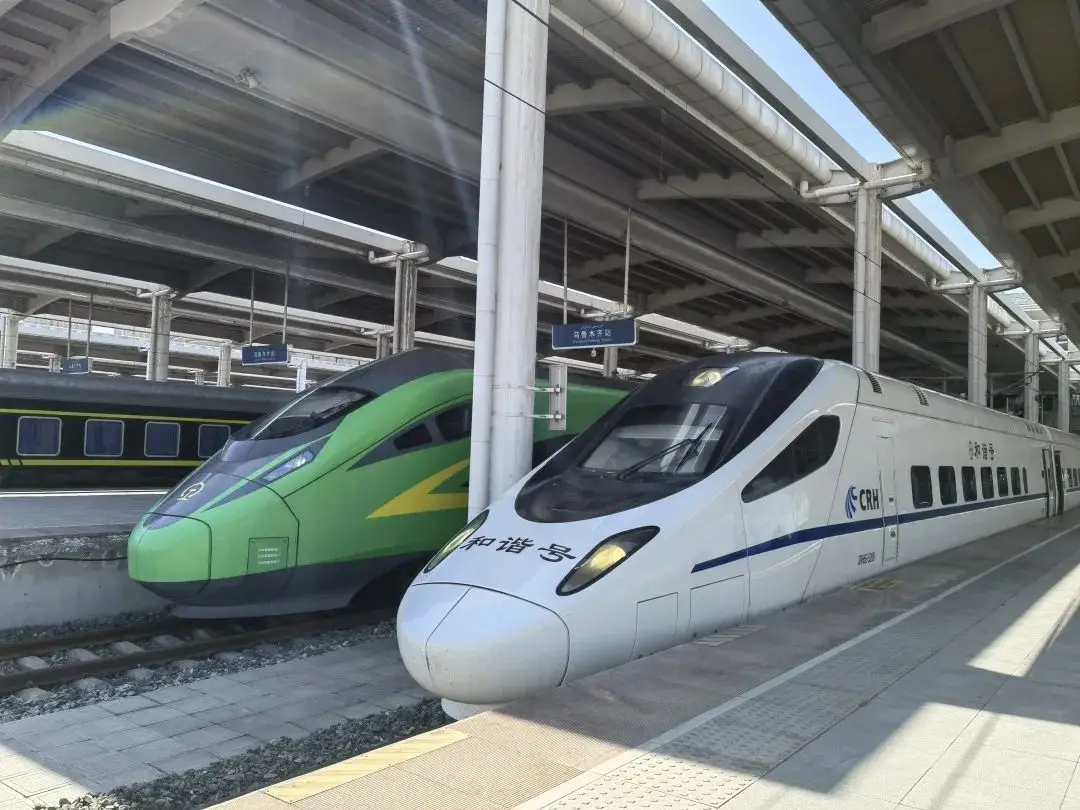
Karamay station sits at the junction of Weiyi Street and Jingsi Road, and the Urumqi run is now entirely intercity C trains. They cover the trip in roughly 2 hours 50 minutes to 3 hours 20 minutes. Second class was 79 yuan and first class 141 yuan when I checked in September 2026, with departures spread from mid morning to early evening. From the station it is a short bus or taxi ride into the centre.
By air, Karamay Airport lies about 16 km from downtown, a drive of roughly 25 minutes, and bus D3 connects the terminal with the coach-station side of town. Neither option is complicated, and the trains are better value if your schedule allows.
Inside the city, buses charge a flat 1 yuan. Summer hours, from 1 May to 15 October, run 08:00 to 22:00, and winter hours, from 16 October to 30 April, run 08:00 to 21:00. Line 14, opened in November 2015, is the one to remember, and it calls at University Town North and Anding Road Leye Yuan. Lines 13 and 15 also stop at University Town North. Taxis are cheap over short hops, and the lake is about a 20 minute drive from the downtown core.
If Karamay is a stop on a longer drive, it also works as a staging point for the mountains. Dushanzi District, an exclave of the municipality far to the south, is where the G217 Duku Highway begins its run across the Tianshan to Kuqa.
When the Lake Looks Its Best
Late September into mid October is my pick. The shrubs planted in 2013 have turned, the light is clean, and daytime temperatures sit in a range where a jacket is enough. A weekday morning gives you the emptiest path.
Late spring and early summer are the second good window. June days run long because Xinjiang keeps Beijing time while sitting two hours west of its solar position, so the sun can still be above the horizon close to 22:00, which makes an evening walk after dinner entirely reasonable.
July and August are hot. The district averages 27.9°C in July and has recorded 46.2°C, a mark set in July 2004 at Baijianquan in Urho. Wind is constant here, with an average of 64.5 strong-wind days a year. Walk before 09:00 or after 19:00 and the heat stops being a problem.
Winter suits people who like hard light and empty paths. January averages minus 15.4°C, and the coldest reading on record is minus 40.5°C from December 1984. The lake usually freezes over. Stay off the ice early and late in the season.
Where to Sleep
Book in the centre, because the lake district is a campus rather than a hotel zone. Look at Yingbin Road, Zhunge’er Road, and the blocks near Huijia mall on Youyi Road. That band holds the city’s business hotels and plenty of mid-range rooms. A double in the low hundreds of yuan is normal outside the July and August peak. In winter I would ask to see the room before paying, since heating varies from tower to tower.
The university town itself has student dormitories and training apartments, not visitor lodging. Two nights in the centre makes a comfortable base, one for the lake and the oil town, one for a day trip northeast.
What to Eat After the Walk
Karamay eats better than its size suggests, largely because the pasture country around it sends in good lamb. Three orders justify the trip. Lamb neck, cooked long and served with chilli and raw onion. Jiazi rou, a rack of lamb roasted and carried to the table on its own frame. And liangpizi, cold noodles in a thin broth, which is the local style rather than the dry version sold further east.
For a quick meal close to the shoreline, the restaurant clusters around Nanhu on the east and west banks off Baihua Road and Hongfeng Road are the nearest thing to the lake district. Downtown, Hanbo Central Plaza is the busiest concentration, and the night market on Nanxin Road fills from about 19:00.
Two practical notes. Most lamb and noodle places are halal, so do not carry non-halal food inside. And because the city runs on Beijing time while the sun runs on local time, kitchens stay open late. A 21:00 dinner here is normal rather than late.
Small Things That Save a Trip
- Carry a windproof layer even in July. The lake is open on three sides and the district is windy.
- Bring water and lip balm. Relative humidity averages around 51 percent.
- Expect daylight to run late. Plan dinner after 19:30 or you will be eating in an empty room.
- Pay by phone. WeChat Pay and Alipay work almost everywhere, but keep a little cash for the smallest stalls.
- Carry your passport. Identity checks are routine in Xinjiang, and hotels register foreign guests.
- Skip the ice. Early and late in winter the surface is not trustworthy and there is no rescue service standing by.
- Shoot in the last half hour of light, when the wind usually drops.
- Treat it as a walking space. I saw no swimming and no fishing on either visit, and nothing on site advertises either.
A Half-Day Plan That Ties In the Oil Town
08:30 Leave downtown for University Town North.
09:00 Walk the shore loop. The water covers about 540,000 sq m, and the paths around it come to two or three kilometres. Allow 90 minutes with stops.
11:00 Ride back and eat near Hanbo or on Nanxin Road.
13:30 Heiyoushan, the natural asphalt mound 2 km northeast of downtown and the reason for the city’s name. Karamay means black oil in Uyghur, and the seep that built the hill still bubbles at the surface.
15:30 Walk the Karamay River and Jiulongtan, the artificial waterfall that feeds the canal running through town. The city’s oil and coal story, covered in industrial heritage towns, makes more sense after an afternoon here.
18:30 Dinner, then the night market.
With a second day, drive northeast to the yardang park at Urho, roughly 100 km away, and stop at Ailik Lake on the way back. The wider loop is set out in this Karamay oil city piece and in the site’s Karamay travel guide.
The Rocks Below the Water Line
One more thing makes this shoreline unusual. The bank exposes the Cretaceous Qingshuihe Formation, a stack of shallow-water delta sandstones with large cross-bedding, and the layers carry roughly ball-shaped sandstone concretions. A 2026 paper in the Journal of Palaeogeography sets out three competing explanations, spheroidal weathering, reworked intraclasts, and differential cementation during burial. A campus sits on one bank and a publishable sedimentology section sits on the other.
The setting explains the geology. Karamay district rests at about 400 m on the northwestern margin of the Junggar Basin, between the Jair Hills and the basin floor, The Journal of Palaeogeography paper is worth a look, and the Karamay municipal government publishes the city’s own account of the rebuild.
Questions People Ask About Hongshan Lake
Is it worth a detour? Not on its own. If you are in Karamay for the oil town, or breaking the drive between Urumqi and Urho or Altay, an hour here is well spent. I would not build a trip around it.
Do I need a ticket? I found no gate and no fee on either visit; the shoreline works as a public park.
How long should I allow? Ninety minutes covers the loop and a few stops. Give it two hours if you are carrying a camera and waiting for the light.
Can I combine it with the Ghost City? They are separate outings. The yardang park at Urho is about 100 km northeast, so give that a full day.
What This Guide Cannot Promise
This page reflects conditions I checked in September 2026. Bus schedules, campus gate rules, water levels and winter access all change, and the lake is working city infrastructure rather than a managed attraction. Confirm current access with the Karamay municipal government or your hotel before you go, and follow the signs posted on the day.
About the Writer
Karl Huang has been travelling Xinjiang since 2019 and writes the guides on this site. He prefers working towns, road corridors and ordinary city parks to checklists, and pays for his own trips.