Published: 15 September 2026 | Author: Karl Huang
Most southern Xinjiang itineraries stop at Kashgar’s old city and the Pamir Highway, but the region’s agricultural heart sits a few hours northeast in Wensu County Xinjiang — a place Chinese guidebooks quietly call the country’s walnut county. We drove out expecting a quick photo stop and left with a sack of thin-shell walnuts and a real sense of why Aksu’s orchards matter. This is a first-hand account of Wensu’s walnut groves, how to reach them from Kashgar, when the harvest happens, and what to eat in the oasis.
| Item | Detail |
|---|---|
| Where | Wensu County (温宿县), Aksu Prefecture, northern edge of the Tarim Basin |
| Distance from Kashgar | About 460 km northeast (5–6 hours by road) |
| Claim to fame | One of China’s official “Walnut Hometowns” (中国核桃之乡) |
| Walnut area | Around 800,000 mu; the Kekeya base alone is 14,000 mu |
| Signature variety | Wen 185 (温185) thin-shell walnut, plus XinXin 2 and Zha 343 |
| Best season | Mid-September to late October (harvest) |
| Base town | Aksu city (hotels, airport, railway); Wensu seat 12 km west |
| Entry | Free; working orchards, not a ticketed scenic area |
Why Wensu County Xinjiang wears the “walnut county” label
Wensu (温宿县) sits in Aksu Prefecture on the northern edge of the Tarim Basin, about 460 kilometers northeast of Kashgar. It is one of the counties the state has formally named a “China Walnut Hometown” (中国核桃之乡), and the numbers back the title. Local figures put the county’s walnut area at roughly 800,000 mu (around 53,000 hectares), and the Kekeya (柯柯牙) greening project on the Taklamakan’s northern rim holds a 14,000-mu national walnut demonstration base that has become a price benchmark for the whole region.
The signature crop is the Wen 185 (温185) thin-shell walnut, prized enough to be named a recommended fruit for the 2008 Beijing Olympics and later a “China Famous Fruit” (中华名果). The shells are paper-thin and the kernels plump and pale, and the trees stand in disciplined rows that run into the desert windbreak. The wider Aksu region grows more than 2.4 million mu of walnuts, so Wensu is the showcase rather than the whole story.
A September morning in the Kekeya walnut groves
We left Aksu city before eight and reached the Kekeya base as the light went flat and gold across the rows. The first thing you notice is the sound: a soft thwack as farmers knock the branches with long poles so the nuts rain down, then the rasp of rakes gathering them off the ground. Locals call it “打核桃” — hitting the walnuts — and during September it is less a harvest than a neighborhood event, with whole families out in the dust.
A grower pressed a fresh, green-husked nut into my hand and showed me how to twist the husk off to reach the wet kernel inside. Eaten within minutes of falling, a September walnut tastes almost milky, nothing like the dry, tannic versions in a supermarket back home. We bought two kilos straight from the orchard at a price no shop in the city could match, and cracked them on the tailgate of the car with a small stone. It is a small thing, but it is the kind of small thing that makes a long drive worthwhile.
The groves only work because of water. Southern Xinjiang is desert, and every orchard here depends on snowmelt carried through channels and, in places, the ancient karez (坎儿井) underground network. Standing among the walnuts with the Tian Shan snow line visible to the north, it is hard not to read the whole place as an argument between people and the sand — and on this edge, the people are winning.
Reaching Wensu from Kashgar and Aksu
The easy gateway is Aksu city, not Wensu’s own county seat. Aksu has an airport (AKU) with regular flights from Urumqi and a station on the southern Xinjiang railway, so you can fly or train in and rent a car for the last stretch. Wensu’s county town is only about 12 kilometers west of Aksu city, a short taxi or local bus ride, and most orchards and the Kekeya base lie in between.
From Kashgar it is a longer haul: roughly 460 kilometers northeast on the G3012 expressway or by train on the same southern Xinjiang line that runs to Urumqi. The drive takes five to six hours and is dull until the oasis belt thickens near Aksu; the train is slower but lets you watch the land flatten from Pamir foothills into pure Tarim desert. Treat Aksu as your hub and Wensu as a day loop out of it. Our Aksu travel guide covers the city, and the Kashgar itinerary explains the southern end of the same route.
Timing the harvest: when the walnuts drop
Walnuts are a narrow-season crop here, and the window shapes the whole trip. The main harvest runs from mid-September to late October. Come in September and you get green-husked, fresh walnuts (青皮核桃) with a sweet, milky kernel that barely needs cracking; come in October and the same nuts are dried, shelf-stable, and better for taking home. We prefer late September, when the picking is in full swing and you can buy straight off the tree.
Avoid the deep winter. From December to February the orchards are bare and dormant, the markets thin, and there is little to see beyond bare branches. Spring (April to May) is pleasant and green but the trees are not carrying nuts yet, so you would be visiting for the countryside rather than the crop. If walnuts are the point, September and October are the only months that deliver.
Using Aksu city as your base
Do not look for boutique hotels in Wensu’s orchards; look for them in Aksu city. Aksu has the full range of Chinese chain hotels, decent restaurants, and reliable transport, which makes it a sane base for a day trip to the groves and a second day elsewhere. We stayed in Aksu both times and commuted out to the Kekeya base in the early morning, which kept the driving in daylight and left the evenings free for a proper plate of noodles.
If you want a second outing, the Kizil caves east of the city are the region’s headline cultural site and pair naturally with a walnut-country visit.
Walnut on the plate in Wensu
Wensu eats walnuts the way a wine region drinks its own wine. You will find walnut naan (核桃馕), walnut pastry (核桃酥), walnut-stuffed buns, and walnut oil pressed from the local crop. None of it is fancy, and all of it tastes better here because the kernels are fresh.
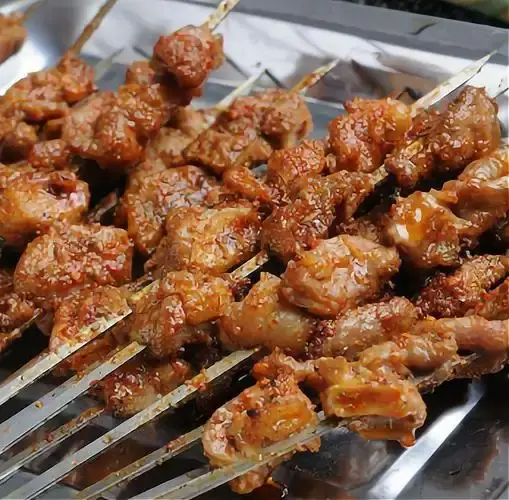
Around the walnuts sits the standard southern Xinjiang oasis meal: roast lamb, hand-pulled laghman noodles, and hot stuffed buns pulled from the tandir. We ate at a roadside spot near the base where the samsa came out blistered and dripping, and a pot of black tea cost almost nothing. If you want the full context on the region’s orchard crops beyond walnuts, our pomegranate and walnut orchard guide runs through the wider Silk Road fruit belt.

Buying, cracking and shipping thin-shell walnuts
The best place to buy is the Kekeya base itself or the walnut stalls along the Aksu–Wensu road, where growers sell by the jin (half-kilogram) and will let you taste before you commit. Look for Wen 185 if you want the thin shell you can break with your fingers; the price rises for the cleanest, lightest kernels. In September, buy them in the green husk for freshness; in October, the dried ones travel better.

Shipping is straightforward: pack the dried nuts and send them by courier, or carry a few kilos in your luggage if flying out of Aksu. Bring small cash as well as Alipay or WeChat Pay, since orchard stalls do not always take cards. Bargain lightly — these are working farmers, not a fixed-price shop.
A relaxed two-day walnut-country loop
Our preferred version, using Aksu as the hub:
- Day 1 morning – arrive in Aksu by flight or train from Urumqi or Kashgar; drop bags at the hotel.
- Day 1 afternoon – taxi out to the Kekeya walnut base, walk the groves, watch the harvest, buy fresh nuts.
- Day 1 evening – roast lamb and laghman in Aksu city; early night.
- Day 2 morning – Wensu orchard road and a walnut stall for tasting and shipping; late breakfast of walnut naan.
- Day 2 afternoon – optional Kizil caves east of the city, or drive back toward Kashgar if the Pamir is next.
FAQ
Is Wensu really the walnut county? Yes. Wensu County in Aksu Prefecture is one of China’s officially designated “Walnut Hometowns” (中国核桃之乡), with walnut plantings on the order of 800,000 mu and the Kekeya national demonstration base on the desert’s edge.
How far is Wensu from Kashgar? About 460 kilometers northeast. By car it is a five- to six-hour drive on the G3012 expressway; by train it is longer but more relaxed.
When is the best time to visit? Mid-September to late October, during the harvest. September gives you fresh, green-husked walnuts; October gives you dried ones to take home.
Can I just walk into an orchard? The Kekeya base and roadside orchards are working farms, not ticketed scenic areas, and growers are used to visitors buying directly. Be respectful of the fields and ask before photographing people.
Which walnut should I buy? The Wen 185 (温185) thin-shell cultivar is the local star — easily cracked and sweet. Taste before you buy and pick the lightest, cleanest kernels.
Disclaimer
This account is based on our own visits to the Aksu–Wensu area in 2024 and 2025 and on figures published by the Wensu County government and regional news outlets. Harvest dates, prices, transport links, and farm access change from year to year, so confirm current conditions with official sources or your hotel before traveling, and treat the descriptions here as a traveler’s notes rather than a guarantee.
About the author
Karl Huang is a Xinjiang-based travel writer who has driven the southern and western corridors of the region for several years. He focuses on the working places between the famous landmarks — orchards, oasis towns, and quiet county roads — and writes from first-hand visits rather than second-hand summaries. His other Xinjiang routes and guides are published across this site.