Published: October 25, 2026 | Author: Karl Huang
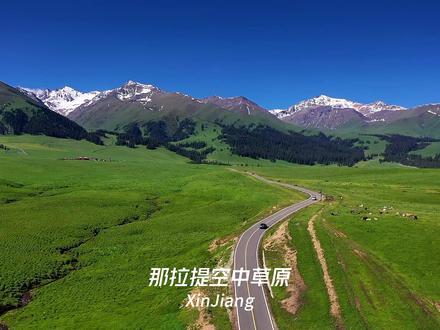
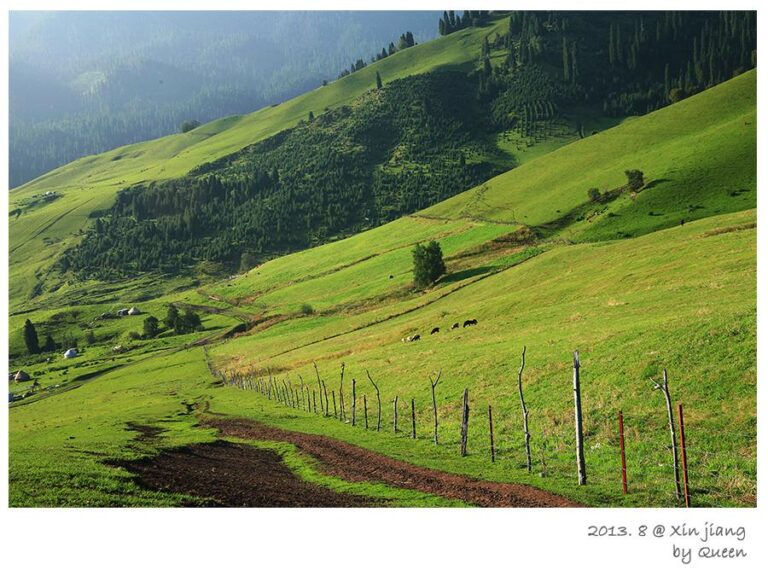
Most travellers who reach the Ili valley have heard of Nalati. Far fewer can point to the county that actually runs the place beneath it. I first rolled into Xinyuan County by accident in 2019, chasing a road sign toward the Duku Highway, and what I found was a working agricultural town that happens to sit under one of China’s most photographed grasslands. This page is written from four separate visits, the most recent in autumn 2025, and it stays on the town itself instead of the scenic gate up the mountain.
Why a county town below Nalati is worth a stop
I get the question a lot: why not just sleep at the Nalati scenic area and skip the county seat? The short answer is that the seat, Xinyuan Town, is where the real life of the county happens, and where your money stretches further. The grassland ticket gates sit about 80 kilometres east of town, so treating Xinyuan as a base rather than a pass-through saves you the daily commute and puts you among the bakeries, the bus station, and the repair shops a scenic zone simply does not have.
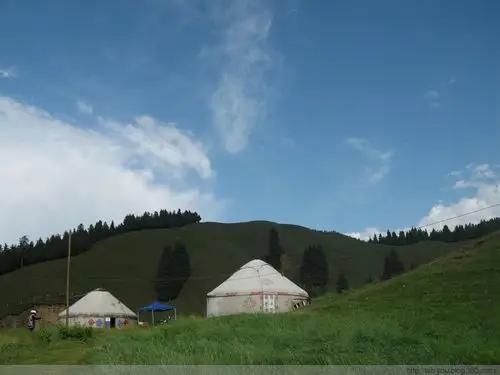
There is also an honesty point. Xinyuan is not a resort. It is a Kazakh-majority farming county of roughly 310,000 people, threaded by the Gongnais River, and it carries two nicknames that tell you what matters here: “pearl of the grassland” and “wine town of Xinjiang.” Understand those two halves and you understand the place.
Snapshot: Xinyuan County’s size, altitude and who lives here
| Fact | Detail |
|---|---|
| Full name | Xinyuan County (新源县), also called Gongnais |
| Region | Eastern Ili River Valley, Ili Kazakh Autonomous Prefecture |
| Area | About 7,581 km² |
| Population | About 310,000, including ~149,000 Kazakhs |
| County seat elevation | ~800 m; county ranges 792–4,621 m |
| Main river | Gongnais River (巩乃斯河) |
| Distance from Yining | ~192 km east |
The numbers come from the county government’s own profile and the 2023 local statistics. What the table leaves out is the shape of the land: a long, narrow valley, roughly 190 km east to west but only about 33 km across on average, walled by the Nalati range to the south and open to the Ili heartland in the west. That funnel is why every north–south and east–west road in this corner of Xinjiang seems to pass through here.
My first night in the county seat
The first time I stayed over, I booked a room above a noodle shop on the main drag and walked out after dark expecting nothing. The street was busy until past 11 p.m. — grilled lamb skewers, a row of fruit stalls still wet from the evening spray, and a Kazakh teahouse where an old man was tuning a dombra. That is the version of Xinyuan most tourists never see, because they are already asleep at the scenic area 80 km away.
I have since learned to build my first evening around the night market and a slow walk along the river. In late September the air turns sharp, the poplars along the banks go gold, and the whole town smells faintly of the mash from the western distilleries. It is a calm, ordinary, genuinely local start to an Ili trip, and I would take it over a hotel buffet any day.
Arriving in town: the roads that meet here
Xinyuan Town sits at a genuine crossroads. National Highway G218 is the spine of the Ili valley and runs straight through the county; G217, the famous Duku Highway, meets it near Nalati town to the east and heads south over the Tianshan toward Kuqa. A smaller provincial road, S316, links the seat to the side valleys.
Getting here without a car is straightforward. Long-distance buses run from Yining and take about three and a half hours for the 190-odd kilometres, usually costing under 70 yuan. From Urumqi it is a longer haul — close to 500 km and eight to ten hours by road, almost all of it scenic once you clear the desert north of the mountains. There is also Nalati Airport, but it closed in March 2026 for runway rebuilding and is not expected back until the end of that year, so for now plan on Yining or Urumqi as your flying entry points and drive the rest. Our separate page on the Duku Highway covers the mountain crossing in detail.
The calendar for a town visit
Xinyuan wears four clearly different faces, and the one you get depends entirely on when you arrive.
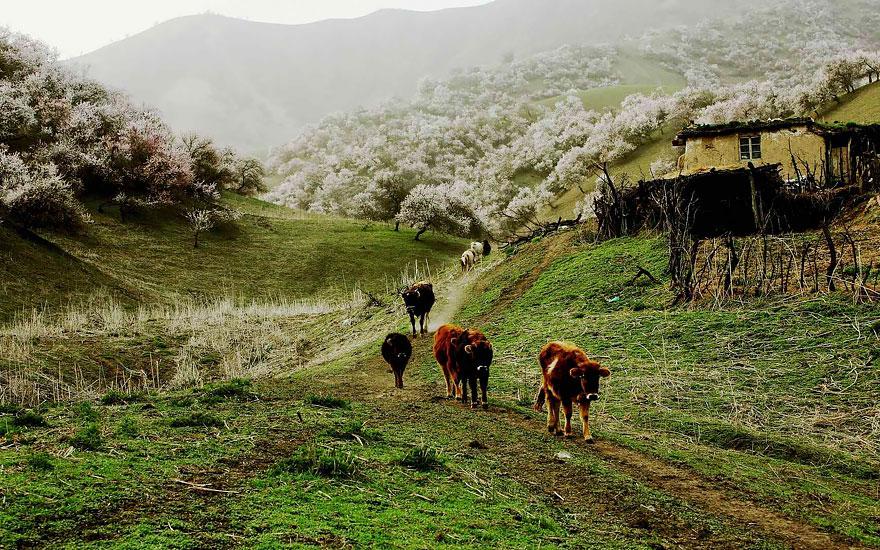
Early to mid April is the sleeper hit: the slopes at Tuergen, north of the seat, turn pink and white with wild apricot blossom, and the photographs you have seen of “Xinjiang spring” almost always come from here. Wild apple follows in May. June through August belongs to the high grassland and the tour buses. Late September into October is my favourite window — the larch and birch go gold, the crowds thin, and the fruit orchards are bringing in the harvest. Winters are long, cold, and quiet; the town keeps running but the scenic area drops to a reduced operation.
If you are matching the wider region, our season-by-season guide to Xinjiang lays out the trade-offs across the whole province.
Sleeping in Xinyuan County: what’s actually available
The seat has the deepest stock of rooms in the whole valley east of Yining: budget guesthouses, mid-range business hotels, and a couple of newer places with proper heating and parking. Rates stay sane compared with the Nalati scenic area, where peak-season prices roughly double and availability thins out fast.
My pattern now is two nights in the county seat, then one night up at Nalati town if I want an early gate entry. The 80 km between them is a good road, about 70 minutes, but I still fuel up in the seat because stations get sparse east of Nalati town and the climb toward the Duku pass eats more than you expect.
Eating in Xinyuan: the county table
Food is where the town beats the mountain. The Kazakh signature here is naryn, hand-pulled noodles tossed with horse meat or lamb, and in winter you will find horse sausage on tables across the county. The Gongnais is a cold, fast river, and its fish end up grilled or in soup at roadside places near the bridge.
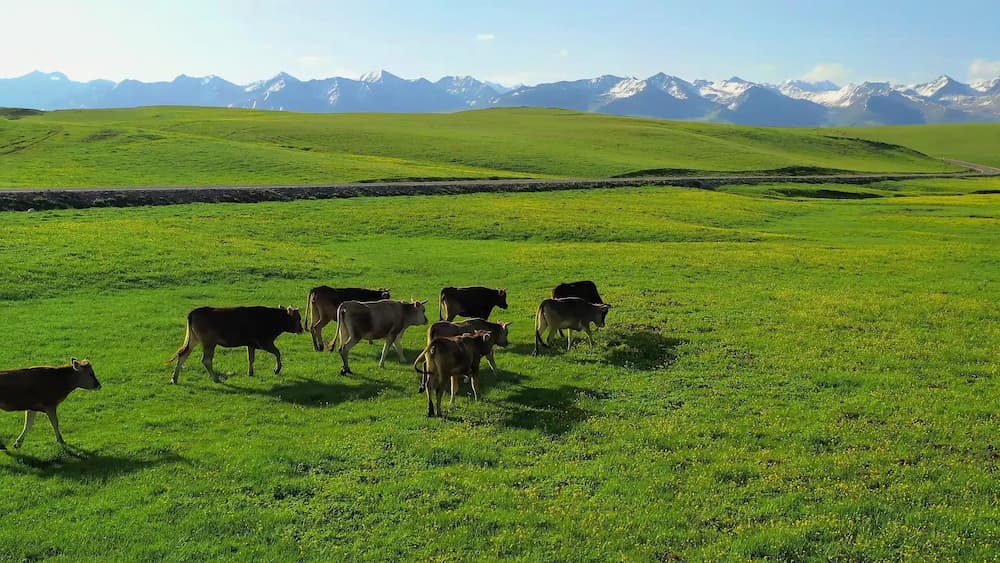
For everyday eating I default to the Hui-run noodle shops and the Uyghur kitchens doing lamb with naan. Breakfast is milk tea and baked buns at a Kazakh teahouse, and portions are generous to the point of silly — two dishes comfortably feed three people. The county is also a honey town, thanks to the Xinjiang black bee kept in the fruit forests, so a jar from a roadside stall makes a good souvenir that actually tastes of the place.
Things that caught me off guard
A few practical notes from trips that did not go perfectly. Card payments work in the seat but smaller roadside stalls and the orchard villages still prefer cash or a quick scan, so keep some on you. The wild apricot bloom is weather-dependent and can shift by two weeks year to year, so confirm before you build a trip around it. Altitude is not a problem in the seat at ~800 m, but if you drive up to the sky grassland you will be near 2,000 m and should read our notes on Nalati Grassland before you go. And the distillery town of Xiaobulake in the west is a working plant, not a theme park — go for the barley fields and the company shop, not a show.
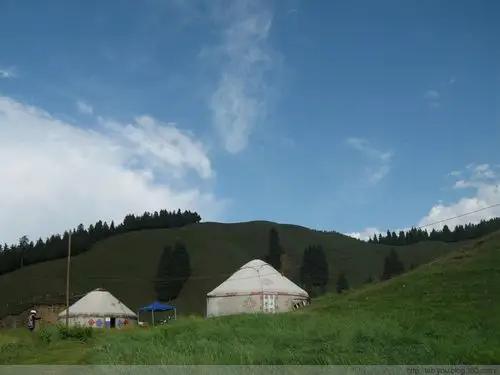
A two-night plan that uses the town as a base
This is the loop I now give friends who have three days and a car.
Day 1 — arrive and slow down. Drive in from Yining, check into the seat, and spend the evening at the night market. Eat naryn, walk the river, sleep low.
Day 2 — the town and its orchards. Morning at the wild fruit forest or, in April, the Tuergen apricot slopes. Afternoon in the seat’s bazaar and a stop at the western distilleries. Dinner at a Uyghur kitchen.
Day 3 — up the mountain, then onward. Drive the 80 km to Nalati for a half day on the grassland, then either return to the seat or continue south on the Duku Highway toward Kuqa if the season allows. If you are heading west instead, Yining is an easy half-day run and a worthy next base.
Questions travellers ask about the town
Is Xinyuan the same as Nalati? No. Nalati is the scenic grassland and the town beneath it; Xinyuan is the county that administers both, with its seat about 80 km west of the gate.
Do I need a border permit? The county seat and Nalati are not restricted areas. Only if you push west to the Khorgos port or into certain border zones do you need a permit, and that is arranged in Yining.
Can I visit the wild apple forest? Yes, the relic orchards are open and there is even a gene-bank narrative around them, since botanists treat the local wild apple as ancestor stock for cultivated varieties worldwide. Go in May for blossom or October for fruit.
What about Kazakh culture? Xinyuan holds close to a tenth of China’s Kazakh population, and you will see it in the teahouses, the horse games, and the Aken singing. Our page on Kazakh nomads of the Tianshan explains the wider picture.
Before you rely on this: a disclaimer
This guide is built from personal visits and public sources, not from a tour operator’s brochure. Prices, bus times, and the airport rebuild schedule change, and the wild-blossom windows move with the weather. Treat the specifics as a starting point and confirm the live details — especially the Nalati ticket rules and the Duku opening dates — close to your travel dates. I have no commercial stake in any hotel or restaurant named here.
Who wrote this and why it’s trustworthy
I’m Karl Huang, and I have been writing about Xinjiang travel for foreign visitors since 2019, with a focus on the Ili valley and the Silk Road corridors. I have driven, bussed, and hiked across Xinyuan County on multiple trips, and I keep these notes updated when roads, airports, or prices shift. Where I cite figures, they come from the Xinyuan county government profile and the UNESCO listing for the Tianshan, not from memory.