Published: 14 October 2026 | Author: Karl Huang
Nobody drives to Dushanzi by accident. This district of Karamay sits about 150 km from the rest of the city it belongs to, wedged between Wusu and Kuitun at the northern foot of the Tianshan, and most travellers meet it only as the place where the Duku Highway begins. That is a shame, because Dushanzi oil history runs deeper than almost anywhere else in China: the first industrial well in Xinjiang was sunk here in 1909, on the slope of a hill that had been leaking crude for generations. We came for the highway and stayed a full day for the wells, the old refinery ground and the volcano that started it all.
This is a first-hand account. We paid our own way, walked the sites on foot, and checked the dates and figures below against the Dushanzi district government’s published history and Karamay municipal sources. Where numbers shift between sources, I say so.
Dushanzi Oil History in Numbers
| Item | Detail |
|---|---|
| What it is | A district of Karamay City, and the site of Xinjiang’s first industrial oil well |
| First recorded use | 1897, when local residents collected seepage crude to burn in lamps |
| First industrial well | 1909, drilled with a rig and refining kettles bought from Russia for 300,000 taels of silver |
| Well location | North slope of the mud-volcano hill, within today’s district boundary |
| Refinery era | 1936, a joint Xinjiang-Soviet refinery opened under the provincial construction department |
| Later role | Starting point of the 561 km Duku Highway (G217) to Kuqa |
| Modern identity | One of PetroChina’s largest refining and petrochemical bases |
| Heritage status | The old refinery complex, including the 1909 well, is listed national industrial heritage |
| Distance | About 250 km, or three hours by expressway, from Urumqi |
| Costs | Mud volcano free; Grand Canyon roughly 30 to 60 yuan depending on season |
Why a District This Small Carries So Much Weight
The name means “lonely hill”, and the hill is exactly what it sounds like: a squat mound of mud and rock standing alone on the plain where the mountains meet the gravel. For centuries it did something odd. It seeped. Thick, dark oil oozed from cracks in its surface, as local families knew long before any geologist arrived. They skimmed the crude off puddles and burned it in lamps, which is the 1897 starting point the district’s own records use.
Geography made the place matter later. Dushanzi sits where the practical road and rail corridors out of the northern Junggar Basin climb toward the Ili valley, so everything moving between Urumqi and the western frontier passes its doorstep. When boundaries were drawn after oil made Karamay rich, Dushanzi was folded in as a district, even though the two urban areas sit more than a hundred kilometres apart, separated by Wusu and Shawan farmland.
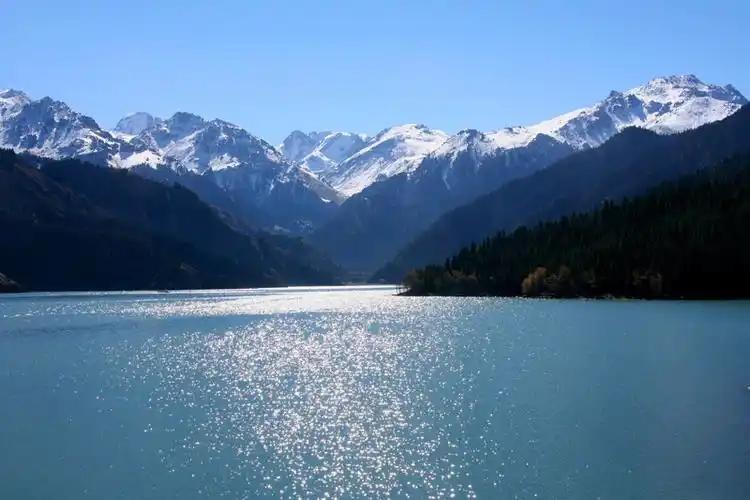
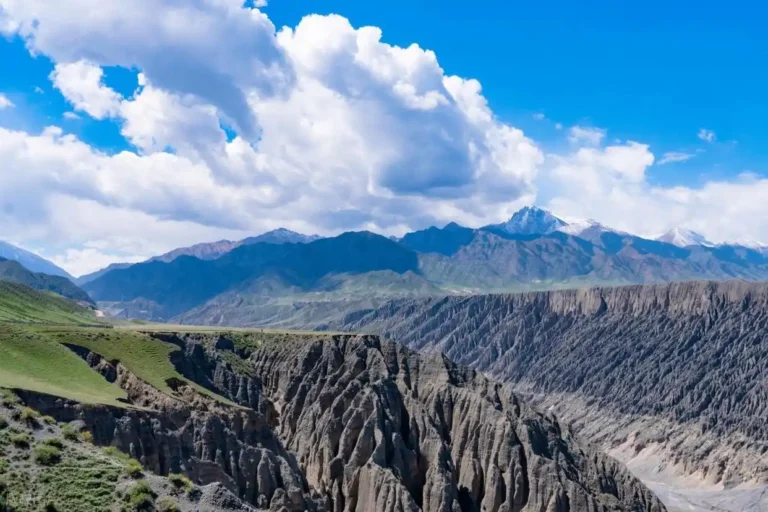
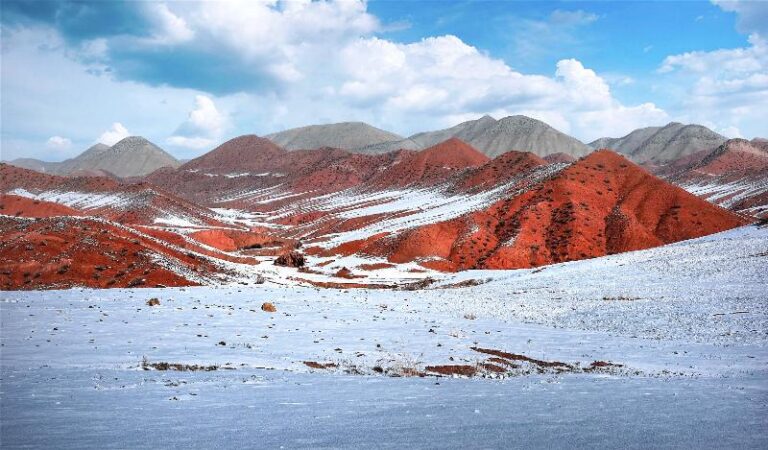
The backdrop explains the oil. The Tianshan wall rises directly south of town, and its folds trap the sedimentary layers that hold the hydrocarbons. Water from the peaks feeds the Kuitun River, which cut the district’s other landmark, the Grand Canyon, through red rock on its way north. Oil, mud volcanoes and a canyon in one small district: the geology is unusually generous here.
Standing at Xinjiang’s First Oil Well
We started our morning at the mud-volcano hill on the edge of town, because that is where the story starts. A short climb up wooden steps brings you to a plateau of cracked grey earth where pools of mud swell and collapse with a slow, wet plop. The smell is faintly of matches and tar. Families were filming the bubbles when we arrived, and a small exhibition shed explains the formation if you look closely.
On the north slope below the pools, a marker notes the 1909 well. It is easy to walk past in ten seconds if you do not know what you are looking at, so let me set the scene. In that year the Xinjiang provincial government spent 300,000 taels of silver on a mechanical drilling rig and a set of refining kettles from Russia, and installed the rig at this hill. The well it produced is counted as the first industrial oil well in Xinjiang, and, because the Yanchang well in Shaanxi had beaten it by two years, usually as the second mechanised well sunk on Chinese soil.
Standing there, I kept thinking about the leap involved. The same slope had been skimmed by hand for a decade; then, within a single year, the method jumped from ladles to a steam-era drilling rig. There is not much to photograph at the marker itself, so give the moment to the slope and the pools instead.
The Mud Volcano That Gave the Game Away
Mud volcanoes are nature’s prospecting reports. Gas and brine push up through weak points in the crust, carry fine clay to the surface, and build low cones that bubble indefinitely. Where you find them in a sedimentary basin, you very often find petroleum nearby, because the pressures that squeeze the mud also migrate oil along faults. Prospectors understood this long before seismic surveys existed, and the Dushanzi seeps were as clear an invitation as any geologist could wish for.
The district’s own chronology makes the progression explicit. In 1897 residents were still collecting crude by hand. In 1902 the nearby Wusu county government set up a small workshop at the hill and began distilling oil with primitive equipment. Seven years later came the Russian rig. Each step took the same seep families had used for lighting and pushed it one stage closer to an industry.
From Qing Silver to a Soviet-Era Refinery
The 1909 well opened the era, but the industry took shape in the 1930s. In October 1936 the provincial government signed an agreement with the Soviet Union, and a refinery rose at Dushanzi, processing crude from the surrounding fields through the war years. That plant, rebuilt and expanded many times since, grew into one of the largest refining and petrochemical complexes in China today.
What strikes a visitor now is how deliberately the place has kept its memory. The refinery’s earliest ground, the 1909 well site and the workers’ club built in 1955 were collectively recognised as national industrial heritage, and the club reopened on New Year’s Day 2016 as an exhibition hall where photographs, tools and scale models walk you through a century of drilling. The staff will happily point you toward the well marker if you ask.
Meanwhile the centre of gravity moved north. In 1955 crude was struck at Karamay proper, and that city’s oil boom produced the metropolis of hotels and museums that our Karamay oil-city guide describes in detail. Dushanzi kept its own identity: a company town of tree-lined streets, unusually green for the desert it sits in, the legacy of sixty years of oil wages spent on shade and lawns.
Reaching Dushanzi Today
From Urumqi the drive runs about 250 km and takes roughly three hours on the G30 expressway. Trains are a good alternative: Kuitun station, a few minutes from Dushanzi, sits on the northern rail main line, with daytime and overnight services from Urumqi taking between three and five hours. For the wider logistics of flights, trains and permits, our guide to getting to Xinjiang covers the connections in depth.
Most visitors arrive as part of a road trip rather than a single-destination stay, because the town is the northern gateway to the mountains. Anyone planning a self-drive trip through northern Xinjiang will find Dushanzi a logical overnight stop with proper fuel, banks and repair shops, exactly what a day of mountain driving does not offer further south.
When to Plan the Trip
Late May to September is the comfortable window. The sites are viewable year round, but the canyon paths and the highway both depend on weather, and the high passes north of town shut for the cold months. The Duku Highway normally runs from June into early October, and in 2026 it reopened on 1 June with its usual rules: daytime-only traffic windows, a seven-seat limit for passenger vehicles, and night closures while maintenance continues. Our Duku Highway driving guide tracks the current booking system and seasonal dates.
Within the season, mornings suit the industrial sites, when the light is flat and the mud volcano is at its most photogenic, and late afternoons suit the canyon, when the red rock finally gets some warmth in it. Winter visits are possible and quiet, but bring serious cold-weather gear, because the steppe wind is unfiltered.
Where to Sleep in a Company Town
Accommodation is practical rather than scenic, which is fine, because you are here for the day’s agenda, not the lobby. Expect clean business hotels in the 150 to 400 yuan band, with the better rooms booking out weeks ahead during the July and August highway peak. If Dushanzi is full, Kuitun and Wusu next door add far more inventory at similar prices, and the drive between them is short. Book ahead for summer; do not assume a midnight arrival in peak season will find you a bed.
Eating at the Edge of the Desert
You eat well here without trying. The district sits in the belt of northern Xinjiang where hearty oil-worker food is the default, and neighbouring Shawan, one county over, lays claim to big-plate chicken, the dapanji of noodle-strewn, chilli-heavy fame. Order it anywhere in town and you will get a plate sized for a table of four. Laghman noodles, baked samsa and lamb skewers fill in the rest, and every restaurant seems to run at the pace of people with a shift to get back to. Bring cash or WeChat Pay; cards are rarely taken.
Reading the Sites: Tickets, Access and Etiquette
The mud volcano area is free, open around the clock, and reached by a stair path with handrails; wear shoes with grip because the clay is slick when damp. The Grand Canyon, a short drive south of town at the highway’s doorstep, charges roughly 30 to 60 yuan depending on season, with the glass walkway and other attractions billed separately, and generally keeps hours of about 10:00 to 19:30 in season; our Dushanzi Grand Canyon guide covers the platforms and walkways in detail. The exhibition hall keeps modest weekday hours, so check before you build a plan around it.
One caution worth stating plainly. The modern refinery is a working plant, not a tourist site, and photography of its entrances, tanks and gates is not welcome. Shoot the heritage markers, the canyon and the volcano instead. Foreign visitors should carry a passport, since hotels and some sites in this region record identification, and allow a few minutes for the routine security checks that punctuate travel in this part of China.
A Half-Day Heritage Loop
Our own rhythm, which fits neatly either side of a highway departure: arrive mid-morning and start at the mud-volcano hill, giving the bubbling pools and the 1909 well marker forty unhurried minutes. Drive to the old refinery quarter for the exhibition hall and a look at the 1955 workers’ club facade, then take a long lunch of dapanji or laghman in the town centre. Rest or stock the car through the middle of the day, because the light does the canyon no favours until after five. Finish at the Grand Canyon for the last two hours of daylight, then stop at the zero-kilometre marker where the Duku Highway begins for the photograph that proves you were here.
Frequently Asked Questions
Is Dushanzi worth a stop on a northern Xinjiang trip?
Yes, especially if you are driving the Duku Highway or already passing on the G30. The well site and the mud volcano take a couple of hours, the exhibition hall another, and the canyon is a natural sunset stop. It rewards curiosity rather than checklists.
Where exactly is Xinjiang’s first oil well?
On the north slope of the mud-volcano hill, marked and protected as part of the national industrial heritage listing. It sits a short climb from the bubbling pools, so you see both in one visit.
Can tourists go inside the refinery?
No. The modern plant is a live industrial facility closed to casual visitors. What you can visit are the heritage buildings around its edge, the exhibition hall in the old workers’ club, the well site and the volcano.
How does Dushanzi connect to the Duku Highway?
The zero-kilometre starting point is in town, and the road runs 561 km south to Kuqa, usually open from June into early October. Anyone driving it passes through Dushanzi, which makes the town the natural place to begin or end the journey.
Disclaimer
Ticket prices, opening hours and access rules change with season and local policy, and the Duku Highway’s operating window varies year to year, so confirm details locally or through official channels before you travel. This article is a personal travel account checked against district and municipal government sources, not official guidance, and I am not responsible for a changed price, a closed site or an altered schedule.
About the author
Karl Huang is a China-based travel writer who has spent years covering Xinjiang’s cities, highways and industrial history. He visits the places he writes about and checks figures against government and heritage sources rather than second-hand blogs.