Published: August 13, 2026 | Author: Karl Huang
Most people who come to Kashgar spend their entire visit inside the Old City walls. That is understandable — the mud-brick labyrinth is genuinely striking. But after our third trip to the city, we started wondering what else was there. Turns out, quite a lot. This Kashgar city guide covers the parts of town that rarely make it into the standard itinerary: the new district with its Silk Road-themed architecture, the Abakh Hoja Mausoleum (often confused with the Id Kah Mosque), East Lake Park where locals actually spend their evenings, the museum, and the practical details about bus stations and train connections that you need if you are using Kashgar as a base for southern Xinjiang.
Kashgar Beyond the Old Town — Quick Reference
| Item | Detail |
|---|---|
| Abakh Hoja Mausoleum | 5 km northeast of Old City; ¥30 entry; 30–45 min visit |
| East Lake Park (Donghu) | Near People’s Square; free; best at dusk |
| Silk Road Light Cultural Zone | New district east of center; evening light show; free entry |
| Kashgar Museum | Tueluqie Road; closed Mondays; bring passport |
| Railway Station | ~10 km north; overnight sleeper to Urumqi (~17 hr) |
| Airport (KHG) | ~10 km north; domestic + limited intl flights |
| Best time for non-winter visit | April–October; July–August hot but lively |
What We Found Outside the Tourist Core
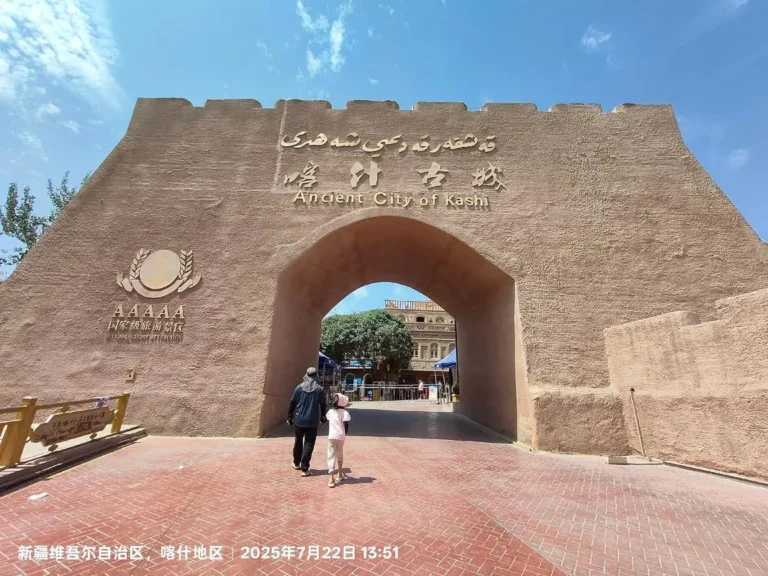
We had a half-day gap between a morning at the Kashgar Livestock Bazaar and an evening flight, so we decided to walk in the opposite direction from most tourists. Instead of heading deeper into the Old City, we crossed Tuman River and walked toward the newer part of town. The change is immediate. The narrow alleyways give way to wide avenues lined with plane trees. The buildings shift from adobe to concrete and glass, though many still carry Uyghur architectural flourishes — arched windows, decorative tile bands above doorways.
About twenty minutes east of the Old City, we hit the Silk Road Light zone. It is hard to miss: an enormous gate with blue tilework, minaret-style towers, and the Chinese characters “丝路之光” (Silk Road Light) across the top. The area around it is a mix of shopping centers, restaurants, and open plazas. During the day it feels like any mid-sized Chinese city’s commercial district. After dark, the gate gets illuminated and there is usually some kind of light show or street performance. We ended up eating dinner at a Uyghur restaurant just behind the main arch — the laghman there was as good as anything we had inside the Old City, and the bill was roughly 30% lower.

The point is not that the new district is more “authentic” than the Old City. Both are real parts of Kashgar. But if you have already spent a day or two in the old quarter, this side of town gives you a sense of how the city actually functions in 2026 — where people go to work, where they shop for groceries, which streets fill up with families after sunset.
Abakh Hoja Mausoleum: Not the Mosque
This is the single most commonly confused site in Kashgar. The Abakh Hoja Mausoleum (also called Xiangfei Tomb or Apak Hoja Tomb) is often mixed up with the Id Kah Mosque by first-time visitors. They are completely different places. The mosque is right next to the Old City entrance. The mausoleum is about five kilometers northeast, a short taxi ride or a long walk through residential neighborhoods.
We visited on a Tuesday afternoon. There were maybe a dozen other visitors. The complex is dominated by a large dome covered in green glazed tiles, flanked by four slender minarets. The tile patterns are intricate — geometric designs in green, yellow, and white that catch the light differently depending on the time of day. Inside the main hall, the space feels cool and quiet even when it is warm outside. The tombs themselves are set back in a separate chamber; photography is technically restricted but loosely enforced during our visit.

East Lake Park and Evening Life
If you want to see where Kashgar residents spend their leisure time, head to East Lake Park (Donghu Gongyuan). It sits just east of the city center, within walking distance of People’s Square. The park itself is nothing remarkable by international standards — a man-made lake, paved walking paths, some exercise equipment used by elderly locals every morning. What makes it worth a stop is the atmosphere.
We went around 7 p.m. on a weekday. The lake was full of families renting paddle boats. On the western shore, groups of men were playing a form of volleyball that looked like a cross between regular volleyball and something local I could not identify. Food vendors sold grilled corn and nuts nearby. It felt like any public park in China — ordinary and relaxed.
From the park you can walk to People’s Square in about ten minutes. The square is dominated by a large statue of Mao Zedong (one of the few remaining large-scale Mao statues in western China). It is worth a quick look for the photo op and the people-watching, especially on weekend evenings when the square fills up with dancers.
Kashgar Museum
The Kashgar Regional Museum is on Tueluqie Road, a short taxi ride from the Old City. It is modest compared to the Xinjiang Autonomous Region Museum in Urumqi, but it covers local history well: prehistoric artifacts from the Tarim Basin, Silk Road trade items, traditional clothing and musical instruments from the various ethnic groups in the Kashgar prefecture. Exhibits have labels in Chinese, Uyghur, and English, though the English translations can be spotty.
Note: the museum is typically closed on Mondays. Bring your passport or ID for entry. Admission is free but requires registration at the desk. Budget one hour if you read everything, thirty minutes if you skim.
Getting Around Kashgar Without a Tour Group
Public buses in Kashgar cover most of the city for ¥1–¥2 per ride. They accept cash and WeChat Pay. Routes are posted in Chinese and Uyghur at each stop; Google Maps coverage is unreliable here, so we found it easier to ask hotel staff to write down the bus number before heading out.
Didi (China’s equivalent of Uber) works reliably in Kashgar. Fares are cheap — most rides within the city cost under ¥15. The app accepts international credit cards linked to a Chinese phone number. If you do not have Didi set up, taxis are plentiful near the Old City entrance and the railway station. Agree on the price before getting in, or insist on the meter.
For travelers planning a broader route through the region, self-drive Xinjiang gives you the most flexibility. Rental cars are available at the airport and near the railway station, but you will need a Chinese driver’s license or an IDP plus a translation certificate. International licenses alone are not accepted.
Transport Hubs: Trains, Buses, and the Airport
Kashgar Railway Station (喀什站) is about 10 km north of the city center. It serves trains to Urumqi (overnight sleeper, roughly 17 hours), Hotan (about 5 hours on the new loop line), and Korla. The station is modern, clean, and has a waiting area with outlets. Buy tickets in advance via Trip.com or the official Railway 12306 app; same-day tickets to popular destinations like Urumqi sell out quickly in summer.
Kashgar Airport (KHG) is also north of the city, roughly equidistant from the railway station. It handles domestic flights from Urumqi (daily, ~2 hours), Beijing, Shanghai, Chengdu, and a handful of others. International service is limited — check current schedules if you are coming from outside China. A taxi from the airport to the Old City area costs around ¥25–¥35.
There are two main long-distance bus stations. One handles regional routes within the Kashgar prefecture (to Yarkand, Yengisar, Poskam). The other covers intercity and international routes, including daily departures to Tashkurgan (for those heading toward the Karakoram Highway and Pakistan) and occasional services to Kyrgyzstan. If your plan involves crossing into Pakistan or Kyrgyzstan, allow extra time for border permit processing. For general advice on reaching Xinjiang from elsewhere in China or abroad, our how to get to Xinjiang guide breaks down the options.
Best Time to Visit These Sites
April through October is the practical window. Summer (July–August) is hot — daytime highs regularly exceed 35°C — but that is also when the city feels most alive, with longer evening hours and more street activity. Spring and autumn offer milder temperatures and better light for photography. Winter (November–March) is cold and many outdoor sites feel deserted; the mausoleum and museum remain open, but East Lake Park is bleak and the Silk Road Light area is quiet.
If you are timing your visit around the famous Kashgar Sunday Market and livestock bazaar, note that both happen only on Sundays. Plan accordingly — arriving on a Monday means waiting a full week for market day.
For a complete breakdown of accommodation options including our specific recommendations, the broader Kashgar travel guide covers hotels across all neighborhoods and budget ranges.
Eating Like a Local (Outside the Tourist Restaurants)
The Old City has plenty of good restaurants, but prices reflect the tourist foot traffic. Once you venture into the new district, the quality stays high while the bills shrink. Here is what we kept going back to:
- Laghman (拉条子) — Hand-pulled noodles in a tomato-and-meat sauce. Every neighborhood eatery makes them slightly differently. Our favorite version came from a no-name spot near the Sports Complex: chewy noodles, generous lamb, sauce with a mild chili kick. Cost: about ¥15–¥20.
- Samsa (烤包子) — Baked dumplings stuffed with minced lamb and onion, cooked in a tandyr oven. Crispy bottom, juicy interior. Best eaten within minutes of coming out of the oven.
- Gangzi rou (缸子肉) — Mutton stew served in enamel mugs. Simple, hearty, and deeply local. You will not find this on many English menus. Point at what other people are ordering.
- Polo (抓饭) — Carrot-and-rice pilaf with chunks of mutton. A lunch staple. Often served with a side of raw onion and vinegar for dipping.

For a deeper dive into the famous Sunday Market food scene (which deserves its own half-day allocation), see our dedicated Kashgar Sunday Market guide.
Using Kashgar as a Base for Day Trips
Kashgar’s geography makes it an excellent hub. Within a 2–4 hour drive you can reach:
- Tashkurgan — Pamir plateau town with stone ruins and views of Muztagh Ata. Requires a border zone permit. Full details in our Tashkurgan guide.
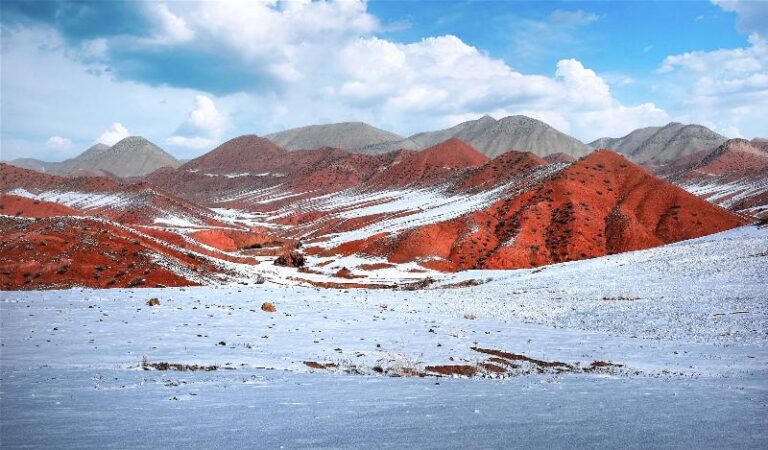
- Oytagh (奥依塔克) — Glacier valley with red mountains. Good day trip; road condition varies after rain.
- Yarkand / Shache — Historic oasis town with a famous tomb and bazaar. About 2 hours southeast on good roads.
- Yengisar (英吉沙) — Known for handmade knives. Interesting half-day trip if you appreciate metalwork.
Frequently Asked Questions
Do I need a permit to visit Abakh Hoja Mausoleum? No. It is a regular ticketed site. Permits are only required if you travel further west toward Tashkurgan or the Karakoram Highway (border zones).
Can I visit these sites without speaking Chinese or Uyghur? Mostly yes. The mausoleum and museum have basic English signage. For taxis and restaurants, a translation app on your phone (or pointing at pictures) works fine. Bus routes are harder without Chinese reading ability.
How does this connect to the Old City? Think of this as the other half of the same city. The Kashgar Old City guide covers the historic core in detail. This article covers everything else. Together they give you a fuller picture of what Kashgar actually is in 2026 — not just a museum-piece old town, but a living regional capital of nearly 700,000 people.
Disclaimer
This article is based on our personal visits to Kashgar (most recently June 2026) and publicly available information. Opening hours, ticket prices, and transport schedules may change. Verify key details before you travel. We have no commercial relationship with any business or site mentioned here.
About the Author
Karl Huang has traveled extensively across Xinjiang since 2019, visiting Kashgar on multiple occasions for both tourism and research. He operates several travel-information websites focused on the region and writes from firsthand experience rather than recycled guidebook content.