Published: October 10, 2026 | Author: Karl Huang
Most travellers have never heard of Wujiaqu city, and that is exactly why it works as a day trip. Sitting about 30 kilometres north of Urumqi, it is the headquarters of the Sixth Division of the Xinjiang Production and Construction Corps (the XPCC, known locally as the Bingtuan), a place where an entire town was dug, planted, and named by soldiers after 1949. I went there on a cold April morning expecting a dusty army outpost and left convinced it is one of the easiest real-Xinjiang experiences you can bolt onto a Urumqi stopover. This is a first-hand account, not a tourism brochure.
| Fact | Detail |
|---|---|
| Where | About 30–32 km north of Urumqi, in the Changji region, between the Tian Shan and the Gurbantünggüt Desert |
| Who runs it | Headquarters of the Sixth Division of the XPCC (Bingtuan) |
| Main sight | Qinggeli Lake resort (青格达湖), a 36 km² reservoir and provincial wetland |
| Best window | Mid-April to early May for the tulip festival; summer for lotus; winter for ice |
| Time needed | Half a day from Urumqi; buses run roughly hourly |
| Cost | Under 60 yuan all-in for a self-guided visit |
Why Wujiaqu city sits where it does
Wujiaqu lies on the flat tongue of land where the Tian Shan drops away to the north and the Gurbantünggüt Desert begins. It is administered inside what is formally the Changji Hui Autonomous Prefecture, and Changji is the neighbour most visitors pass through without ever registering it. Wujiaqu is the corollary almost nobody visits. The ground is fertile only because water was forced onto it, and that single fact explains the city’s whole personality: it exists because an army decided the desert edge was worth holding.
I found the geography useful for planning. You can wake up in Urumqi, be at the lake before ten, and still be back for an Urumqi lunch. For a province where “nearby” often means three hours of mountain road, that closeness is the whole selling point.
How a division of soldiers built the town
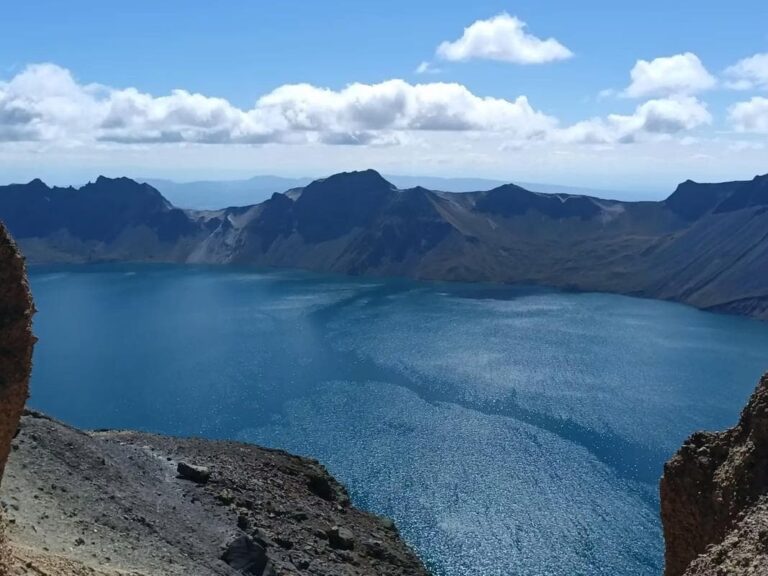
The story locals tell starts in 1949, when units under General Wang Zhen marched west and were ordered to settle the frontier rather than merely garrison it. The Sixth Division took the swampy basin south of the desert and, between 1951 and 1955, built the Mengjin Reservoir (猛进水库) by hand: picks, woven baskets, and shoulders, with almost no machinery. The lake you see today, Qinggeli, is that reservoir, and its name is Mongolian for “spirit water” — a word chosen by people who had just made water appear where there had been none.
Out on the water sits the General’s Pavilion (将军阁), a floating hall whose walls carry the portraits and short biographies of 52 generals of the division. It is the most honest museum piece in town: a city that admits out loud it was built by an army. After weeks of places that paper over their own making, I found that refreshing. Stand on the causeway and you are looking at reclamation as a finished object, not a slogan.
The tulip festival: Wujiaqu’s loud, brief spring
For roughly three weeks from mid-April to early May, the Qinggeli resort runs the Wujiaqu Tulip Culture Festival (郁金香文化旅游节). The XPCC’s own spring-flower map lists the Sixth Division’s tulip fields as the headline act of northern Xinjiang’s flower season, with more than two million bulbs across dozens of varieties laid out in colour blocks against the still-bare Tianshan. I timed my visit for the third week of April and caught the tail of the bloom: a hard wind, bright beds of red and yellow, and almost no foreign faces.
What surprised me was the scale relative to the effort. This is not Keukenhof. It is a worked reservoir dressed for three weeks of attention, and the locals treat it as a proper holiday. The beds are replanted in bands of single colour rather than mixed drifts, which reads as modest from ten metres but photographs cleanly against the grey Tianshan behind. Food stalls, a small fairground, and weekend performers show up. If you want a photograph of Xinjiang that includes both snow mountains and tulips in one frame, this is one of the few places that delivers it within an hour of a major airport.
A morning I spent on the reservoir shore
I arrived by bus before ten, paid the modest gate fee, and walked the causeway slowly. Retirees from the division were doing their laps around the water; a few fishermen sat by the reeds; a small deer enclosure near the east bank drew more children than the generals’ pavilion did. The place is not a wilderness and does not pretend to be. It is a worked landscape — lotus ponds that will not open until July, reed beds where the wind never stops, and a fairground that sleeps except on weekends.
What it lacks in wildness it makes up for in sincerity. Nobody here performed “tradition” for me. I ate a sesame biscuit from a cart, watched a man in a padded jacket feed the deer, and left when the wind got under my collar. A keeper at the deer enclosure told me, without being asked, that the fawns are born in May and that the winter ice on the lake often holds until March. Small facts, freely given, the kind you only collect when nobody is performing for you. That unstyled ordinariness is the thing I remember, more than any single view.
What the Bingtuan plate tastes like
Reclamation cooking is canteen cooking with better raw materials. Around the lake and in the town centre you will find banmian (hand-pulled noodles), liangpi (cold sesame noodles), kajiaman (oven buns), and zhuafan (pilaf). The division’s own mess halls — the 兵团大食堂 style spots — serve horse sausage (machang) and laghman to locals who have eaten this way for sixty years. A plate of pilaf with a braised chicken leg costs less than a coffee back home, and the oven buns come out blistered and salty in a way the city versions never match. I paid about 25 yuan for a plate of banmian that could have fed two people, and the cook shrugged when I tried to tip.
If you want something sweeter, the nearby Changji corridor is famous for its own banmian and for melon in summer. Wujiaqu itself is not a food destination, and I would not route a trip around its restaurants. But as fuel for a half-day walk, the canteens are cheap, filling, and about as local as Xinjiang gets.
Using Wujiaqu as a northern springboard
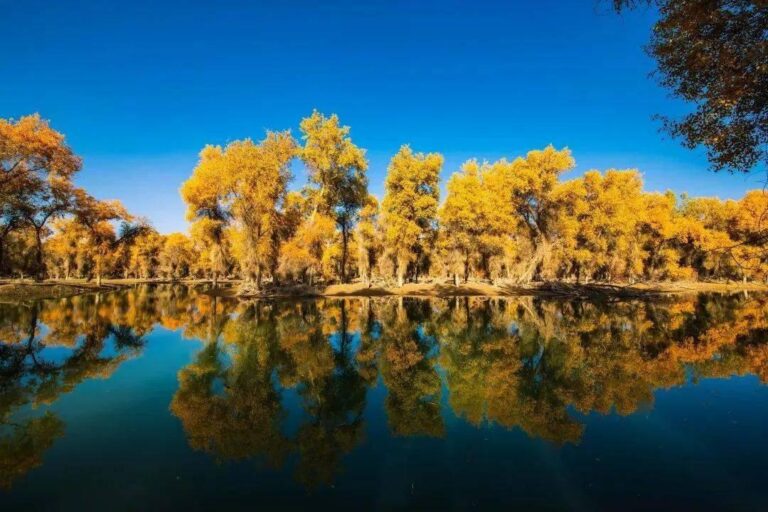
Wujiaqu is less a destination than a doorway. North of it the road runs into the southern edge of the Gurbantünggüt, Xinjiang’s largest desert, and on to the coloured basins of Wucaiwan and the wild-horse country of the Kalamaili Nature Reserve. If organised dunes are more your speed, the Kumtagh Desert near Shanshan is the cleaner, more famous field, but Wujiaqu is the easier launch pad when you are already based in Urumqi.
I treat the city as a sampler. In one morning you get the desert’s edge, a soldier-built lake, and a working town that most guidebooks skip. Push two hours further and the coloured basins of Wucaiwan (五彩湾) open up under the same low light that draws painters to the region; another hour puts you in Karamay, the oil city whose skyline you can see from the highway long before you reach it. From there the north opens up: the yardang formations, the coal town of Karamay, and the long G216 haul over the Junggar. Wujiaqu is the gentle on-ramp to all of it.
How I spent six hours there
My loop, door to door from Urumqi: 08:40 bus north; 09:50 at the lake gate; causeway walk and the General’s Pavilion by 11:00; a late bowl of noodles in town; 13:30 bus back. Total cash spent, including the ticket and food, came to under 60 yuan. It is not a “must-see,” and I would not claim it is. It is a satisfying half-day that costs you almost nothing but the bus fare, and it tells you more about how modern Xinjiang was actually assembled than any museum in the capital.
If you would rather have greener, higher pasture for the same effort, Nanshan Pasture is the other easy Urumqi day trip, and it swaps reclamation history for alpine meadow. I have done both; they answer different questions.
Questions people actually ask
Do I need a permit to visit Wujiaqu?
No. It is a normal Chinese county-level city, open to all visitors, domestic and foreign. Bring your passport for hotel check-in if you stay over, but a day trip needs nothing special.
Is the tulip festival worth planning around?
If you are already in Urumqi in late April, yes — it is the cheapest pretty thing near the city. If you would cross the province for it alone, no; the blooms are brief and weather-dependent.
Can I reach it without a car?
Yes. Buses run from Urumqi’s north bus stations to Wujiaqu in about an hour. A taxi or ride-hail for the whole trip is also reasonable if you are in a group.
Is there anywhere to stay?
Wujiaqu has standard Chinese business hotels and the division’s guesthouses. Most foreign visitors do it as a day return from Urumqi and that is what I recommend.
A note on accuracy
This article is based on the writer’s own visit in April 2026 and on public information from the Xinjiang Production and Construction Corps’ official spring-flower guidance and the Qinggeli Lake resort’s own descriptions. Opening dates, festival timing, and ticket prices change year to year and with the weather; confirm the current season with the resort or a Urumqi travel desk before you go. This is not official advice, and the author is not a licensed guide.
About the author
Karl Huang is a Xinjiang-based travel writer who has spent the last decade driving, riding, and missing buses across the region. He focuses on places that reward a half-day and a curious eye rather than a packed itinerary, and he prefers canteen food to banquet food. He has written field guides to more than 40 Xinjiang counties and cities.