Published: October 17, 2026 | Author: Karl Huang
When we first saw the Jiaohe ruins from the edge of the plateau, the city looked less like a ruin and more like a sculpture that someone had left half-finished. Two rivers cut around a 30-metre-high island of compacted earth, and inside that island are streets, courtyards, temple platforms and the remains of roughly two hundred cave-like houses, all carved downward rather than built upward. That single fact is what makes Jiaohe different from almost every other ancient city on the Silk Road, and it is why UNESCO added it to the Silk Roads World Heritage corridor in 2014.
This article is not another photo list of rubble. Having walked the site twice, I want to explain what you are actually looking at: a capital that served the Jushi kingdom and the Tang dynasty before it went silent around the 14th century. I also want to help you decide whether Jiaohe or the nearby Gaochang ruins deserve your time if you can only visit one.
Key Facts About Jiaohe Ruins
| Chinese name | 交河故城 (Jiāohé Gùchéng) |
|---|---|
| Uyghur name | Yarghul / Yarkhoto |
| Location | Yarnaz Valley, 10 km west of Turpan, Xinjiang |
| Plateau size | About 1,650 m north-south, 300 m at widest point |
| Site area | Roughly 37 hectares |
| Founded | 2nd century BC |
| Peak period | Tang dynasty, 640-658 AD as Anxi Protectorate seat |
| Abandoned | Late 13th century |
| UNESCO status | World Heritage Site, 2014 (Silk Roads: Chang’an-Tianshan Corridor) |
| Protection rank | First Batch National Key Cultural Relics, 1961 |
| Typical ticket | About 70 CNY peak season; 40 CNY off-season |
| Best time | Spring (April-June) and autumn (September-October) |
| Visit length | 2-3 hours |
A Capital Hewn From a Single Sandstone Tongue
Jiaohe sits on a loess plateau shaped like a willow leaf. The Yarnaz River splits around it, rejoins a little farther south, and leaves the city on a naturally fortified island. That is where the name comes from: jiao means to meet or intersect, and he means river. The Chinese name literally describes the geography: the place where two rivers meet.
Because the cliffs already formed a wall, the builders never bothered with a defensive perimeter. Instead of piling stone or mud brick upward, they carved the city downward into the plateau. This “subtractive” building method is rare anywhere in the world and almost unheard of for a settlement of this size. Streets, rooms, storage pits and wells were all cut from the same yellow-brown earth. The result is a dense map of a Silk Road city not rebuilt by later rulers. What you walk through today is essentially the negative space left behind by daily life.
The Jushi Kingdom and the City’s First Thousand Years
The earliest phase belongs to the Jushi, also written as Cheshi, an Indo-European people who founded the city around the 2nd century BC. Jiaohe became the capital of the Anterior Jushi kingdom, one of the small oasis states the Han dynasty would later call the “Thirty-Six States of the Western Regions.”
The Han court understood the site’s value immediately. Whoever held Jiaohe controlled the approach to the Turpan Basin from the north, and that meant control over east-west trade. The famous “Five Battles for Cheshi” between the Han and the Xiongnu ended in 60 BC with Han dominance and the establishment of the Protectorate of the Western Regions. From that point on, Jiaohe was never fully independent, but trade kept it wealthy.
From Han Garrisons to the Uyghur Idikut: A Timeline of Power
The city changed hands several times, but each new ruler kept using it because the location was too useful to abandon. Around 450 AD the Qu clan, who had founded the Gaochang kingdom in the Turpan Basin, absorbed Jiaohe. In 640 AD the Tang dynasty conquered Gaochang and turned Jiaohe into the seat of the new Jiaohe County. From 640 to 658 AD it was also the headquarters of the Anxi Protectorate, the highest Tang military administration in the west. Tang records suggest the city housed around 7,000 people at the time.
After the Tang withdrew, Uyghur groups who had left Mongolia settled in the Gaochang area and created the Gaochang Uyghur kingdom, often called the Uyghur Idikut state. Jiaohe continued as an administrative and religious centre under their rule, with Buddhism still prominent at the large northern temple complex.
Why Jiaohe Was Abandoned — and Left to the Wind
By the late 13th century, the Turpan Basin had become a battlefield between rival Mongol factions. The rebellion of Kaidu against Kublai Khan is generally blamed for the final devastation of Jiaohe. The city did not disappear overnight, but after that period it effectively vanishes from historical records. The Silk Road routes were shifting, the local water table may have dropped, and the population did not return.
For six centuries, Jiaohe sat empty. Western explorers such as Aurel Stein visited in the early 20th century and described a maze of ruined dwellings and shrines carved out of the loess. Systematic excavation by Chinese archaeologists began in the 1950s, and the ruins were listed among the first group of National Key Cultural Relics in 1961, as recorded by the Gaochang District government.
How a Mud City Survived Nine Centuries of Weather
The same dry climate that makes Turpan brutally hot in summer is what preserved Jiaohe. Annual rainfall in the basin is tiny, and the loess soil hardens into a durable crust when exposed. Because the buildings were carved into the earth rather than piled on top of it, there were no freestanding walls to topple outward. The entire city settled slowly as a single mass.
That does not mean the site is indestructible. Wind erosion, foot traffic and temperature swings all take a toll. Since 2006 the Dunhuang Academy and other institutions have carried out a major reinforcement programme, completing five phases by 2022, according to a China News Service feature on the conservation work. In 2014 the ruins were inscribed as part of the transnational Silk Roads World Heritage property, shared by China, Kazakhstan and Kyrgyzstan, under reference 1442. The citation highlights Jiaohe as evidence of urban planning, earthen construction and Buddhist transmission along the Silk Road.
Jiaohe or Gaochang? Picking Between Turpan’s Two Ruined Cities
Most visitors to Turpan have limited time, and the two big ruined cities sit close enough to be confusing. Here is how they differ.
| Jiaohe | Gaochang | |
|---|---|---|
| Layout | Carved into a river island, no outer walls | Walled rectangular city on open desert |
| Age | Founded 2nd century BC | Grew from 1st century BC, peak 6th-7th centuries AD |
| Size | About 37 hectares | About 200 hectares |
| Atmosphere | Dense, vertical, intimate | Wide avenues, grand scale |
| Key sights | Temple platform, cave dwellings, central avenue | Palace ruins, monastery, city gates |
| UNESCO | Yes, 2014 | Yes, 2014 |
Our advice: if you enjoy architecture and want to feel the scale of a Silk Road metropolis, go to Gaochang. If you want the most atmospheric walk and the clearest sense of how people actually lived, go to Jiaohe. With a full day, you can do both.
Reading the Giant Temple Platform: What the Ruins Whisper
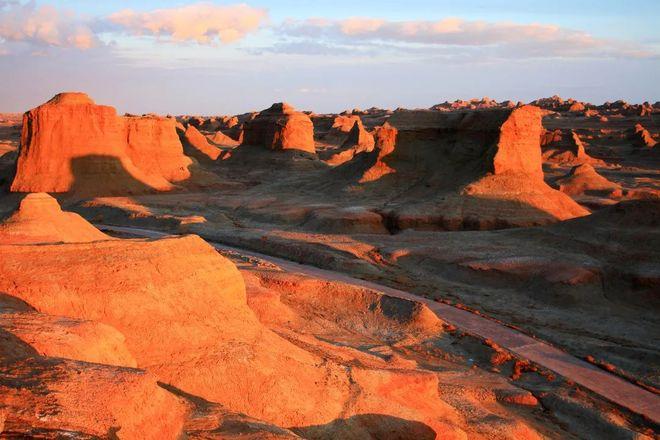
The northern end of the plateau is dominated by the remains of a large Buddhist temple platform. This was not a single building but a complex of courtyards, halls and a central stupa. Archaeologists have also identified a stupa forest, residential quarters with sunken courtyards, an administrative area and craft workshops. The central avenue that runs north-south was the spine of the city, with smaller lanes branching off it like ribs.
What struck us most was not any individual monument but the repetition of ordinary spaces. You can still see the slots where roof beams once rested, the niches where lamps sat, and the low walls that divided one courtyard from the next. The city may have been abandoned, but the layout is still readable. You do not need to be an archaeologist to understand that this was once a busy, working neighbourhood.
Walking Jiaohe Today: A First-Person Account
We visited in late September, which in Turpan means warm mornings and afternoons that still feel like summer. The entrance path leads you up to the southern end of the plateau, and the first view is almost disappointing because the ruins look like low ridges of dirt. The detail only appears once you are inside.
We walked the central avenue first, then cut east into the residential quarter. The walls are taller than they look from a distance, often two to three metres above the floor of a sunken room. In one spot, a narrow passage opens into what was clearly a courtyard with a well in the centre. A cat was sleeping on the rim. The only sounds were wind and a distant tour guide. After twenty minutes we reached the temple platform and sat on a low wall. From there you can see the whole city, the river beds on both sides and the modern Turpan basin beyond.
The heat is the real enemy. Even in autumn, the dark earth absorbs sunlight and radiates it back. We finished the main loop in about two hours and were glad we had carried more water than we thought we needed.
Planning a Visit: Getting There, Timing, and Logistics
Jiaohe is roughly 10 km west of downtown Turpan, in Gaochang District. The most flexible way to reach it is by taxi or hired car, which costs around 20-30 CNY one way from the city centre. Some travellers take city bus 1 or 101 towards Yar Township and then negotiate a short ride to the entrance. If you arrive by high-speed rail at Turpan North, a shuttle or taxi takes about 30 minutes.
The standard adult ticket is about 70 CNY during the peak season and 40 CNY in the off-season. Opening hours are usually 09:30 to 19:30, though times can stretch later in summer. A shuttle bus is sometimes offered, but the main archaeological area is only a short walk from the ticket gate. English-speaking guides are not always available, so hiring a Chinese-speaking guide through your hotel is worth considering if you want context.
Spring and autumn are the most pleasant seasons. We have been to Turpan in July, and the midday ground temperature can exceed 50°C. If you must visit in summer, arrive at opening time and leave before noon. Winter is quiet and the light is good for photography, but the wind across the plateau is cold.
Stay in Turpan city, which has the full range of hotels. For food, the night market near Qingnian Road serves lamb skewers, pilaf and freshly baked naan. September is grape season, and the Turpan grape harvest is worth timing your trip around if you have a sweet tooth.
A Morning at the Ruins, an Afternoon in Turpan
Here is the itinerary we would recommend for a first visit. Start at Jiaohe at 09:30, walk the central avenue to the temple platform, loop back through the residential quarter, and leave by 12:00. Back in Turpan, have lunch and visit the karez system to understand how the oasis survives. In late afternoon, drive out to the Flaming Mountains while the light is still warm. If you have a second day, add Gaochang and the Bezeklik caves.
The best time of year depends on what else you want from Xinjiang. We usually suggest checking our season-by-season guide before locking in dates, because autumn in Turpan overlaps with snow on the Tianshan passes to the north.
Visiting Jiaohe: Questions Travelers Actually Ask
How long does a visit take?
Most people spend two to three hours inside the ruins. Add an hour if you hire a guide or want to photograph the site in different light.
Is Jiaohe suitable for children or older travellers?
The paths are mostly level earth, but the ground is uneven and there are no handrails at the edges. Good walking shoes and sun protection are essential for everyone.
Can I fly a drone?
No. Drones are prohibited at cultural heritage sites in China, and Jiaohe is no exception.
Should I visit Jiaohe or Gaochang first?
Visit Jiaohe first if you want the more atmospheric introduction. Visit Gaochang first if you prefer grand scale and open spaces.
Are there English signs?
Some, but not enough to fully explain the history. A guide, or reading up beforehand, makes the experience far more rewarding.
Travel Conditions and a Plain-English Disclaimer
This guide is based on our own visits to Jiaohe and Turpan, combined with current information from UNESCO, the Gaochang District government and Chinese archaeological publications. Ticket prices, opening hours and transport options can change without notice. The site is an exposed archaeological area with uneven ground and extreme summer temperatures, so please take sensible precautions. We are not responsible for any decisions you make based on this article.