Published: October 17, 2026 | Author: Karl Huang, editor at Xinjiang Attractions | Reviewed for accuracy prior to publication
Most people arrive at the Bezeklik caves expecting a smaller Dunhuang. They leave either disappointed or fascinated, depending on what they were really looking for. The site is not a polished gallery of intact murals. It is a cliff temple in the Flaming Mountains that carries more than half a millennium of Uyghur Buddhist painting, much of it now sitting in museums in Berlin, Tokyo and Saint Petersburg. This guide focuses on the art itself: what the murals show, who paid for them, and why so little of the colour remains on the walls.
| Feature | Detail |
|---|---|
| Chinese name | 柏孜克里克千佛洞 (Bózīkèlǐkè Qiānfódòng) |
| Meaning | “The place where there are paintings” (Uyghur) |
| Location | Mutou Valley, Flaming Mountains, ~45 km northeast of Turpan |
| Period | 5th to 14th century; peak under the Gaochang Uyghur Kingdom (9th-13th c.) |
| Caves catalogued | 83 numbered cells; around 40 still carry mural fragments |
| Heritage status | National key cultural relic protection unit (1982) |
| Typical ticket | ~¥40-60; Ctrip lists a basic adult ticket at ¥40 |
| Time needed | 60-90 minutes at the caves |
| Best season | April-May and September-October |
| Photography | Not permitted inside the caves |
The cliff the paintings were cut into
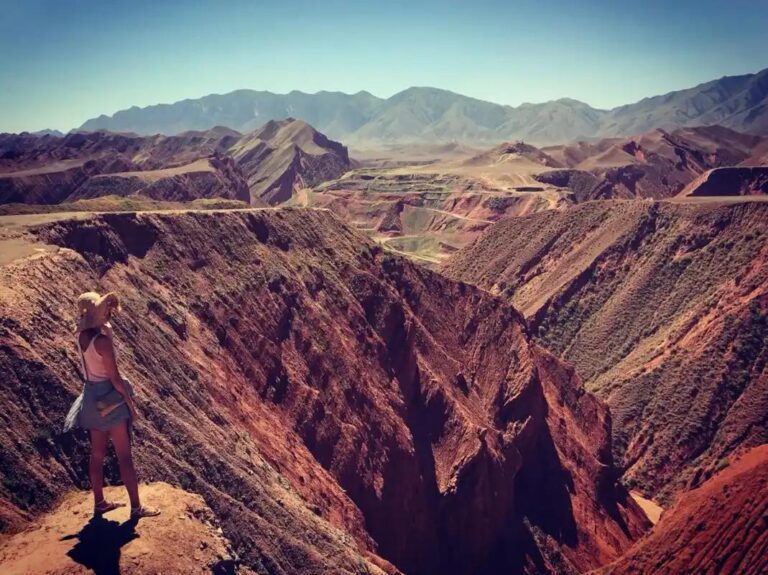
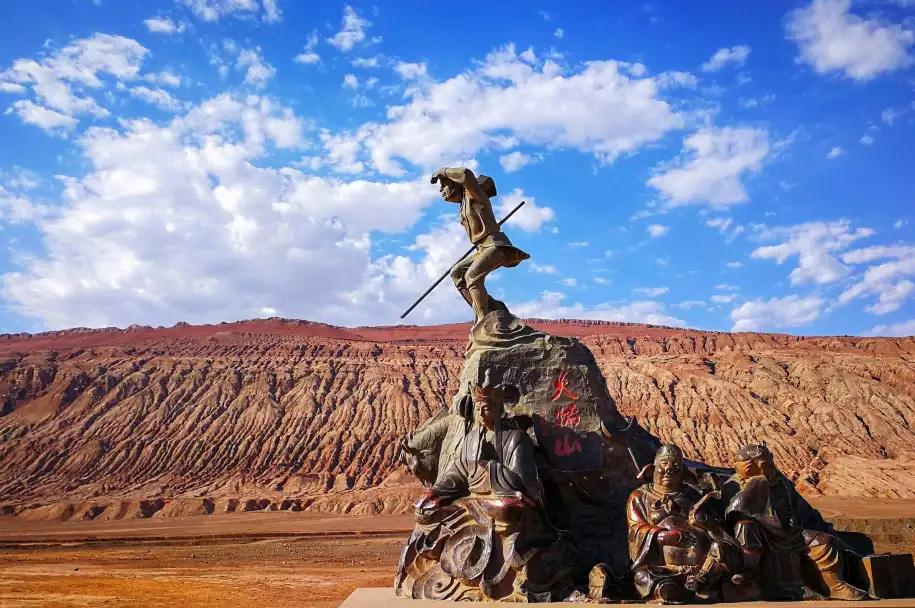
When we left Turpan city at eight in the morning, the thermometer in the car already read 24°C. By the time the road dropped into Mutou Valley, forty-something kilometres northeast of the city, the cliffs had turned a deep rust red. This is the same Flaming Mountains ridge that travellers photograph from the highway, but here, inside the gorge, the rock walls close in and a strip of poplars and grape trellises runs along the stream. The Bezeklik caves are cut into the west cliff above that green line, roughly ten kilometres south of the Gaochang ruins and a short drive from Tuyoq Valley.
The name Bezeklik is usually traced to a Uyghur phrase meaning “the place where there are paintings.” It fits. Eighty-three cave cells have been catalogued along the gorge, and around forty still carry mural fragments. The rest are empty, collapsed, or walled off. What matters is that most of the surviving colour comes from the Gaochang Uyghur period, roughly the ninth to thirteenth centuries, when this was a royal temple rather than a roadside attraction.
What the Bezeklik caves’ murals actually depict
The Bezeklik caves are not a single painted hall. They are a vertical temple complex, and the art changes as you climb. The lower cells held Buddha preaching scenes and lotus medallions. Higher up, the walls shift to large processional tableaux known as pranidhi scenes, in which kings, queens and nobles offer flowers, bowls and kingdoms to the Buddha. The donors are not anonymous. Their faces are recognisably Uyghur: men in tall fur-trimmed hats, women in high headdresses and long robes, often labelled in old Uyghur script.
One of the most reproduced panels, from Cave 9, shows a group of Uyghur princesses painted at roughly life size. The originals are now in Berlin; the empty rectangle on the wall tells you exactly where the saw went in.
From Qu family Gaochang to the Uyghur royal temple
The earliest cells probably date to the late fifth century, when the Qu family ruled the Gaochang kingdom. During the Tang period the site was known as Ningrong Temple or Ningrong Cave Temple. The real flourishing began after 840, when Uyghurs from Mongolia established the Kingdom of Qocho, centred on Gaochang. Researchers at the National Ethnic Affairs Commission note that more than ninety percent of the surviving murals belong to that Uyghur period.
The Uyghurs were not yet the Muslim Turkic people most travellers associate with Xinjiang today. They were a Buddhist, Manichaean and Nestorian Christian society, and their painters borrowed from every culture that passed through the Tarim Basin. Chinese pigment names sit next to Iranian-style landscape lines and Indian mudra gestures. That layered look is what makes Bezeklik different from Dunhuang or Kizil.
The monk who paused here in 629
Every Silk Road guide mentions Xuanzang, the Tang monk who travelled to India to collect Buddhist texts. In 629, he stopped in Gaochang, and the local king, Qu Wentai, tried so hard to keep him that the monk went on a hunger strike until the king relented. There is no direct record saying Xuanzang climbed to Bezeklik, but he certainly passed through the valley below. By the mid-seventh century the temple was already known to travellers, and his account helps date the site’s importance to the early Tang.
A Silk Road palette of red, green and deep blue
Inside the chambers, the colours are what stay with you. The palette is warm and heavy: vermilion, malachite green, ochre and a deep ultramarine that probably came from lapis lazuli carried along the Silk Road. The outlines are thick and confident, and the figures have real weight. Bodhisattvas wear Han-style robes over Central Asian tunics. Some donor figures hold Chinese-style vessels. The backgrounds include Persian-influenced pearl roundels and scrolling vines.
This was not a provincial copy of Chinese or Indian art. German scholar Albert von Le Coq, who removed many panels in the early twentieth century, published his findings in 1913 and noted how Sasanian Persian details appeared alongside Tang Chinese ones.
The other religions painted on the same walls
Few visitors realize that Bezeklik is not only a Buddhist site. Cave 38 has been identified as containing Manichaean imagery, and Cave 39 has produced Nestorian Christian touches, including a cross-shaped halo around a female donor. The National Ethnic Affairs Commission notes that this multireligious layering reflects the Uyghur elite’s earlier Manichaean faith before they turned to Buddhism.
The Uyghur elite shifted from Manichaeism to Buddhism during their first centuries in the Tarim Basin. Bezeklik captures that transition in paint. After the Chagatai Khanate converted the region to Islam in the late fourteenth century, figurative images were seen as forbidden, and many faces were gouged out or whitewashed.
The saw marks and the Berlin panels
Between 1902 and 1914, four German expeditions worked the Turpan oasis. Albert von Le Coq’s teams sawed painted plaster away from the rock, crated it, and shipped it to Berlin. Chinese researchers have documented how the Cave 15 and Cave 20 panels, in particular, were removed and are now split between museums worldwide. The largest Berlin panels could not be moved to safety during the Second World War, and Allied bombing in 1943 and 1944 destroyed much of the collection.
Other fragments ended up in Saint Petersburg, Tokyo, Delhi, Seoul and London. In 2021, Germany’s Ethnological Museum returned twelve fragments to China after years of negotiation, but the bulk of the removed art remains abroad or is simply gone. The empty rectangles at Bezeklik are not a sign of neglect; they are a record of how Silk Road art was dispersed.
Reading the site chamber by chamber
If the caves are open to the public in rotation, the exact chambers change, but the overall layout is fixed. The lower caves tend to show Buddha figures and Jataka tales, the stories of the Buddha’s previous lives. The middle level holds the great donor processions. The upper caves, carved later and higher into the cliff, include Tibetan-influenced imagery from the Yuan period, including a four-armed Avalokiteshvara in Cave 29.
Photography is not allowed inside, which is a good reason to sit still for ten minutes and let your eyes adjust. The fragments left behind are small, but the setting itself is the main exhibit: a vertical Buddhist monastery stacked into a red cliff above a desert stream.
What we saw when the lights went on
We visited in late September, leaving early to beat the heat. At the ticket gate we were almost alone. The shuttle dropped us at the cliff foot, and we climbed the wooden walkway. In the third chamber our guide pointed a torch at the ceiling corner and a patch of blue robe appeared, the fold lines still sharp. That fragment did more for me than any reproduction panel.
From the terrace, the view down the valley is the best part. The red cliffs, the green poplars and the flat grey-brown of the basin floor line up exactly the way monks would have wanted: water below, protection above, and the wider world kept at a distance.
Reaching Bezeklik from Turpan
There is no public bus to the site. The practical choice is to hire a car with driver for the day from Turpan. A half-day loop to Bezeklik, Tuyoq Valley and the Gaochang ruins typically costs around 400 to 600 yuan, depending on your bargaining and the season. Ride-hailing apps do not work reliably here, so arrange the car through your hotel the night before.
The drive from central Turpan takes about fifty minutes on good roads. Some travellers combine Bezeklik with the Flaming Mountains photo stop, but the two are different experiences: one is a sculpted red ridge, the other is a cliff temple hidden inside it.
Timing your visit to the caves
Spring, from April to May, and autumn, from September to October, are the comfortable windows. Daytime temperatures sit between 18°C and 28°C, and the light on the red cliffs is strong. Summer is brutal: the Turpan Depression regularly exceeds 45°C in July and August. Winter is cold but quiet, and an occasional snow dusting on the red rock is memorable.
Opening hours are usually 09:30 to 19:00 in summer and 10:00 to 18:00 in winter. Always confirm on arrival, because local authorities adjust times around holidays and maintenance.
Where to stay near Bezeklik
There is no accommodation at the site itself. Stay in Turpan, where mid-range hotels run from 250 to 500 yuan per night and the choice is wide. Some travellers base in Shanshan to the east, but that only makes sense if you are also heading to the Kumtagh Desert. For the Bezeklik-Gaochang-Tuyoq triangle, Turpan is the obvious base. Our full Turpan city guide explains how to string the sites together.
Lunch after the cliff walk
The small café at the entrance sells cold drinks, instant noodles and raisin bread. For a proper meal, wait until you return to Turpan. Try laghman hand-pulled noodles, pilaf with local mutton, or a plate of cold noodles with vinegar and chilli. Turpan grapes and raisins are available almost everywhere in season, but they taste better bought from a market stall than from the tourist counter.
A half-day loop through the Tuyuq valley
If you have one morning, start at Bezeklik around 08:30, then drive the short distance to Tuyoq Valley, where a traditional Uyghur village sits at the gorge mouth. After that, head south to the Gaochang ruins and, if time allows, the Astana Tombs. The order matters: Bezeklik faces east, so morning light is kinder, and the heat builds fast after eleven.
What to bring and what to expect
Bring at least two litres of water per person, a brimmed hat, closed shoes for the stair climb, and a translation app. Do not expect English signage or staff who speak it. Photography inside the caves is banned, and the ban is enforced. The toilets are basic but usable. The site is not wheelchair-friendly: the shuttle stops at the base of a steep stairway.
Standalone admission is roughly 40 to 60 yuan; combination tickets with Gaochang or other Turpan sites can be better value if you plan to visit several places. Prices are revised periodically, so check at the gate.
Visitors ask this most often
Is Bezeklik worth visiting if the murals are gone? Yes, if you come for the architecture, valley setting, and the story of Silk Road art dispersal. For intact murals in situ, head to the Kizil Caves near Kuqa.
How many caves can you enter? Only a small rotating set is open at any time. The number varies with restoration work.
Where are the original Bezeklik murals now? Fragments are in Berlin, Saint Petersburg, Tokyo, London, Delhi, Seoul and elsewhere. Some were destroyed in Berlin during the Second World War.
Can I visit without a car? Not easily. There is no reliable public transport to the entrance.
Before you go: a straight note
Bezeklik is a cultural heritage site, not a polished theme park. The damage is real, the explanations are mostly in Chinese, and the heat can be extreme. Go with the right expectations and it becomes one of the most honest Silk Road stops in the Turpan area. This article reflects my own visit and current sources available in October 2026; prices and hours can change, so confirm before you travel.