Published: October 21, 2026 | Author: Karl Huang
Most travellers race through the stretch of road west of Kashgar without stopping, eyes fixed on the Pamirs or the Pakistan border beyond. We almost did the same, until a driver in Kashgar mentioned a small oasis town where one of the Islamic world’s great linguists is buried. That town is Upal, and the Upal Kashgar pilgrimage stop turned out to be one of the most quietly moving half-days of our time in southern Xinjiang.
This guide comes from our own visit in autumn 2025, cross-checked against the site’s official heritage listing and a handful of Chinese travel write-ups. I’ll be straight about what is verified and what you should confirm on the ground, because details at small sites like this change faster than any guidebook.
Upal Kashgar at a glance
| Item | Detail |
|---|---|
| Location | Upal Township, Shufu County, Kashgar Prefecture |
| Distance from Kashgar | About 45–50 km southwest (roughly 1 hour by car) |
| Main draw | Tomb of Mahmud al-Kashgari (11th-c. Turkic lexicographer) |
| Heritage status | National Key Cultural Relic (6th batch, 2006, ref 6-0293) |
| Ticket | Small, around 10 yuan; grounds often free to walk |
| Time needed | 1–1.5 hours |
| Best months | April–May, September–October |
Why a scholar’s tomb became a pilgrim stop
The man buried here, Mahmud al-Kashgari, was born around 1008 near Upal in the Karakhanid court. After a palace coup killed his father, he spent roughly fourteen years walking through the Turkic-speaking towns of Xinjiang, Central Asia and Persia, listening to how people actually spoke. In Baghdad he wrote the Dīwān Lughāt al-Turk — the first full dictionary of Turkic languages — finishing it in the 1070s. The book is far more than word lists: it carries folk poetry, proverbs, a famous circular world map drawn with the south at the top, and a record of how ordinary Turks lived a thousand years ago.
He came home to die, and was buried on a low hill at the edge of the Upal oasis that locals now call “Sage Mountain” (Aizireti Maolamu). Over the centuries the grave became a mazār — a place of pilgrimage. Even today, parents bring children here hoping the scholar’s blessing will make them studious, and during religious festivals the hill fills with visitors. That living devotional layer is what separates Upal from a dry museum stop.
We found the contrast striking: a world-class intellectual landmark that still functions as a neighbourhood holy site. In the same hour you can see school groups, old men reciting quietly by the tomb, and fruit vendors out front. The survival of the book itself is its own story — the only complete copy we have was made in 1266 and now sits in Istanbul, six centuries after the author’s death.
What you actually see on the hill
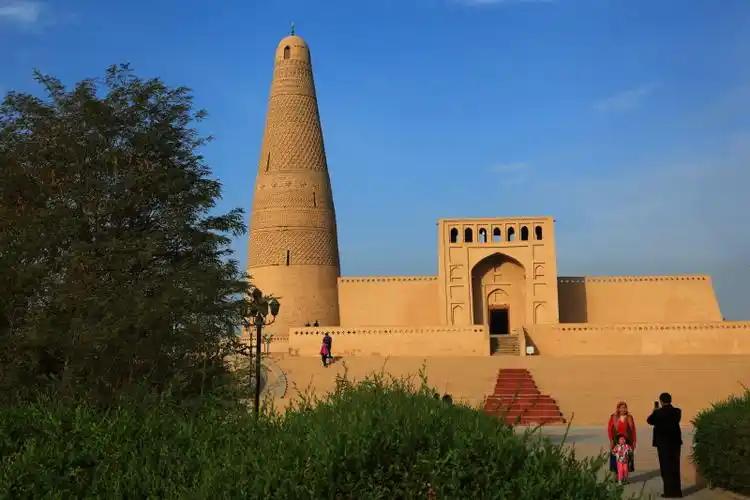
The current structure dates from a 1985–86 reconstruction of an older building, and it carries the National Key Cultural Relic plaque (listed 2006, reference 6-0293). It is compact — about 1,200 square metres — with a gatehouse, a main tomb chamber and a small prayer room, topped by the five round towers that give it its silhouette. The tomb itself sits under green cloth in the central chamber.
Beside the tomb is a modest exhibit room holding editions of the dictionary in several languages. If you read Turkish, Azerbaijani or any Turkic language, flipping through a modern reprint of the Dīwān on the spot where its author is buried is a genuine thrill. We spent longer there than we expected.
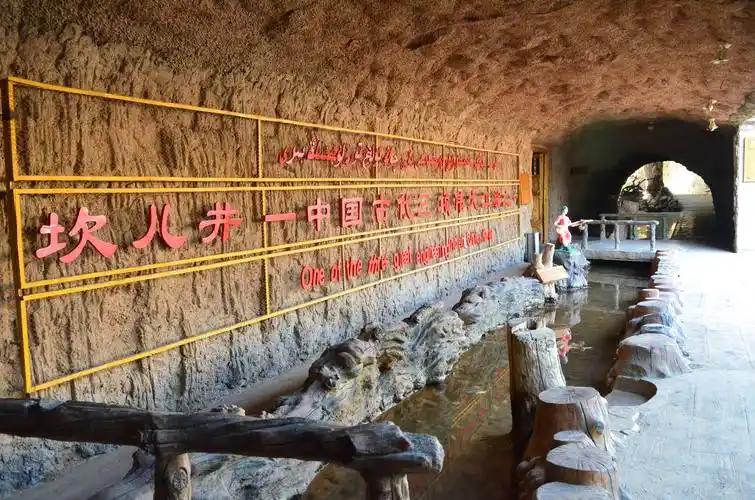
Out front, two things draw every visitor. One is the “wisdom spring” (智慧泉) — a cold freshwater source the faithful consider blessed. The other is an ancient poplar said to have sprung from Mahmud’s walking stick. Whether or not you believe the legend, standing under a tree the whole town treats as sacred is its own experience.
Getting to Upal from Kashgar
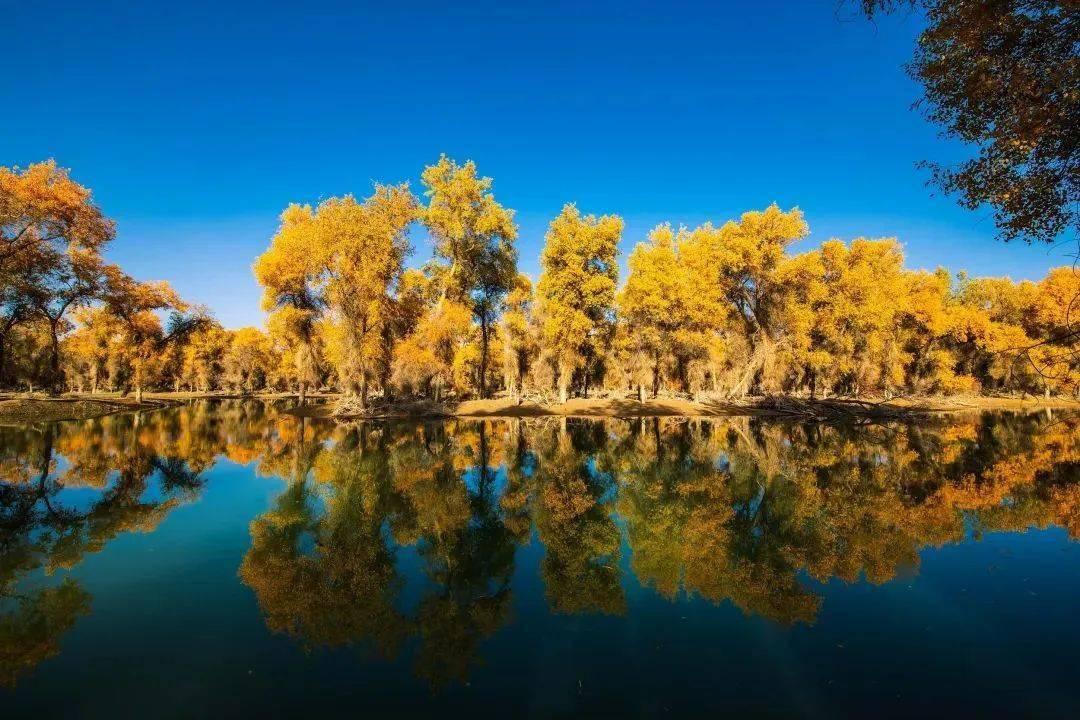
Upal sits just off the G314, the highway that runs west out of Kashgar and then turns south toward the Pamirs, Tashkurgan and the Khunjerab crossing into Pakistan. the Karakoram Highway is the same road, so Upal is a natural first pause if you are heading south.
From Kashgar city it is roughly a one-hour drive. The simplest options:
- Charter a car or taxi from Kashgar — most convenient, and easy to combine with the old city the same morning.
- Public minibus toward Shufu/Upal from Kashgar’s long-distance bus station; ask the driver to drop you at the mausoleum road, then a short walk or motorcycle taxi up the hill. The same county is covered in our Shufu County guide.
- Private tour — many Kashgar day-tour operators include Upal as a half-day add-on.
Roads in this part of the Tarim basin are flat and straight, but the desert light is merciless. We left Kashgar by 9 a.m. to beat both the heat and the midday glare on the white buildings. The drive itself is a quiet reset: Kashgar’s dust and noise give way to open fields, then a single green seam of orchards where the oasis begins.
Best time to visit Upal
Because the site is outdoors and the walk up the hill is fully exposed, timing matters. best time to visit Xinjiang covers the region in full, but for Upal specifically:
- April–May: orchards around the oasis bloom, temperatures sit in the low 20s °C, and the spring is at its fullest. Our favourite window.
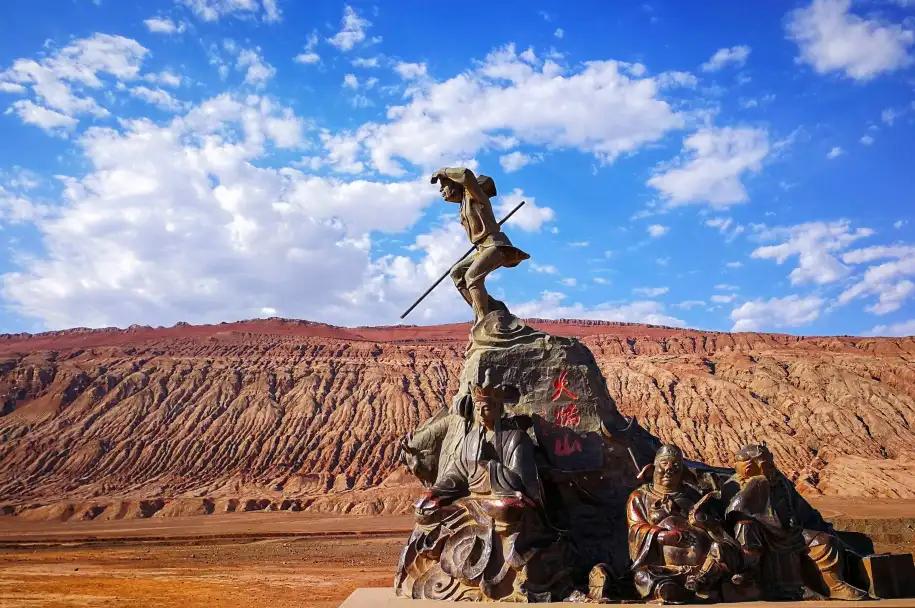
- September–October: harvest season, clear air, and the Pamir foothills turn gold. Comfortable for the hill walk.
- June–August: avoid if you can — basin temperatures climb past 38 °C and the exposed hill bakes.
- November–March: cold, and some nearby eateries close, but you will have the hill to yourself.
Where to stay
Upal itself has only basic guesthouses; almost everyone bases in Kashgar and does Upal as a half-day loop. Kashgar’s old city has everything from restored courtyard hotels to backpacker guesthouses, and staying there puts the Uyghur mosque architecture and the famous Sunday bazaar within walking distance of your door. We stayed in the old city and left after breakfast — back in time for a late lunch.
Food: eat in Kashgar, snack in Upal
Upal has small teahouses and noodle stalls but little worth a special detour; save your appetite for Kashgar. Before or after the trip, work through the old-city basics: naan pulled from the tandoor, polo (rice with carrot and lamb), sizzling kawap kebabs, hand-pulled laghman, and seasonal fruit — Kashgar melons in summer, figs and grapes in early autumn. If you want the literary angle, our piece on Uyghur literature for travellers pairs well with a visit to Mahmud’s tomb.
Practical tips
- Dress modestly. This is an active mazār. Cover shoulders and knees; women may want a scarf for the prayer areas.
- Shoes off in the tomb chamber and prayer room.
- Cash. The ticket (if charged) and village stalls often do not take cards.
- Budget 1–1.5 hours, plus drive time. No toilets or shade up the hill — bring water.
- Ask before photographing people at prayer; outdoor shots of the buildings are fine.
- Combine it. Pair with Kashgar old city in the morning, or as the first stop on a Pamir-bound day.
A sample half-day itinerary
08:30 — Breakfast in Kashgar old city. 09:00 — Drive west on the G314 (~1 h). 10:00 — Arrive Upal, walk up Sage Mountain, visit the tomb, spring and exhibit room (1–1.5 h). 11:30 — Tea and nan in the village. 12:15 — Drive back, or continue south if you are Pamir-bound. 13:30 — Late lunch in Kashgar.
Frequently asked questions
Is Upal worth the trip? If you care about Silk Road history, language or Islamic architecture, absolutely — and it is only an hour from Kashgar. If you only want big scenery, skip it.
How far is it from Kashgar? About 45–50 km, roughly an hour by car along the G314.
How much is the ticket? A small fee, around 10 yuan in recent years; the orchards and spring area are often free to walk. Confirm at the gate.
Can I visit on the way to Tashkurgan or Pakistan? Yes — Upal is right on the G314 corridor and makes a natural first stop heading south.
Is it a working religious site? Yes. Treat it as a mazār: quiet voices, modest dress, no climbing on the tomb.
Disclaimer
This article reflects a visit in autumn 2025 and public sources available at the time of writing. Opening hours, ticket prices and transport links at small heritage sites in Xinjiang change without notice. Confirm details locally before you travel, respect all posted rules and religious customs, and note this is an independent travel account, not an official site.
About the author
Karl Huang is a travel writer focused on Xinjiang and the Silk Road. He has driven the G314 from Kashgar toward the Pamirs and visited the Mahmud al-Kashgari mausoleum at Upal. His work stresses verified facts, respectful cultural guidance, and practical, first-hand detail for independent travellers.