Published: October 21, 2026 | Author: Karl Huang
Qitai County is the county town most travellers pass through on the way to the wheat terraces of Jiangbulak, and that is exactly why its own story gets missed. We drove in from Urumqi expecting a quiet agricultural stop and found instead a place that once ranked beside Urumqi, Ili and Hami as one of the four great commercial cities of Xinjiang, a caravan hub so profitable that locals still call it Golden Qitai. This guide covers that trading past, the Tang-dynasty walls now being dug out of the county seat’s northeast corner, the noodle counters the town is quietly proud of, and the practical business of stopping here for a day. It is built on visits in 2025 and 2026, the county government’s own profile, and a People’s Daily report from July 2025 that followed the old trade routes through town. It is deliberately not another walking guide to the terraces; our Jiangbulak wheat fields guide already does that job.
| Item | Detail |
|---|---|
| Location | Changji Hui Autonomous Prefecture, on the northern foot of the Tianshan, roughly three hours east of Urumqi by road |
| County established | 1773, first seat at today’s Laoqitai; moved to the present town in 1889 and renamed Guchengzi, “the old city” |
| Trading nickname | “Jin Qitai” (Golden Qitai) and “dry dock” (han matou), one of Xinjiang’s four historic commercial centres |
| Trade at its peak | Around 690 registered firms in the late Qing and early Republic, with camel trains reported at more than 40,000 animals |
| Key ancient site | Tangchaodun, a walled Tang-dynasty town in the northeast corner of the county seat, under excavation since 2018 |
| Airport | Qitai Jiangbulake Airport (JBK), opened 8 August 2024, about 16 km from the county seat |
| Farming | National high-quality wheat county; annual grain output near 780 million kg, about half of Changji Prefecture’s total |
| Eat | Guoyourou banmian, huangmian with kebab, lamb steamed with thin pancakes, Gucheng baijiu |
| How long | One full day for the town; two if you add Jiangbulak or the petrified wood park |
Qitai County’s dry dock years
The nickname confuses visitors until someone explains it. A “dry dock” was what Chinese merchants called a rich trading hub with no river and no port, and Qitai earned the title honestly. The town sits where the corridor between the Tianshan and the Gobi narrows, so caravans moving between the Junggar basin, Mongolia and the oasis towns to the south funneled past its gates. By the late Qing there were some 690 trading firms inside the old city, and the county’s records put the camel trains at more than 40,000 animals, which is why people said a thousand camels walked through Qitai and a hundred carts entered the old city. Grain made the town rich before anything else did: the northern slope’s soils and snowmelt streams turned this into the granary of the region, and merchants came first for flour and stayed for tea, hides and everything the Central Asian trade pushed through. Walking the town today you mostly see a normal county seat, but the scale of the old shop compounds hints at a place that handled money far larger than its size. For how this corridor fits into the longer story, our Xinjiang Silk Road history guide covers the full route.
Tangchao Dun: the city the excavators reopened
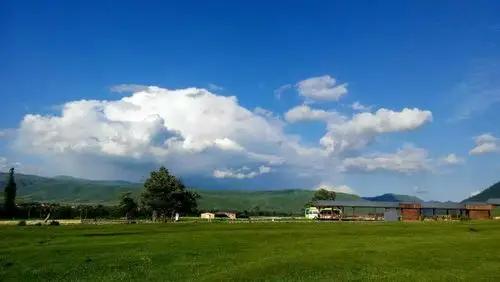
The single most interesting thing in town is also the easiest to miss. In the northeast corner of the county seat, behind site hoarding, lies Tangchaodun, the walled town that stood here in the Tang dynasty, when this was the seat of Pulei county under the Beiting protectorate. Since 2018 a team from Renmin University and the Xinjiang Institute of Cultural Relics and Archaeology has been digging through it, and what they have pulled out reads like a catalogue of the Silk Road in one pit: Tang courtyard houses, a Buddhist temple, a monastery of the Church of the East, and a bathhouse built in the Roman style, complete with underfloor heating. We stood at the fence on a weekday morning and watched the trench cut through layer after layer of occupation, and the published reports make the point the walls only hint at: this was the eastern anchor of the northern Silk Road, a customs post as much as a fortress. Access is limited while the dig continues, so treat it as a stop at the perimeter rather than a site tour, and ask locally whether any viewing area is open when you pass through. The county also holds Shichengzi in the southern hills, the Han-era fort where the general Geng Gong held out through a siege so stubborn it gave Chinese chess one of its classic endgames.
Reaching the county town by air and road
For most of two centuries the joke about Qitai was that a place built on caravan trade had no easy way in. That changed on 8 August 2024, when Qitai Jiangbulake Airport opened about 16 km from the county seat. It is a small 4C field with a 2,800-metre runway, and in its first summer it linked the county with eight cities on six routes; the hundred-thousandth passenger passed through within ten months, and a direct service to Taiyuan began in May 2026. Route lists at small airports shuffle constantly, so treat those numbers as a snapshot and check current schedules before booking. By road the county sits roughly three hours east of Urumqi, most of it on fast expressway, which makes it an easy extension of a stay in the capital; our Urumqi travel guide covers the city end of that drive. Buses run the same corridor through the day, and if you are building a wider loop, the spruce valleys of Mulei county lie immediately east and pair well with a night here.
The seasons of a wheat county
Because the county’s fame is agricultural, its calendar matters more than most. June and July turn the high terraces green and pull the peak crowds up the mountain road, which is precisely when the town itself is at its best in the evenings, warm enough for the food streets but past the spring wind. The lowland wheat comes off in July, and the high fields gold up through August, so a September visit gets you harvest light, thin traffic and the first properly cold nights. Winter here is not a suggestion. The town drops far below freezing and the county’s roads run on snow clearance for months, so come between May and October unless you specifically want the cold. Pack a warm layer even in summer; the moment the sun goes behind the mountains the temperature falls fast.
Beds in the county seat
Accommodation is the plain county-town kind and none the worse for it. The main streets hold a scatter of mid-range chains and family hotels within a few minutes’ walk of the food lanes, priced below what the same room costs in Urumqi, and the better ones fill up on summer weekends when tour groups base here for the mountain. Booking ahead for July and August is the single most useful thing you can do. There are hotels and homestays closer to the scenic area gates in the southern hills, and the county’s own tourism routes list three-star options and village stays, but for eating and walking the old streets the town is the better base. We have stayed twice, both times in simple rooms booked the same afternoon, and both times the front desk pointed us to a noodle counter still open at ten at night, which is worth more than a gym.
A noodle county first
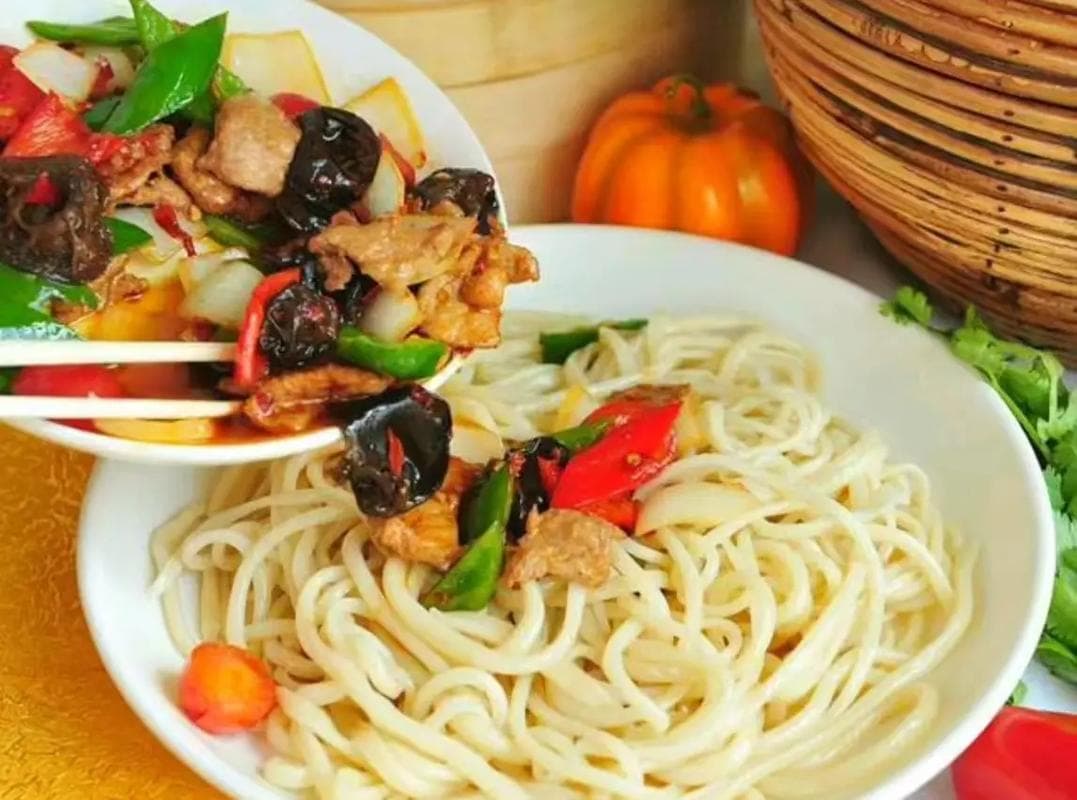
Every county in Xinjiang claims its food, but Qitai’s claim has a mechanical explanation: the wheat. The county’s flour is a national geographical-indication product, and the county’s own figures put annual grain output near 780 million kg, roughly half of Changji Prefecture’s entire harvest, with milling capacity around a third of Xinjiang’s total. High-protein flour pulls into dough that stretches without tearing, which is why the town’s laghman counters can pull a serving of noodles in under a minute, and why the benchmark dish here, guoyourou banmian, fried lamb and peppers over hand-pulled noodles, is taken so seriously. Order it at any counter and you get noodles with real resistance to the bite. Beyond it the town eats huangmian, yellow noodles served cold with grilled lamb laid on top, lamb steamed under layers of thin pancake until the bread drinks the broth, and a clay-pit roast the locals call land, sea and air, fish, chicken and lamb cooked together, a dish invented at a village banquet in this county. To drink there is Gucheng baijiu, distilled in town on a site the distillery traces back six centuries under the name Xinjiang’s first cellar. Our guide to laghman noodles explains the hand-pulled tradition for anyone who wants to know what the fuss is about.
Small practicalities of a market town
A few things worth knowing that apply to this town specifically. Cash still moves faster at the small stalls around the markets, so carry a few small notes. English is rare here, so a hotel business card and a screenshot of your destination in Chinese solves most taxi conversations. The old part of town is flat and compact, easily walkable in an afternoon. Museums follow the common Xinjiang pattern of closing on Mondays, so plan around that if the county museum is on your list. Distances outside town are big and fuel stations thin out quickly, so fill the tank before heading into the southern hills or the northern gobi. Bring sun protection even on cool days; the county sits dry and open enough that a September afternoon will burn you through a T-shirt.
One day in the old city, step by step
Here is the shape of a day we would repeat. Start at Tangchaodun early, when the light is low on the ramparts and the traffic has not built up, and spend an hour at the perimeter reading what the dig has uncovered. Walk to the county museum afterwards for the context the fence cannot give you, from the dinosaur fossils found in the northern gobi to the ledgers of the old trading houses. Eat a late lunch at a laghman counter, then split the afternoon by mood: north to the petrified wood and dinosaur geopark, where a fossil forest lies on the surface, or south toward the Jiangbulak gate for the terraces. Either way, be back in town by dark, because the evening is the point. The food lanes fill, the noodle counters pull their last batches, and a town that lived on passing caravans does what it has always done, which is feed people on their way somewhere else.
What visitors ask about Qitai County
Is the town worth a stop if I only care about Jiangbulak? We think so, for half a day at minimum. The food and the Tang-era dig are things the mountain cannot give you, and the drive between them is short.
Do I need any permit to visit? No. Nothing in Qitai County requires the border permits that the far west of the province asks for. Foreign visitors travel on a passport as anywhere else in China, with hotels registering your stay as they must everywhere.
When is the wheat at its best? Green on the terraces in June and July, gold up high through August. The lowland harvest comes earlier, in July, so the plains and the mountain fields look different in the same week.
Can I visit without speaking Chinese? Yes, with patience. This is a working county town rather than a tourist one, so carry translated names for dishes and hotels, and expect the noodle counters to communicate by pointing and smiling, which works.
How current this guide is
We visited in 2025 and 2026 and leaned on the county government’s published profile and on the official re-publication of the People’s Daily reporting cited above. Airport routes, excavation access, museum days and hotel prices all move, and small-county information ages faster than big-city information, so verify anything time-sensitive before you commit. The Tangchaodun dig is ongoing, which means what we saw at the fence will not look the same when you arrive. We have no commercial relationship with any hotel, restaurant or operator mentioned in this guide.
About the writer
Karl Huang writes about northern Xinjiang for independent travellers. He has passed through Qitai County twice, once chasing the terraces and once for the old city, and now plans the stop around lunch rather than the other way round.