Published: September 9, 2026 | Author: Karl Huang | Category: Xinjiang Cities
Most guidebooks reduce Pishan to a paragraph on jade and pomegranates. When we drove off the G3012 near Guma, my companion asked: where is the silk? It turned out to be the right question. Pishan has run a mulberry and cocoon trade for over a century and sits at the literal foot of the Kunlun and Karakoram. That pairing, silk from one of China’s hottest mulberry zones and a county that climbs from 1,100 metres to the snowline in a single afternoon, makes it worth a stop between Hotan and Kashgar.
Pishan at a glance: the numbers that matter
If you want a one-screen summary of the place, this is what I keep in my notebook. Cross-check against the Hotan city guide and the Silk Road timeline; local numbers come from the county portal and a 2026 Hotan Daily report on the new sericulture base.
| Item | Figure | Source note |
|---|---|---|
| Chinese / Uyghur name | Pishan (皮山) / Guma (固玛) | ps.gov.cn; Xiyu Tongwen Zhi |
| Prefecture | Hotan Prefecture, Xinjiang | Hotan Daily 2026 |
| Area | about 39,700 km² | ps.gov.cn |
| Population (resident) | about 300,000 (2021) | 7th census |
| County seat elevation | about 1,100 m at Guma town | Guma gazette |
| Oasis footprint | 54 separate blocks split by gravel and sand | Bo Baike |
| Annual rainfall | 57 mm at Guma; 53 mm at Kiryang | local gazettes |
| Annual evaporation | about 4,200 mm at Kiryang | Kiryang gazette |
| Average temperatures | 12.5 °C annual; 25.3 °C July; -5.0 °C January | Guma gazette |
| Recorded extremes | 41.6 °C (Jul 1997); -22.9 °C (Jan 2006) | Guma gazette |
| Frost-free days | 217 | Guma gazette |
| Railway station | Pishan Station, Kashgar–Hotan line (2011) | Hotan Daily |
| Main roads | G315 east–west; S217 south to Kunlun | Guma gazette |
| National GI products | Pishan yam; Kiryang snow chrysanthemum; Kokterek grape | Ministry of Agriculture GI register |
| National heritage building | Turdi Aghi Manor, Awati village (2013, 7th batch) | State Council notice |
Mulberry first: why silk, not jade, is Pishan’s real story
The first time we drove through Koshtagh town, about 15 km south of Guma, we kept pulling over for trees we could not identify. They turned out to be mulberries, planted in regimented rows on land fallow until 2024. The county now runs 660 mu of mulberry around Koshtagh village, with a standardised silkworm house kept at constant temperature and humidity. Each batch uses 150 sheets of silkworm eggs; eight batches a year; 60 tonnes of fresh cocoons; roughly 4 to 5 million yuan in annual output. None of this was here in 2023.
Pishan has the climate of southern Xinjiang (long, hot, dry summers) plus a water table fed by Kunlun snowmelt, which is the exact recipe for mulberry leaves heavy with sugar and protein. The county is part of a wider Hotan push to rebuild a silk belt that the 1923 Xinjiang Tuzhi says once shipped cocoons and raw silk as far as England and Russia. The same source notes that in 1908 Pishan exported 323,000 jin (about 161 tonnes) of local cocoons, and British and Russian buyers pushed the price per jin from one-and-a-half qian to two-and-two-fifths in a single year.
The mulberry rows at Koshtagh are not a novelty. They are a recovery. If you want a primer on what a finished Atlas silk garment looks like, the Xinjiang Atlas Silk shopping guide is the best on this site.
From 1905 to now: a cocoon trade that once reached Britain and Russia
What surprised me in the Tuzhi was how technical the original silkworm programme was. Pishan had at least three named villages, Muji, Sangzhu and Guiyaboer, where every household kept mulberry trees and raised worms. The 1923 gazette records that in 1905 Pishan produced just under 70,000 jin of fresh cocoons, then tripled output the next year, and more than quintupled it the year after. By 1908 the county was exporting the harvest to British and Russian buyers, who pushed prices up by half in a year.
Modern Pishan is not trying to recreate a museum trade. The current scheme, run by a Funan County cooperative under the Anhui aid programme, supplies a major silk processor outside Xinjiang. Reeling tests on the 2024 trial cocoons showed an 84 percent reelable yield, which is 5A grade, and the cooperative expects to lift annual output past 300 tonnes once a planned 3,000 mu expansion matures. For a wider Silk Road frame, the Silk Road timeline explains why Hotan’s oases were the southern anchor of the trade.

Inside Koshtagh: a working silkworm shed in 2026
When we visited in July 2026 the Koshtagh base was running at full stretch. Forty villagers rotate through harvesting leaves, feeding worms, sterilising trays and sorting cocoons. The land rent alone, 260 yuan per mu per year, generates a stable dividend for 660 mu of pooled farmland. Reports from a sister village note mulberry trees 100 years old and a metre across, evidence that smallholder sericulture never fully died out.
Two practical notes. The silkworm house is a working facility, not a tourist attraction; ask the village committee in advance and bring dust masks, the room is warm and humid by design. The June to August window is when the worms are active; in winter the sheds are cleaned and the cocoons are trucked out.
Turdi Aghi’s manor: the 1915 house that became a national monument
If the silk sheds are Pishan’s working craft, the Turdi Aghi Manor in Awati village is its preserved craft. The two-storey courtyard house was built in 1915 and 1916 for a Uyghur landlord named Turdi Aghi. The original complex covered 2,500 m² with 72 rooms; what remains is the main building, about 888 m² of wooden frame with a south-facing covered veranda. The wood carving mixes Han motifs, Western clocks, and Arabic and Chagatai calligraphy. It was added to the State Council’s seventh batch of national key cultural relics protection units in 2013.

Ask for “Tu’erdi Haji Zhuangyuan’’ in Mandarin or “Turdi Haji’’ in Uyghur; signage is in Uyghur only. Photography of the inner rooms is restricted, so plan time for the woodwork. Across the courtyard is the small Awati Friday Bazaar, a calm alternative to Kashgar’s livestock market; the Kashgar city guide covers the larger bazaars further west.
The foothills: 1,100 metres to snow line in one county
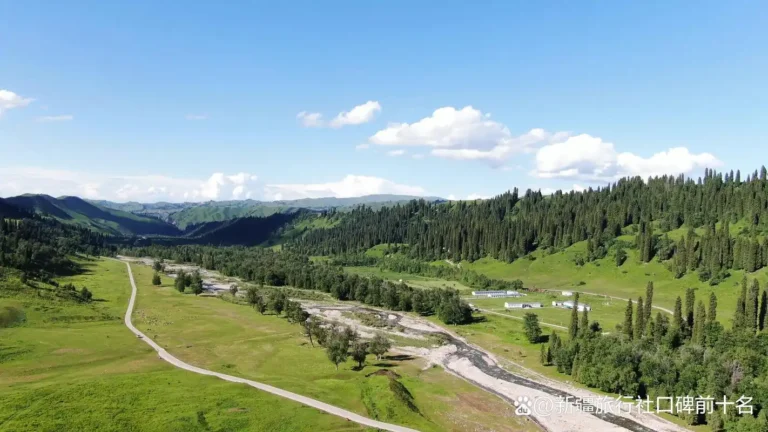
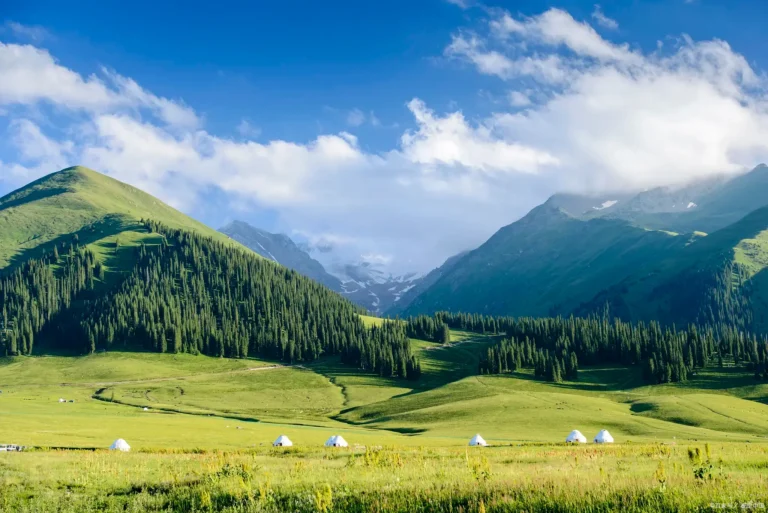
Pishan’s vertical range surprises visitors. The county seat sits on the Taklamakan’s southern rim at 1,100 metres. Within a two-hour drive south you cross the Kunlun foothills at around 3,000 m and the Kirghiz summer pastures above 3,500 m. The southern boundary runs along the Kunlun main ridge and the high plateau continues to the Aksai Chin. You can leave the date palms at Guma in the morning and watch snow drift down by afternoon.
Sangzhu’s walnut grove and the Kiryang snow chrysanthemum
Two of Pishan’s three national geographic-indicator products sit in the same mountain band. Sangzhu town has a heritage walnut grove; locals estimate the largest trees at four to five centuries. Walnuts ripen in early October and are sold at the Guma bazaar and along the G315. Kiryang township, at about 2,800 m in the foothills, grows a yellow-and-red chrysanthemum (Coreopsis tinctoria, locally xueju) that is dried into a tea recognised as a national GI product in 2013. The tea has a sharp, honey-like aroma and stains the cup a deep amber; a small packet costs roughly 30 yuan. For the wider oasis trade, see the Hotan rose jam guide.
Reaching Guma: rail, road and what the timetable really means
Pishan has no airport of its own. The closest is Hotan Kunang (HTN), about 175 km east on the G3012, with regular flights to Urumqi. From Urumqi fly or take the overnight high-speed rail to Kashgar, then connect by Kashgar–Hotan rail to Pishan Station. The line opened for passenger service on 28 June 2011; trains run roughly every two hours and the Hotan–Pishan segment takes about 35 minutes and costs around 15 yuan. By road, G315 runs 15 km through Guma town and S217 branches south into the foothills. For the wider map, the Xinjiang airport guide is the quickest reference.
Where to sleep in Guma and what a room costs
Guma is a small county seat, so hotel stock is limited. The most reliable mid-range choice is the Pishan Hotel, with rooms typically 280 to 380 yuan in summer and 200 to 260 yuan in winter. A Home Inn and a Hanting have opened along the G315 in the last three years and run 180 to 240 yuan. Outside Guma the only proper hotel is at the Yapu Spring Reservoir resort in Abale scenic area, about 25 km southeast of town, with 320-yuan lake-view cottages in autumn. There is no guesthouse in Koshtagh, Sangzhu or Kiryang; day-trip from Guma. For Yarkand as a next stop, see the Yarkand oasis guide.
Eating in Pishan beyond the pomegranate
Yes, there are pomegranates. The Piyaman pomegranate, from Piyalma township southeast of Guma, is a thin-skinned, ruby-seeded fruit with a national reputation; the season runs September to early November and a kilogram costs 8 to 15 yuan at the bazaar. The everyday food in Guma is Uyghur home cooking: girdeh naan dipped in brick tea for breakfast, then laghman (hand-pulled noodles), dapanji (big-plate chicken, often with potato here instead of green pepper), and roasted lamb ribs for dinner. Sheep’s head is a festive winter dish.

For bazaar eating across the southern Silk Road, see the Hotan Sunday bazaar guide. Pishan yam, walnuts, dried mulberries and chrysanthemum packets all travel well in checked luggage.
Dust, water and altitude: staying well here
Three factors shape every visit and are worth understanding before you arrive. Annual evaporation runs at roughly 80 times the rainfall, so dust events are common from March to early May; pack a buff or thin mask. Tap water in Guma is safe after boiling but heavily mineralised, so most travellers drink bottled water. The county seat is mild but the high pastures above 3,500 m are real altitude; plan a slow ascent and avoid alcohol on the first night.
The county’s southern boundary is part of a national border zone. Non-Chinese passport holders must apply in advance for a border permit from the Public Security Bureau in Hotan or Kashgar before entering the high foothills.
A two-day plan built around silk and walnuts
Day 1. Early Kashgar–Hotan train to Pishan Station, store bags at the Pishan Hotel and walk to the Guma bazaar for a girdeh naan breakfast. Taxi south to Koshtagh to see the mulberry rows and the silkworm house; bring a Mandarin-speaking guide if you can. Lunch back in Guma on Guma South Road, afternoon at the Turdi Aghi Manor in Awati, sunset at the Yapu Spring Reservoir.
Day 2. Drive south on S217 to Sangzhu for the heritage walnut grove; in October you can buy a few kilograms directly from the families that tend the trees. Lunch in Kiryang with a bowl of yam and lamb stew, then walk through the chrysanthemum terraces. Return to Guma in late afternoon and take the evening train east to Hotan or west to Kashgar. The Kashgar vs Hotan guide helps you pick a base.
Frequently asked questions
Is Pishan worth a stop if I am already going to Kashgar and Hotan?
Yes, especially between mid-June and late October when both the mulberry sheds and the walnut harvest are active. Plan one full day for the bazaar, manor and Koshtagh, and a second if you want to climb into the foothills.
Can I visit the silkworm house without booking?
Not really. The sheds are working facilities and entry is controlled by the village committee. Email the Pishan culture and tourism bureau a few days ahead through the county government website and they will arrange a guided visit.
Do I need a permit for the Karakoram foothills?
For the lower foothills around Sangzhu and Kiryang, no. For driving beyond the township line toward Kangker, Naobati or the high plateau, a border permit is required from the Public Security Bureau in Hotan or Kashgar.
How cold does winter get?
Guma town has recorded -22.9 °C in January (2006). Snow is rare at the county seat but common above 2,500 m.
Is the food halal?
Yes. Every restaurant serves halal Uyghur food; pork is not on any menu.
Disclaimer
This guide draws on the 1923 Xinjiang Tuzhi, the county portal at ps.gov.cn, a July 2026 report from China News Xinjiang, and the author’s two visits. Prices, schedules and permit rules change frequently; verify before you travel. Travel beyond the formal oases requires a current border permit, and high-plateau roads can close for days between November and April.
About the author
Karl Huang has been writing the Xinjiang Cities series for this site since 2024. He holds a degree in geography and a soft spot for high-altitude deserts. He has travelled every county seat in Hotan Prefecture on foot or by local bus. He is not affiliated with the Pishan culture and tourism bureau or any operator mentioned in this guide.