Published: August 31, 2026 | Author: Karl Huang
Most visitors to Xinjiang meet the Uyghurs, the Kazakhs, the Hans, and stop there. We almost missed the Xinjiang Tatars ourselves. On our second afternoon in Yining we were chasing the blue-doored houses of Kazanqi when a local pointed at a weathered wooden school building and said, in passing, “That one was built by the Tatars.” It sent us down a thread that most travel writing never pulls. The Tatars are one of China’s smallest recognized ethnic groups, a few thousand people at most, but their story in the Ili valley is longer and stranger than their numbers suggest.
Why write this at all? I have spent parts of five trips in Yining and Tacheng between 2017 and 2024, and the Tatar presence kept surfacing in places I did not expect: a bakery’s honey cake, a girls’ school that opened a century before its time, a printing press that put Turkic books on real paper. The notes below are what we learned from those visits and from conversations with people who still remember the old neighborhoods. I have kept the facts checked against published local histories and flagged the bits where memory and record disagree.
Who the Xinjiang Tatars are
The Tatars (塔塔尔族 in Chinese, Tatar in Uyghur) are one of the 56 ethnic groups recognized by the state, and one of the smallest. Nationwide the count sits somewhere around 3,500 to 5,000, and almost all of them live in Xinjiang. They are not a local mountain tribe that slowly drifted into the region. Their ancestors were Volga Tatars, the Turkic-speaking Muslim people of Kazan and the middle Volga in Russia, and they arrived as travelers with tickets and trade ledgers, not as a migrating clan.
That matters for how you meet them. There is no “Tatar village” to point a camera at. Their mark is in city neighborhoods, in food, in old schools and in the rhythm of the bazaars. The community is small enough that you will rarely hear the language spoken aloud on the street, but you will walk past their legacy constantly in Yining.
| Fact | Detail |
|---|---|
| Official name | Tatar (塔塔尔族), one of China’s 56 recognized ethnic groups |
| Population in China | roughly 3,500 to 5,000, almost all in Xinjiang |
| Main homes | Yining (Ghulja), Tacheng, Ürümqi, plus Qapqal and Tokkuztara |
| Ancestry | Volga (Kazan) Tatars of Russia |
| Arrived | late 1800s to the 1920s, via Siberia and Semirechye |
| Language family | Kipchak Turkic, close to Turkish and Bashkir |
| Religion | Sunni Islam, Hanafi school |
| Known for | trade, baking, the first girls’ school in Yining |
See our quick overview of Xinjiang’s ethnic groups for the wider picture, then come back to the Tatar thread below.
A Volga-to-Ili migration
The Tatars did not come in one wave. The first to reach the Ili valley in the late Qing period were merchants and religious scholars who traveled east out of Kazan, crossed the steppe, and found a willing trading partner in the leafy towns of the Ili basin. A larger group arrived during and after the Russian Civil War, when communities on the Volga and in Semirechye were upended and families walked or rode eastward into Xinjiang, where they already had co-religionists and trading contacts.
What struck us in the archive rooms and in conversation was how literate the migrants were. These were not penniless refugees. They carried bookkeeping skills, Russian and Tatar newspapers, and a habit of building schools. Within a generation the Tatars of Yining ran some of the most modern small businesses and classrooms in the town.
Where Tatars live in Xinjiang today
If you want to look, go to Yining first. The Kazanqi district, the old grid of lanes south of the city center, held Tatar, Russian, Uyghur, Hui and Xibe families side by side, and the wooden houses with deep porches are the physical record. Tacheng in the far north is the other strong address, a town with a long Russian and Tatar flavor that we wrote about in our piece on Russian heritage in Yining and Tacheng. Smaller numbers settled in Ürümqi and in the county towns of Qapqal and Tokkuztara.
One honest caveat: the community shrank through the 20th century as people married into neighboring groups, moved to the cities, or left. Today you are more likely to meet Tatar heritage than a Tatar household. That is not a sad story, it is simply the real one, and it is why the buildings and the food carry the memory.
Language, faith and the printing houses
Tatar is a Kipchak Turkic language, closer to Turkish and Bashkir than to Uyghur or Kazakh, though a Tatar in Yining will usually also speak Uyghur, Russian and Mandarin. In Xinjiang the language was traditionally written in an Arabic-based script, and the older generation still reads it. Faith is Sunni Islam, Hanafi, the same school followed by most of the region’s other Muslim peoples, so the mosques they attended were shared neighborhood mosques rather than separate Tatar buildings.
The detail I like best is the printing. Tatar settlers in Yining ran small presses that set Turkic-language books and periodicals in movable type, at a time when most publishing in the region was still handwritten manuscript work. The press is gone, but the reading habit it left behind still shows in the town’s bookshops.
What Tatars brought to the table
This is the part you can actually taste. Tatar cooking leans sweet and careful, the baking of a people who ran the best pastry shops in town. The headline item is chak-chak, small pieces of fried dough bound with honey into a golden mound that shatters when you press it. Nearly as famous is talkysh-kaleve, a pulled-thread halva that looks like a tangle of pale gold strands and melts before you can describe it. Then there is gubadiya, a layered pie with rice, dried fruit and a salty cottage cheese called qort, and pilmän, Tatar dumplings that sit somewhere between manty and a Russian pelmeni.
We chased chak-chak through three bakeries before we found a tray still warm, and the woman behind the counter laughed when we asked if it was “Uyghur.” “Tatar,” she said, and slid us an extra piece. You can read the wider market context in our guide to Xinjiang’s bazaar culture, but the honey cakes are their own chapter.

The Tatar mark on Kazanqi
The single most concrete Tatar site in Xinjiang is the former girls’ school in Yining. Founded by Tatar women in the early 1900s, it was among the first modern schools for girls in the whole region, decades ahead of its time, and it taught in a mix of Tatar, Russian and later Chinese. The building still stands in Kazanqi, a plain two-storey wooden house with a porch, easy to walk past if nobody points it out. That is the building our neighbor mentioned, and standing in front of it reframed the whole neighborhood for us: these lanes were not just picturesque, they were ahead of their era.
The Kazanqi quarter itself is the right frame for all of this. The blue doors and wooden verandas are usually described as “Uyghur old town,” which is true as far as it goes, but the street plan and several of the surviving houses carry a Tatar and Russian hand. Knowing that changes what you photograph.
Getting to Kazanqi and Yining
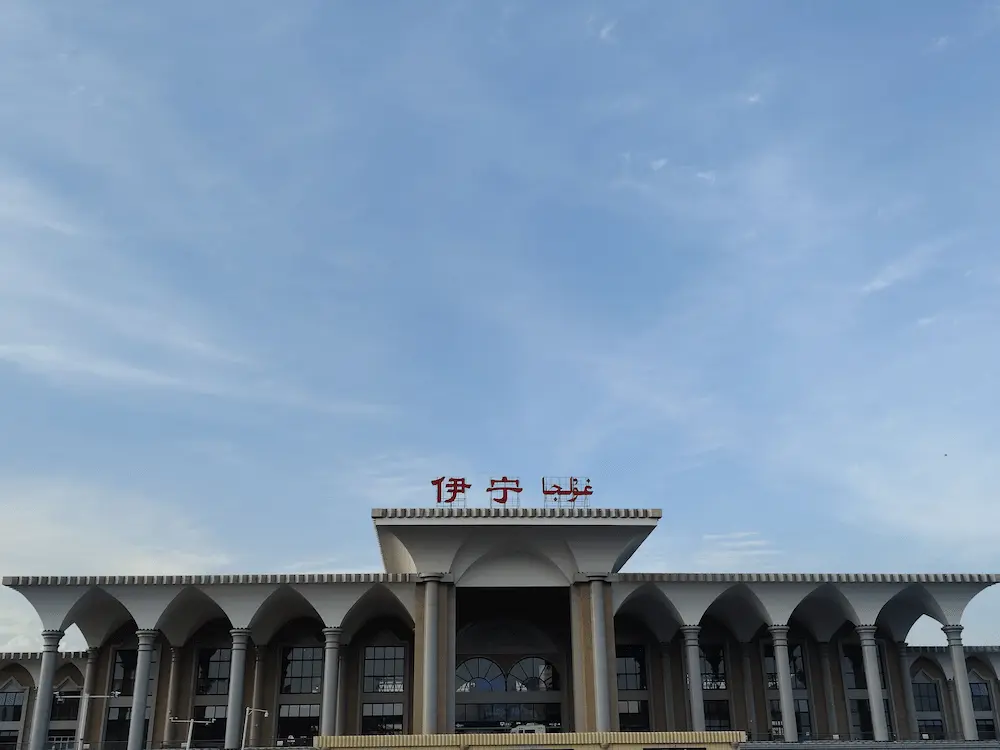
Yining is the hub. Flights run daily from Ürümqi, and the road approach through the Ili valley is one of the gentlest drives in the region. Our Yining travel guide covers the airport, the long-distance bus station and the taxi ride into the old town. Kazanqi sits a short hop south of the center; most drivers know it as the “blue town.”
Within Kazanqi the lanes are pedestrian-scale and uneven, so wear real shoes. There is no entrance fee and no gate; it is a living neighborhood, not a museum, and that is exactly why it rewards a slow walk.
The best time to walk the old town
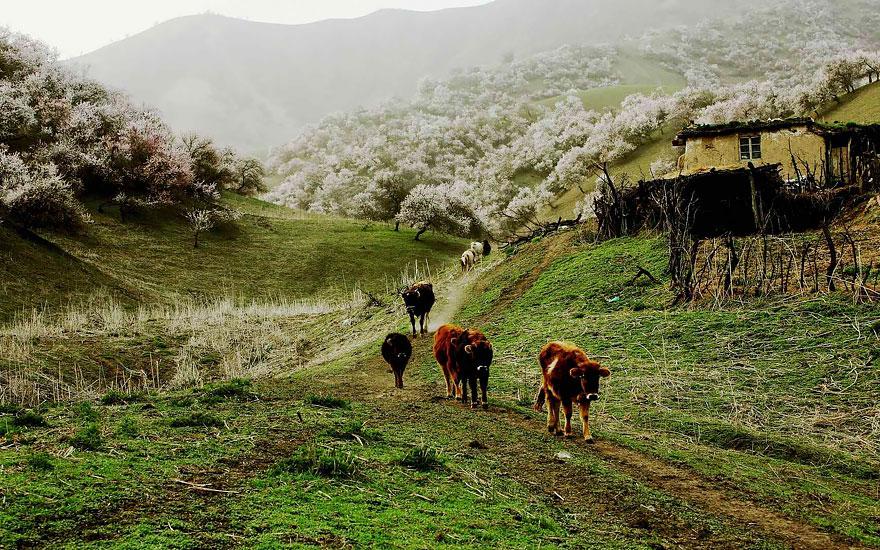
Late April to early June is the window we would pick. The Ili valley greens up, the apricot trees along the lanes throw pink, and the light on the painted woodwork is soft enough to photograph without fighting glare. Autumn, from September to mid-October, is the second choice: cool, clear, and quiet once the summer tour groups thin out. We tried Kazanqi in deep winter once; pretty, but the houses read best with leaves on the trees.
Where to stay while you look
Sleep in Yining itself. The city has a full spread of hotels from budget to mid-range, and staying central means you can reach Kazanqi on foot or by a short ride and avoid the parking tangle inside the lanes. We favor a place within walking distance of the riverfront so the old town is a morning stroll rather than a scheduled tour. Book ahead in May and October, when the valley fills with domestic travelers chasing the same blossoms and the same blue doors.
Meeting Tatar heritage as a visitor
Be honest about scale. You are not going to a Tatar theme park. You are reading a city for the layers it forgot to erase. Start at the former girls’ school, walk the wooden lanes, buy chak-chak from a bakery that has been there longer than the sign suggests, and listen for the older residents who still call the quarter by its mixed name. If a door is open and someone invites you in for tea, that is the real encounter, and the one we remember best.
Respect is the whole game. These are private homes. Photograph the streets, not the courtyards, unless you are waved in. Learn one phrase of greeting. The community is small and proud, and a visitor who treats the neighborhood as a living place, not a backdrop, gets far more out of it.
A half-day walk through Kazanqi
Make it a morning. Arrive at the lane mouths around nine, when the bakeries are firing their first trays and the light is flat. Spend forty minutes on the wooden houses south of the main drag, find the old school building, then loop back toward the bazaar for chak-chak and a glass of milk tea. By noon the tour groups arrive and the light hardens, so quit while it is good. If you still have energy, the riverside walk back to the center is the calmest end to the morning you will find in the city.
Frequently asked questions
Are the Xinjiang Tatars the same as the Tatars of Russia? Same people, different passport. The ancestors came from the Volga and Kazan region of Russia, and the language and food are continuations of that heritage, adapted to life in Xinjiang.
Is there a Tatar village to visit? No single village. The heritage is concentrated in Yining’s Kazanqi quarter and in Tacheng, expressed through houses, schools, bakeries and bazaars rather than a separate settlement.
Will I hear the Tatar language spoken? Unlikely on the street. The community is small and bilingual or trilingual; you are more apt to meet the culture through food and architecture than through conversation.
Can I go inside the old girls’ school? It is a protected old building and sometimes hosts small exhibitions, but access changes. Treat it as a landmark to view from the lane, and ask locally on the day.
What should I eat to taste Tatar influence? Chak-chak and talkysh-kaleve halva are the signatures. Ask for them by name at a Yining bakery rather than assuming every sweet in the bazaar is the same.
Disclaimer
This piece is based on personal visits to Yining and Tacheng between 2017 and 2024, on conversations with local residents, and on published local histories available at the time of writing. Population figures, dates of migration and the history of the girls’ school vary between sources, and some details rest on oral memory as much as on record. Buildings change use, bakeries open and close, and access to heritage sites shifts with local policy. Confirm current conditions with official tourism sources before you travel, and always ask before photographing or entering private homes. Nothing here is official advice.
About the author
Karl Huang is a travel writer who has covered Xinjiang’s towns, trade routes and minority communities since 2017. He prefers the small stories behind the famous landscapes, and has written guides to the region’s ethnic heritage, old towns and bazaars for Xinjiang Attractions.