Published: 10 October 2026 | Author: Karl Huang
Most travellers meet Bosten Lake in summer, when the reed beds rustle and the water seems to go on forever. We went in January, on purpose, because a Bosten Lake winter is a different country. The surface locks into a grey-blue sheet you can walk across, the cut reed stubble pokes through the snow, and the only sound for long stretches is the grind of an auger biting into ice. This is a diary of a real ice-fishing trip based out of Yanqi, not a polished tour brochure, and we have kept the awkward parts in.
Trip facts at a glance
| Item | Detail |
|---|---|
| Where | Bosten Lake (Bosten Hu), accessible north shore near Yanqi and Bohu counties, Bayingolin Prefecture, Xinjiang |
| Ice season | Late December through late February, weather and ice thickness permitting |
| What you fish | Oriental bream (bian), common carp, and perch, pulled through drilled holes |
| Base town | Yanqi Hui Autonomous County, about 21 km from the lake’s reachable north side |
| Gateway | Korla (KRL airport and rail hub), roughly one hour by car to Yanqi |
| January temperature | Daytime around -10 C, nights near -18 C, colder with wind on open ice |
| Permit | Fishing on designated winter lots; arrange through a guesthouse or licensed operator |
| Our trip | 3 days, 2 nights, mid-January |
If you want the broad picture before the cold details, our longer write-up on Bosten Lake covers the lake’s size, ecology, and summer side. This page is only about the frozen months.
Why I kept a January diary instead of writing a guide
A guide pretends to be complete. A diary admits it is not. We spent three days on and around the lake and learned just enough to be useful, plus a few things the hard way. I am not a professional angler. I am someone who travels Xinjiang in the off months and writes down what actually happened, because the off months are when the region stops performing for visitors and starts being itself.
The honest version is more useful than the clean one. On our second morning the wind came up and the ice fishing stopped being fun and started being a question of whether we could feel our hands. That belongs in the story. So does the fact that the fish we caught were modest, and that the best meal came from a roadside pot, not from our line.
Rolling into Yanqi as the lake turned to glass
We took the morning train from Urumqi and changed at Korla, then a shared car the last stretch to Yanqi. By the time we reached the county seat the light was the flat white of deep winter, the kind that makes every building look like a paper cutout. The guesthouse owner, a retired railway worker, took one look at our gear and said the ice was “thick enough, but bring the red thermos, not the blue one.” We never found out why the blue one was inadequate. We brought the red one.
Yanqi itself sits in wine country, and in January the vine rows are bare stakes marching toward a pale horizon. If you want context on the county beyond fishing, our notes on Yanqi county explain why this small place punches above its weight. For us it was simply warm beds and hot basins of tea between fishing sessions.
What ice fishing on Bosten Lake really looks like
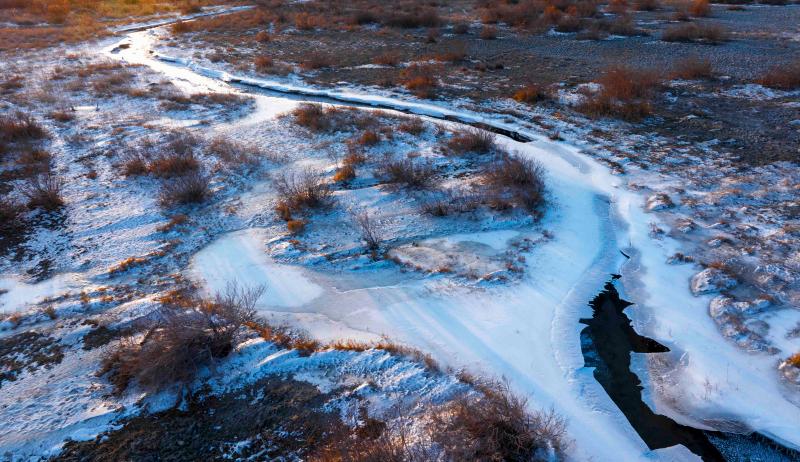
Forget the postcards. Out on the north shore the lake is a kilometres-wide pane of ice, with snow blown into low ridges and the occasional flagged marker showing where someone has already cut a hole. You do not need a boat. You need an auger, a stool, a short rod, and the patience to sit while your breath freezes on your collar.
The local method is unhurried. A hole roughly fifteen centimetres across is drilled through perhaps half a metre of ice. A small jig or a line with a couple of hooks goes down. Then you wait, sometimes with a tiny electronic finder, sometimes just with experience. The first fish we pulled was a bream no longer than my hand, and the man next to us nodded as if to say that was about right.
Augers, shelters, and the local method
Most casual visitors rent gear from operators who set up on the permitted lots. A manual auger is lighter and quieter than a powered one, and on a still morning the manual version is the one you hear from far away, a rhythmic complaining sound that becomes the soundtrack of the shore. Shelters range from a folded windbreak to a pop-up tent with a heater, and on a windy day the tent stops being a luxury and becomes the only reason you stay.
Locals fish with a calm efficiency we never matched. They pre-mark spots, they bait with small routines, and they pack up the moment the light goes. We learned to copy the packing-up part first. The fishing part came slower.
What to bring mattered as much as the gear. Layer like you are wrong about the temperature: a wicking base, a fleece, and a wind shell, plus a second pair of gloves you can swap when the first freezes stiff. Insulated boots with felt inners were the difference between a good day and a miserable one. We also carried chemical warmers for the pockets and a thermos that was never just water; sweet milk tea kept us out there an extra hour each morning.
Reaching the frozen shoreline from Korla
Korla is the logical base for anyone arriving by air or long-distance train, and our full Korla travel guide lays out the transport options in detail. From Korla to Yanqi it is a short hop by frequent bus or shared car. From Yanqi to the lake shore, most people arrange a ride through their guesthouse, because public transport thins out in winter and the last few kilometres are unmarked tracks across frozen farmland.
Do not try to drive onto the ice yourself unless you know the spot and the thickness. The safe lots are chosen by people who measure. We paid a small fee to fish on a managed stretch and considered it the cheapest insurance we bought all trip.
Reading the ice: thickness, safety, and timing
This is the part that matters more than any fish. Ice needs to be at least about fifteen centimetres thick for a person on foot, and more if you plan to sit in a shelter or run a heater. After a warm spell or near where a channel meets the open lake, thickness can drop fast. We asked the operator to drill the test hole, watched the colour of the core, and only then set the stools.
Best timing within the season is mid-January to early February, after the ice has settled and before the late-winter thaw begins to weaken the edges. Calm, clear days are better than sunny windy ones; wind on open ice cuts through every layer you brought. Go out early, fish the cold morning bite, and be off the ice by mid-afternoon when the surface starts to soften near the shore.
Sleeping in Yanqi between fishing mornings
Yanqi has the usual range of county-town hotels: clean, warm, and inexpensive, with the bonus of being walking distance from food stalls that open late. We stayed near the main road and counted it a win that the heating worked and the shower was hot, because both matter more after a day on the ice than any star rating.
Book ahead only if you are travelling on a holiday week; in ordinary January you can usually walk in. Ask at the front desk about a winter fishing operator rather than trusting random listings, since the reliable ones are local and word-of-mouth.
From the hole to the table: winter fish in Yanqi
The fish from Bosten Lake taste of the place, mild and clean, and in winter they are at their firmest. We ate better than we caught. A nearby kitchen cooked our modest haul as a simple fried plate and a sour cabbage soup, and either beat anything we managed on the rod. For the fuller story of how this lake’s fish reach the plate across the region, see our piece on Bosten Lake fish.
Beyond fish, Yanqi’s Hui kitchens serve hand-pulled noodles, stuffed buns, and sweet tea that fixes cold hands faster than gloves. We made a habit of the noon bowl and regretted nothing.
One January day on the ice, hour by hour
07:30 – Wake to a room that is warmer than the window suggests. Tea, then layers, then the red thermos.
08:45 – Ride to the managed lot. The operator drills the first hole while we stamp our feet.
09:30 – Lines down. The morning bite is real but small. Two bream, one perch, many cold fingers.
11:00 – Wind arrives. We retreat to the tent, eat something hot, and watch the flagged holes across the ice.
12:30 – Pack up. The shore ice is already softening. We are off the lake well before it matters.
13:30 – Late lunch in Yanqi, fish and noodles, then a long sleep.
16:00 – Walk the bare vine rows, buy nothing, watch the light go flat white again.
19:00 – Early dinner, early bed. The lake will still be there tomorrow, frozen and waiting.
Questions people actually ask about Bosten Lake ice fishing
Is it safe for beginners? On a managed lot with an operator who drills and checks the ice, yes, within reason. Never go solo onto unknown ice.
Do I need my own gear? No. Rentals and guided setups are available on the permitted winter lots near Yanqi and Bohu.
Will I catch anything? Usually something small, sometimes nothing. Treat the catch as a bonus, not the point.
How cold does it get? Plan for -10 C days and -18 C nights, worse with wind. Dress for the worst hour, not the best.
Can I drive onto the ice? Not advised unless you are with someone who measures thickness daily. Use the managed lots.
A note on safety and accuracy
This diary describes a single mid-January trip and should not be read as a guarantee of conditions, prices, or access. Ice thickness, permits, and operator availability change year to year and with the weather. Always confirm locally, fish only on designated lots, and never trust a frozen surface you have not measured. We are not fishing professionals, and nothing here is formal advice; it is one visitor’s account, written to be honest about what went well and what did not.
About this diary’s author
Karl Huang is a Xinjiang-based travel writer who prefers the quiet months. He has spent several winters moving between the region’s frozen lakes and county towns, documenting practical details for visitors who arrive outside the peak season. His reporting draws on first-hand trips, conversations with local operators, and official tourism and transport information where available.
Questions travelers ask about Bosten Lake in winter
What is Bosten Lake known for in winter?
Ice fishing on the frozen lake and the January harvest, when locals cut holes in the ice and pull up fat freshwater fish.
How do I get to Bosten Lake?
From Yanqi or Korla by road; the lake is about one hour from Korla on a straightforward winter drive.
Is it cold?
Very – plan for minus double digits, dress in layers and keep cameras and phones warm.