Published: 11 October 2026 | Author: Karl Huang
Turpan’s karez are easy to miss from a moving car. All you see is a string of low, doughnut-shaped mounds of earth marching in a line across the gravel, and unless somebody explains them, you would never guess a river runs beneath. The Turpan Karez Museum exists to close that gap, and it does the job better than any roadside sign. We spent a slow morning there on our most recent trip, and it reset how we read the whole basin afterwards: the vineyards, the poplar rows, the gullies that are not really dry at all.
This is a visitor’s account, not a rewrite of a tourism leaflet. I paid for our tickets, walked the underground section myself, and checked the figures below against Turpan municipal and irrigation sources. Where a number shifts from year to year, I say so.
| Item | Detail |
|---|---|
| What it is | A dedicated karez museum inside the Karez Folk Customs Park (坎儿井民俗园), Turpan |
| Where | Ya’er township, Gaochang District, on the southern edge of Turpan city |
| Opened | June 2007, built for about 2.4 million yuan |
| Size | Roughly 500 sq m of above-ground exhibits plus a 100 m-plus walkable underground channel |
| Core exhibits | Sand-table model, distribution map, cross-sections, old digging tools, photos, a grape corridor and a raisin-drying house |
| Turpan’s karez today | About 1,108 of Xinjiang’s roughly 1,540 karez; underground channels total more than 3,400 km |
| Heritage status | Turpan karez joined the World Heritage Irrigation Structures list on 3 September 2024 |
| Entry | The museum sits inside the park; park entry is about 40 yuan for adults, around half for seniors |
| Hours | Roughly 08:30 to 21:00 in the warm season; confirm on the day |
| Underground temperature | Cool and steady, about 13 to 16 degrees C, whatever the surface is doing |
The Sand Table That Finally Made It Click
The first thing you meet inside is a physical model, and it is worth standing at for a while. The sand table lays out a strip of the Turpan basin in miniature: a wall of mountains at one end, a fan of gravel in the middle, and a patch of green at the far end. A dotted line of vertical shafts runs across the gravel, and beneath it a dark tunnel carries a thin blue thread of water downhill until it surfaces at the fields. Scale models can be gimmicks. This one is not, because it shows the one thing a photograph cannot: that the water never travels above ground until the last possible moment.
Beside the model, the museum hangs a distribution map of Turpan’s surviving karez and a set of cross-sections. The grape corridor and raisin-drying house in the park belong to the same story. Once we had seen the model, the green we had driven past stopped looking like scenery and started looking like plumbing.
Walking the 100-Metre Replica Tunnel
From the hall you step down into the section that most people come for. The temperature drops as you descend, and the noise of the street disappears. A walkway runs beside a shallow channel of moving water, with rough timber posts along the edge and a low, arched ceiling of packed earth overhead. The wall carries a painted sign that translates as “karez, one of the three great engineering works of ancient China”, the same claim you will hear from guides about the Great Wall and the Grand Canal.
Be clear about what you are walking through: a reconstructed, dressed section of a working karez, not a raw excavation. It is built so an ordinary visitor can see inside the system safely. For the deeper mechanics of how a karez moves water through a kilometre of gravel, our explainer on how Turpan’s karez wells still work covers it. What the museum adds is the sensation: cool air, the sound of water that has travelled underground for kilometres, and a human-height sense of how cramped the real thing must be.
Four Parts, One Invisible Engine
The museum organises everything around four components, and once you know their names the whole landscape starts to make sense.
The vertical shafts (竖井) are the row of mounds you see from the road. Each one is a well dug down to the tunnel line, spaced tens of metres apart, and they served three jobs at once: they let workers and spoil move up and down, they ventilated the tunnel, and they fixed the line during construction. Two low-tech tricks kept a tunnel straight between them: one hung a cord with a stick from each shaft so diggers could aim at the point where the two sticks pointed, and the other placed an oil lamp on the centre line so a worker could follow his own shadow.
The underground channel (暗渠) is the water carrier and the reason the system exists. The open channel (明渠) is the short stretch once the water reaches the surface, usually a few hundred metres to the fields. The reservoir (涝坝), a small settling pond, stores and warms the water before it is released onto the crops. Nothing here is powered; it all runs on the slope of the ground and gravity.
Why the Water Stays Cold, Clean and Evaporation-Proof
The underground design is a direct answer to Turpan’s climate. This is the driest corner of China, with average rainfall of only around 16 mm a year but evaporation of more than 3,000 mm, so any drop left in the open simply leaves. By keeping the channel buried, the karez cuts evaporation to almost nothing, and by running the water through sand and gravel it filters it as it travels, which is why many karez are clean enough to drink untreated. The depth also holds the water at a steady, cool temperature, cool enough that the tunnel feels air-conditioned on a 40-degree day and warm enough that it does not freeze in winter.
When to Come, and Why Summer Is Worth the Heat
The mild windows in Turpan are spring, roughly April to May, and early autumn, September to October. Those are the months when you can walk the above-ground exhibits and the park without wilting, and early autumn also lines up with the grape harvest. High summer, July and August, is genuinely brutal on the surface, with temperatures that push past 40 degrees C.
That said, summer is the one time when the museum’s design pays you back. The tunnel stays at about 13 to 16 degrees C no matter what happens above, so on a punishing afternoon it becomes the coolest place in Turpan, and sitting in it feels less like sightseeing and more like relief. Winter is quieter: the karez flow all year and the exhibit hall stays open, but the park around it is bare and the outdoor displays lose context without the vineyard greenery.
From Drying Wells to the 2024 World Heritage List
The museum does not pretend the story is only about the distant past. One section sets out the modern decline: through the 1990s and up to about 2003, Turpan lost karez at a rate of dozens a year as motorised pumps pulled the water table down faster than the tunnels could refill. One researcher warned the system could vanish within a generation at that pace.
What followed is why there is still something to visit. From 2009 Turpan ran a protection programme that spent close to 100 million yuan across seven phases, reinforcing 165 karez, shoring up more than 15,000 shaft openings and dredging almost 800 km of channels. Motorised wells near the shafts were shut down and the water table stopped falling. Recognition came in two stages: on 3 September 2024 the Turpan karez joined the World Heritage Irrigation Structures list, and in January 2025 it entered the reserve list for China’s Globally Important Agricultural Heritage Systems.
The Museum vs Turpan’s Other Karez Sites
Turpan has more than one place to see a karez, and travellers often muddle them. The museum in this article sits inside the Karez Folk Customs Park (坎儿井民俗园), which pairs the exhibit hall and walkable channel with courtyard Uyghur houses. A second site, the Karez Paradise (坎儿井乐园), a 4A park, claims Xinjiang’s first professional karez museum and has several real karez running through it. A third, the Jiaohe Post and Karez Source (交河驿·坎儿井源), lowers visitors about 60 metres by lift into a deep shaft with a more multimedia treatment. For one visit, the Folk Customs Park gives the best mix of explanation and hands-on tunnel walking; for the deepest shaft, choose the Jiaohe site.
Tickets, Hours and How to Get There
The park sits on the southern edge of Turpan, a ten to fifteen minute taxi ride from the centre and cheap by any standard. From Urumqi, the high-speed train to Turpan North takes about an hour, and the expressway drive is roughly two and a half hours, so the museum works as a half-day stop rather than a full expedition.
Expect park entry of around 40 yuan for adults, senior tickets at roughly half, and free entry for children and some serving military categories. The ticket covers the museum, so you do not pay twice to go underground. In the warm season the site has generally opened from about 08:30 to 21:00, but hours and prices move with the season, so treat those as a guide. Foreign visitors should carry a passport, since the park records visitor identity like most attractions in Xinjiang. Payment is easiest by WeChat Pay or Alipay, with a little cash as backup.
What to Wear and Carry Into the Tunnel
Dress for two climates in one building. The surface can be scorching and the tunnel cool and a touch damp, so a light long-sleeved layer you can pull on below ground is the most useful thing to bring. Wear shoes with grip, because the walkway beside the water can be slick. Carry water for the above-ground sections and skip the tripod, since the light underground is low and flash is restricted in places. The underground stretch is short and flat, so it suits most fitness levels, families included.
A Two-Hour Museum-First Afternoon
Our own rhythm worked well and needs no rushing. Arrive in the late afternoon, when the light softens, and give the exhibit hall twenty minutes before you go down. Spend as long as you like in the tunnel, then walk back through the grape corridor and the courtyard at an easy pace. That fills roughly two hours without strain. From there, drive east toward the Flaming Mountains for the last hour of daylight, the best time to see them, and keep the vineyards for the following morning.
Pairing It With Grape Valley and the Flaming Mountains
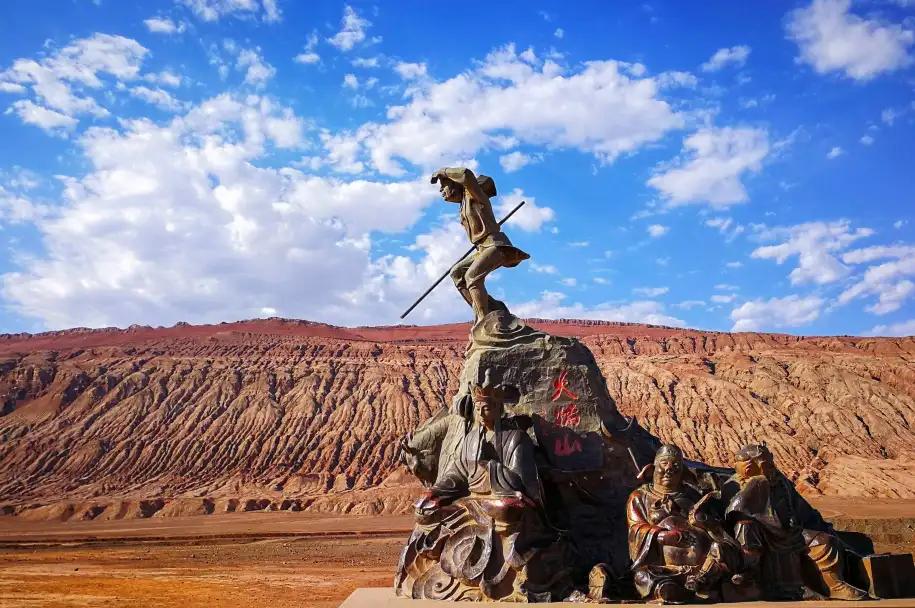
The museum sits well inside a natural Turpan loop. The Grape Valley is a short drive to the northeast and is the greenest place in the basin, a narrow gorge of trellised vines and cold streams that shows what a karez-fed oasis looks like in working order; our Grape Valley guide covers the timing and the walk. The Flaming Mountains lie further east, a band of eroded red ridges that glow at sunset and that most travellers recognise before they arrive; our Flaming Mountains guide explains the overlooks and the heat. Put the museum, the valley and the mountains in a single day and you have seen the three faces of Turpan: the water, the green it buys, and the dry rock it crosses. For a longer stay, the full Turpan travel guide pulls the rest of the city into a route.
Frequently Asked Questions
Is the Turpan Karez Museum worth visiting?
Yes, if you want to understand the engineering rather than just photograph the spoil mounds from a car. It is a small museum and will not take a whole day, but the underground walk gives a body-level sense of the system that no signboard can.
Can you actually go inside the underground channel?
Yes. The museum includes a reconstructed section of channel, more than 100 metres of walkable tunnel, where you go down beside a flowing water channel. It is dressed for visitors rather than left as a raw dig, but the temperature, sound and confinement are real.
How long should I allow for the museum?
Around two hours is comfortable if you read the exhibits and take the tunnel slowly. If you are tightly scheduled, ninety minutes still covers the hall and the underground stretch.
Is it suitable for children or older visitors?
Generally yes. The underground section is short and level, with no climbing, and the cool air is a relief in summer. The main things to plan for are the temperature drop and slippery floors, so bring a light layer and wear shoes with grip.
Disclaimer
Opening hours, ticket prices and the layout of the exhibits can change, and Turpan’s summer heat and winter closures affect the park from time to time, so confirm details before you travel. This article is a personal travel account checked against Turpan municipal and irrigation-authority sources, not official advice, and I am not responsible for a changed price, a closed section or a cancelled visit.
About the author
Karl Huang is a China-based travel writer who covers Xinjiang’s history, landscapes and practical logistics. He writes about places he has visited and checks figures against regional government and heritage sources rather than second-hand blogs.