Published: 02 September 2026 | Author: Karl Huang | Last updated: 02 September 2026
Almost everybody who flies into Xinjiang ends up with a few hours in Urumqi they did not plan for. The city is the region’s air hub and a Urumqi airport layover is usually somewhere between two and nine hours. I have connected through URC more than a dozen times since 2017, on both sides of the terminal change in April 2025, and my honest summary is this: the airport got a great deal better and the city got slightly harder to reach in a hurry. What follows is organised around the clock rather than around a list of sights, because during a layover the only question that matters is how much time you really have.
Quick reference: Urumqi airport layover at a glance
| Question | Short answer |
|---|---|
| Airport name and code | Urumqi Tianshan International Airport (URC), renamed from Urumqi Diwopu in March 2025 |
| Terminals in use | T4 only. T1, T2 and T3 closed on 17 April 2025 and are being handed over to cargo use |
| Distance to the centre | About 16 km northwest of Hongshan and People’s Square, in Xinshi District |
| Cheapest reliable transfer | Free airport people-mover to International Airport Station, then Metro Line 1: roughly 30 minutes to Erdaoqiao, CNY 5-7 |
| Taxi to the centre | CNY 40-80, about 30 minutes off-peak, 45 to 60 minutes in the evening rush or in snow |
| Realistic minimum to leave and return | Two and a half hours on a domestic connection, three on an international one, with no slack for delays |
| Can foreign passport holders go into the city? | Only with a temporary entry permit from border inspection. URC is not on China’s 240-hour transit port list |
| Sleeping | A transit hotel attached to the ground transport centre, plus pay-in lounges airside |
Before anything else: can you leave the airport?
This decides everything else. The first case is easy: a domestic-to-domestic connection involves no immigration at all. If your bags are checked through, you never see the landside part of the building.
The second case is an international connection on a foreign passport. China runs a nationwide 24-hour direct transit exemption at every open port, for all nationalities: hold a confirmed onward ticket to a third country or region, stay inside the port area, be gone within 24 hours, and you need no visa. The moment you want to step outside the port area, and a trip into Urumqi counts, you need a temporary entry permit from border inspection, which is discretionary.
The third case is where the bad advice lives. China’s 240-hour visa-free transit scheme covers 57 nationalities and 65 ports across 24 provincial-level regions; Urumqi is not among those ports. In November 2025 the regional commerce department, customs, border inspection and the civil aviation authority published measures that include exploring a pilot of the scheme at Urumqi. That is a proposal in a policy document, not a rule you can use at the counter.
There is a much better route for many travellers, though. China’s unilateral visa-free entry, normally 30 days, covers dozens of nationalities and the list is revised several times a year. If your passport is on it, none of the transit machinery applies: you arrive as an ordinary visitor and walk out.
The arithmetic to finish on. Budget 45 to 60 minutes for the permit and border formalities on the way in, and be back at the terminal two hours before a domestic departure or three before an international one. Add 60 to 90 minutes of round-trip transfer, and a four-hour international connection is not a city trip.
What changed in April 2025, and why it matters to you
T4 opened on 17 April 2025 and the old T1, T2 and T3 closed the same day. The upside is that terminal confusion is over: China Southern, Air China, Hainan, Urumqi Air and the international carriers to Almaty, Bishkek, Tashkent and Islamabad are all under one roof now.
The downside is scale. T4 covers something in the order of 500,000 square metres, with three piers and close to 70 contact gates. The walk from the far end of a pier to the arrivals hall is a genuine fifteen minutes with a bag, and I have done it at something close to a jog. Check your gate number before wandering off for coffee, and if you are heading into the city, start walking out earlier than feels necessary.
The other change is the people-mover. A free automated shuttle links T4 with International Airport Station, the northern terminus of Metro Line 1, and with the ground transport centre where the transit hotel, the bus bays and the coach ticket office sit. T4 also has, for the first time at a Xinjiang airport, a dedicated international-to-domestic transfer corridor.
The three ways into the city, ranked by layover length
Metro Line 1 is what I use whenever I have more than five hours. Take the people-mover to International Airport Station, ride south, and you are at Erdaoqiao for the Grand Bazaar in about half an hour for CNY 5 to 7, with no exposure to traffic. Trains run from roughly 07:40 to 23:30, and every station has a security screen, so add a couple of minutes for the bag check.
A taxi or a Didi is the right answer for three to five hours. It costs CNY 40 to 80, takes half an hour at midday and up to an hour in the evening rush or in snow, and it is door to door.
Airport buses to Hongshan and the railway station run around CNY 15 to 20 and take 50 to 60 minutes, worth considering only when the metro has stopped for the night. The network is covered in more detail in our Urumqi metro and bus guide.
Under three hours: stay inside and pick a good seat
Be honest with yourself. On an international connection you have inbound immigration, possibly a baggage reclaim, a re-check, outbound immigration and security to get through, and none of that gets faster because you would like a plate of pilaf. Free Wi-Fi covers the terminal, though you need to authenticate with a phone number or a passport scan. The domestic side has a China Southern lounge on the third floor and a pay-in lounge near the central security channels. The far ends of the piers are quieter than the central concourse.
Three to six hours: one neighbourhood, one meal
Pick exactly one. Erdaoqiao and the International Grand Bazaar are the obvious choice because Line 1 takes you there directly and because the bazaar works at any hour. Give yourself two hours, eat, and go back. The trap at this length is trying to fit the bazaar plus Hongshan plus the museum; you will spend the whole layover in transit.
If you have a little more room, Hongshan Park is free, sits on a cliff above the centre, and on a clear day gives you the Tianshan ridge behind the skyline. It is a 40-minute stop.
Six to ten hours: museum, bazaar, and a proper sit-down meal
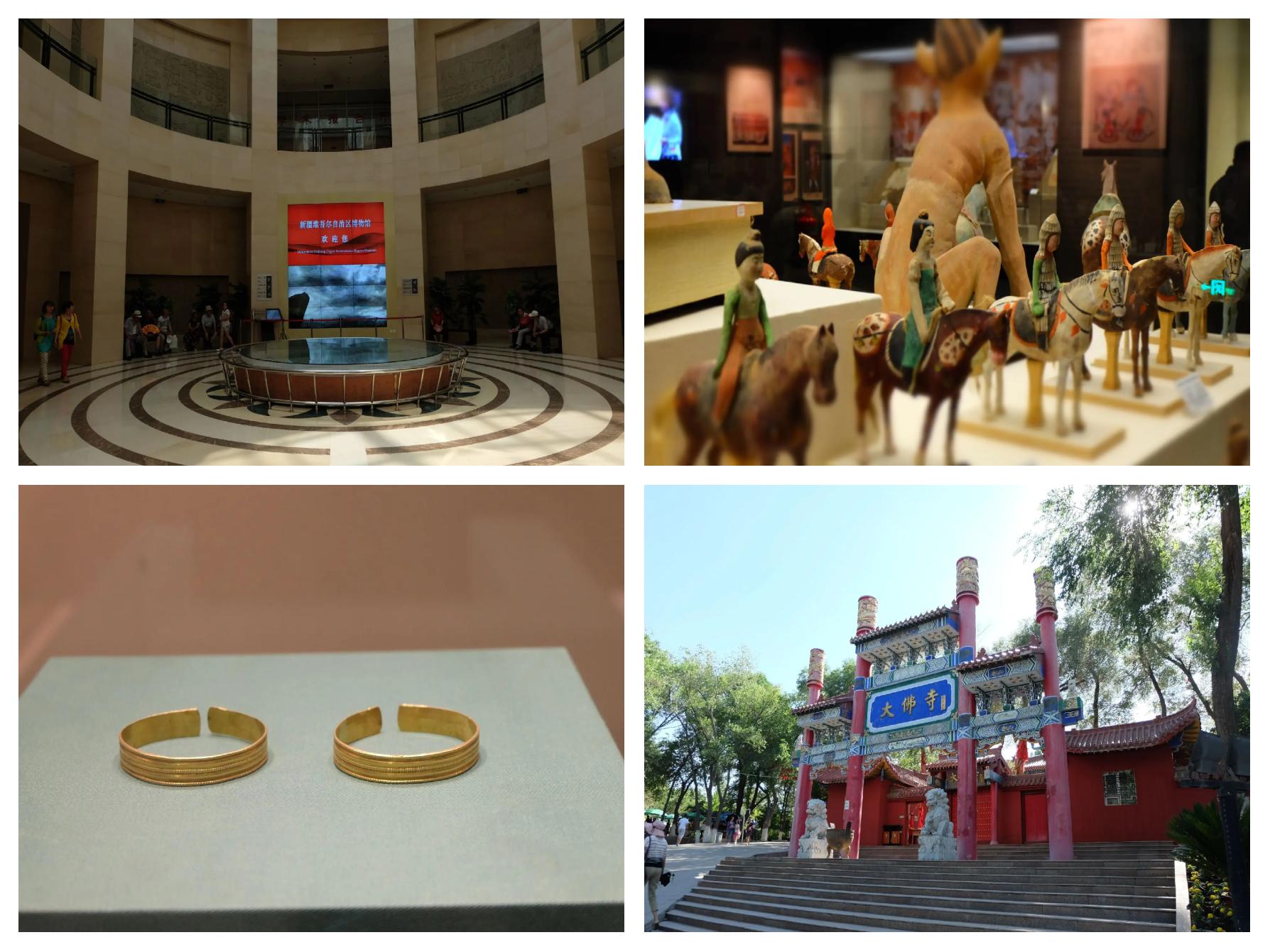
At this length you can do two things properly. Start with the Xinjiang Museum, which is free, closed on Mondays, and holds the Tarim Basin mummies that make every other museum in the region feel like a footnote. Ninety minutes is enough for the main halls. Then take a taxi or the metro to Erdaoqiao for lunch, and if you still have two hours left, add Hongshan for the view.
Note the sequencing: museums close, food does not. Our Urumqi city guide covers the neighbourhoods in more depth.
What to eat, given the clock
Fifteen minutes buys you samsa, the baked lamb-and-onion parcels that come out of the tandoor ovens in a constant stream. They cost a few yuan each and you can eat three standing up.
Forty-five minutes buys you a plate of pilaf: rice, carrot, onion and lamb cooked in its own fat, served with a small salad and tea. It is the most reliable order in Xinjiang and it arrives fast.
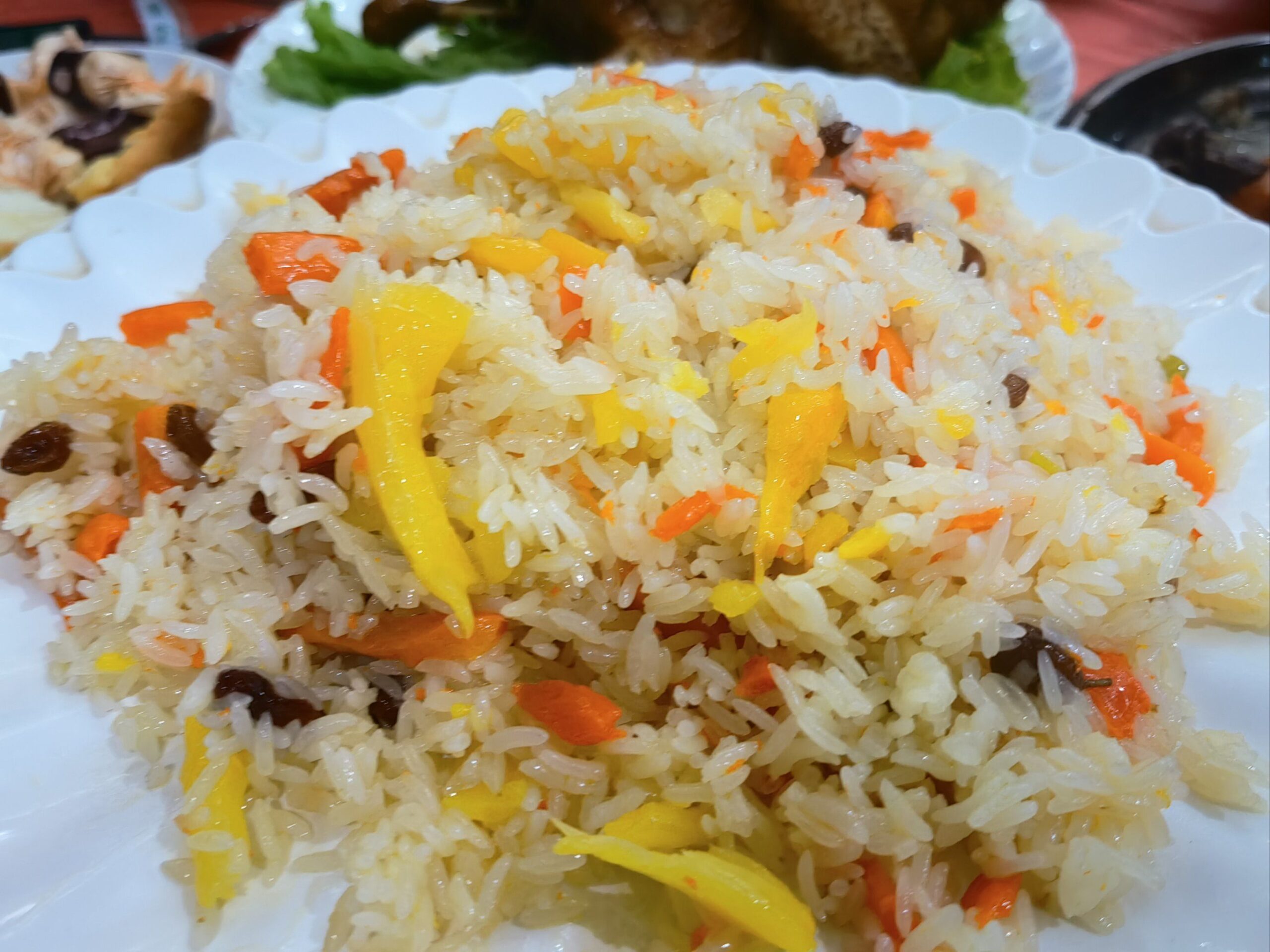
Ninety minutes opens up laghman and skewers, which is what I would actually choose: hand-pulled noodles with a stir-fried lamb and pepper topping, then cumin-and-chilli skewers off the grill, then tea. Inside the terminal the options are the usual international fast food plus a handful of local counters, which are fine and are not why you came.
A seven-hour layover, hour by hour
Hour zero: land, clear formalities, drop any bag you do not need at the left-luggage counter. Hour one: people-mover and Metro Line 1 to Erdaoqiao, . Hours one to three: bazaar, tea, samsa. Hour three: taxi to the museum, ninety minutes inside. Hour five: pilaf or laghman on the way back north. Hour six: back to the airport, security, outbound immigration, gate. That leaves an hour of slack, roughly the amount a layover needs.
Overnight and red-eye: where to sleep
There is a transit hotel attached to the ground transport centre, reachable without going outside, and it is the right answer if your connection runs past midnight. Book ahead in summer. Airside, the lounges close overnight and you are left with bench seating, which is survivable but not restful.
Winter deserves a warning. URC sits in a hollow that collects fog, and January and February bring low visibility and heavy snow. Diversions to Turpan Jiaohe, the designated core alternate about 200 km southeast, are a normal operational event rather than a rare one.
Mistakes we have made so you do not have to
Assuming the bags are through-checked: on separate tickets they almost never are, and finding out at the carousel costs half an hour. Underestimating the size of T4, which I have now done twice. Believing the 240-hour transit scheme applies at Urumqi. Leaving the airport on a four-hour international connection, which ends with a sprint and no meal.
And one that catches people who plan with a map rather than a road: Chaiwopu Lake and the Dabancheng wind farms and salt lakes look close to Urumqi on a regional map, but they sit on the far southeast side of the city, on the road to Turpan. From the airport, in the northwest, that is a long cross-town drive.
Frequently asked questions
Is four hours enough to leave Urumqi airport?
On a domestic connection, just about, if the bags are checked through. On an international one, no: between the permit, formalities and the round trip, four hours leaves no margin.
Do I need a visa for a layover at Urumqi?
Not if you stay inside the port area for under 24 hours with a confirmed onward ticket to a third country or region. To enter the city you need a temporary entry permit from border inspection, a regular visa, or a passport covered by the unilateral visa-free scheme. URC is not a 240-hour transit port.
How far is the airport from the Grand Bazaar?
About 22 km. Metro Line 1 runs there directly in roughly half an hour; a taxi costs CNY 50 to 70.
Can I sleep in the terminal?
Yes, but not well. Bench seating is the only free option; the transit hotel in the ground transport centre is the comfortable one, and it fills up fast.
Is there left luggage at T4?
Yes, in the ground transport centre, where the people-mover delivers you.
Can I visit Tianchi during a layover?
Almost certainly not. Heavenly Lake is roughly two hours’ drive from the airport in each direction.

Metro or taxi?
Over five hours, the metro, because it is immune to traffic and costs almost nothing. Under five hours, a taxi, because the door-to-door saving is worth more than the fare.
Disclaimer
This guide reflects connections I have made through Urumqi between 2017 and 2026, plus the terminal layout in place since T4 opened on 17 April 2025. Transit and visa rules change frequently and are applied at the discretion of border inspection officers; the National Immigration Administration is the only authoritative source, and its 240-hour port list does not currently include Urumqi. Fares and opening times will drift. Nothing here is immigration advice, and if your connection is tight enough that a mistake would cost you a flight, stay in the terminal.
About the author
Karl Huang has connected through Urumqi more than a dozen times on routes between Central Asia, China and Europe, including the first summer after T4 opened. He writes logistics guides based on transfers he has actually timed, and has been caught out by the size of the new terminal often enough to warn other people about it.