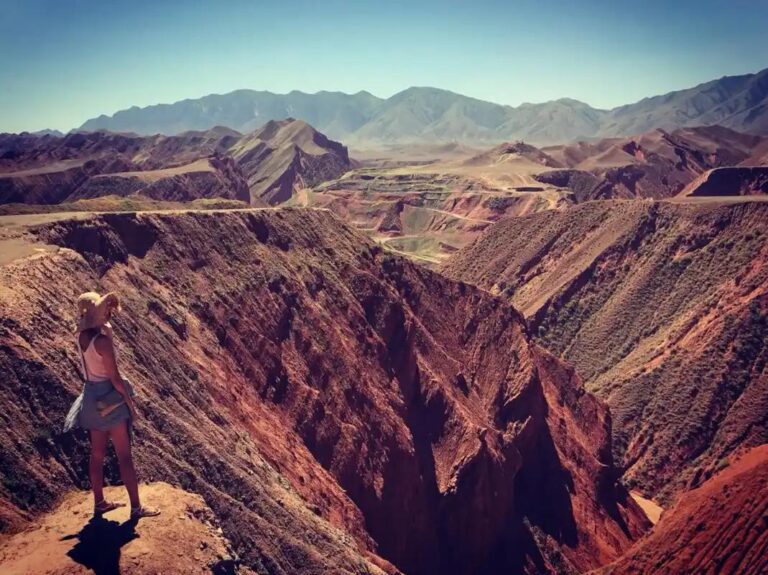
Published: July 26, 2026 | Author: Sanne Vermeulen, river valley and slow travel writer
Most travelers racing between Sayram Lake and Nalati never hear the name Nilka, let alone drive the ninety-odd kilometres of river valley east of it. That valley is Tangbula Grassland, a corridor of meadows, spruce slopes and hot springs strung along the Kax River in the eastern Ili Valley. Locals call the road through it the Hundred-Li Gallery, and after two trips there, one in June 2024 for the wildflowers and one in September 2025 when the poplars along the river turned yellow, I think the nickname undersells it. This guide covers how to get in, where the road actually goes, and why Tangbula rewards a slower pace than the region’s headline grasslands.
A quick note on why you can trust what follows: I paid for every night, every meal and every driver myself, took my own notes on prices and distances, and I flag anything I could not verify. Where conditions change seasonally, I say so rather than pretend the valley behaves the same in May as in October.
Quick reference: Tangbula Grassland at a glance
| Item | Details |
|---|---|
| Location | Nilka County, Ili Kazakh Autonomous Prefecture, along the upper Kax River |
| Elevation | Roughly 1,500 to 2,000 m on the valley floor |
| Distance from Yining | About 110 km to Nilka town, then 80 to 100 km through the scenic corridor |
| Best months | Mid June to early July for flowers; September for autumn colour |
| Entry fee | Around 30 to 60 CNY depending on section; some stretches of road are free to drive (verify locally, pricing changed twice in recent years) |
| Key feature | The valley road ends near Qiaoerma, where it meets the Duku Highway |
| Time needed | One long day minimum; one night in the valley recommended |
What the Tangbula Grassland corridor is actually like
The first thing that surprised me is that Tangbula is not a single grassland you stand in the middle of. It is a drive. The road follows the Kax River upstream, and the scenery changes every twenty minutes: flat pasture with grazing horses, then a gorge where the river runs grey-green over boulders, then side valleys climbing toward snow. My driver on the first trip, a Kazakh man named Nurlan who grew up in Nilka, kept pulling over at unmarked spots and saying “this one is better than the ticket gate views.” He was usually right.
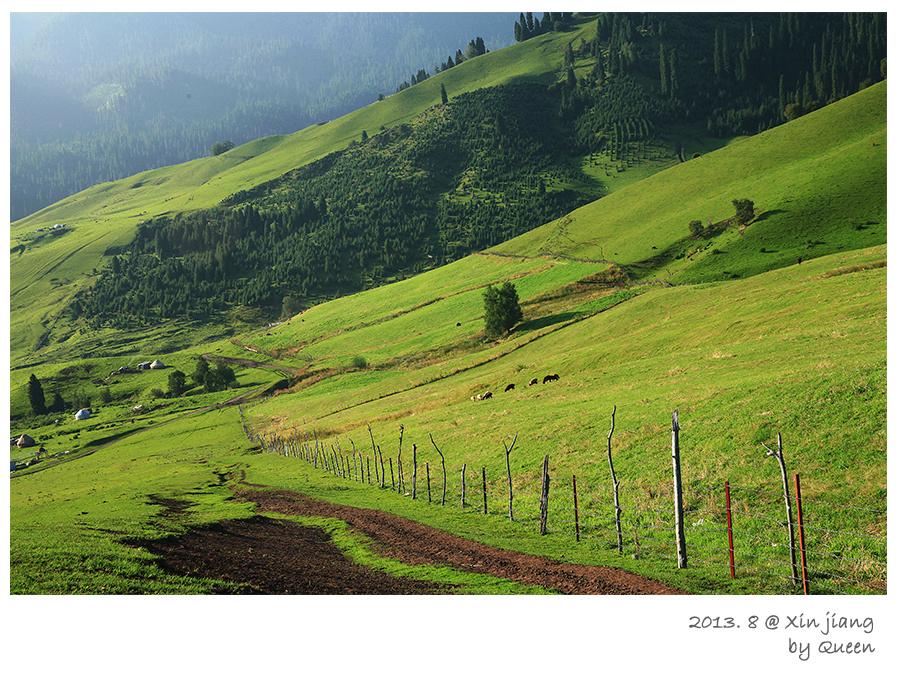
Valley-floor pasture in the Ili region. Tangbula’s meadows sit between the Kax River and spruce forest.
In June 2024 the slopes above the road carried bands of wild flowers, including patches of the red poppies this area is loosely famous for. A 1964 Chinese film shot around here helped fix the valley in the national imagination, and domestic visitors still come specifically for the red blooms. Timing is luck. We hit good colour around June 18; a couple we met who had come ten days earlier saw mostly green.
The September trip was quieter and, honestly, my favourite. The herders were moving stock down from the summer pastures, so the road kept getting blocked by sheep, which nobody minded. We drank tea in a roadside yurt where the owner, an older woman named Kunsulu, sold honey from her son’s hives. Nilka County is known within Xinjiang for its black bees, and the dark, slightly grainy honey is a genuinely good souvenir. I paid 80 CNY for a jar and regretted not buying two.
Getting to Tangbula Grassland
There is no airport or railway in Nilka, so everything runs through Yining, the Ili Valley’s hub city.
By hired car or taxi: This is how almost everyone does it. Yining to Nilka town takes about two hours on a good road. From Nilka, the scenic corridor begins roughly 40 minutes east. A full-day round trip from Yining cost me 700 CNY in 2024 and 750 CNY in 2025; splitting with other travelers is easy to arrange through hostels in Yining.
By bus: Buses run from Yining to Nilka town several times a day, but public transport into the scenic corridor itself is thin to nonexistent. You would still need to hire a local car in Nilka. Doable, but it eats time.
As part of a Duku Highway trip: This is the option I would pick if I went back. The eastern end of the Tangbula corridor meets the Duku Highway near Qiaoerma. If you are driving the Duku north to south, you can exit west at Qiaoerma, sleep in the Tangbula valley, and continue to Yining the next day. It turns a transit day into a highlight. Check road status first; the Duku itself typically opens only from roughly June to early October, and our Xinjiang self-drive guide covers the paperwork and fuel logistics.
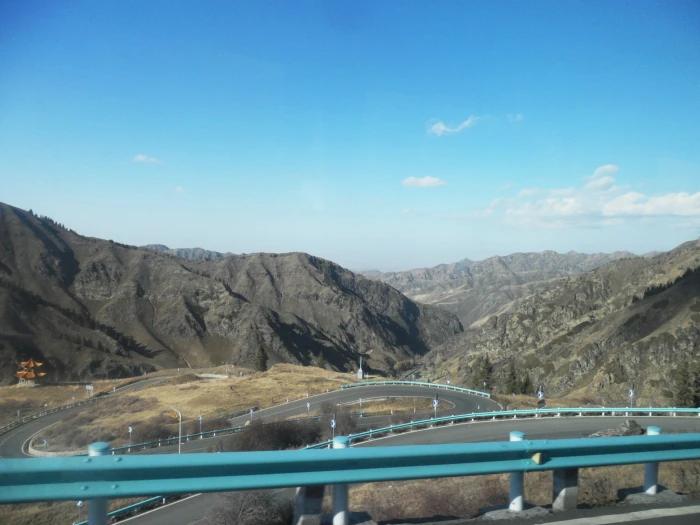
The Duku Highway in the Tianshan. Its junction at Qiaoerma is the eastern doorway into the Tangbula corridor.
When to go
Mid June to early July is peak season for a reason: flowers on the slopes, green pasture, herders in the summer camps and long daylight. It is also when domestic tour traffic is highest, though “high” here is relative; we never struggled to be alone.
September brings yellow river poplars, harvest activity around Nilka and empty homestays. Nights get cold fast; we had frost on the car on September 21.
April and May are green but changeable, with rain and mud on side tracks. Lower parts of the Ili Valley are in apricot blossom season in April, which pairs well with a Tangbula detour if the weather cooperates.
November through March is effectively off season. The road to Nilka stays open, but the corridor sees heavy snow and most guesthouses close. For month-by-month conditions across the region, see our Xinjiang weather guide.
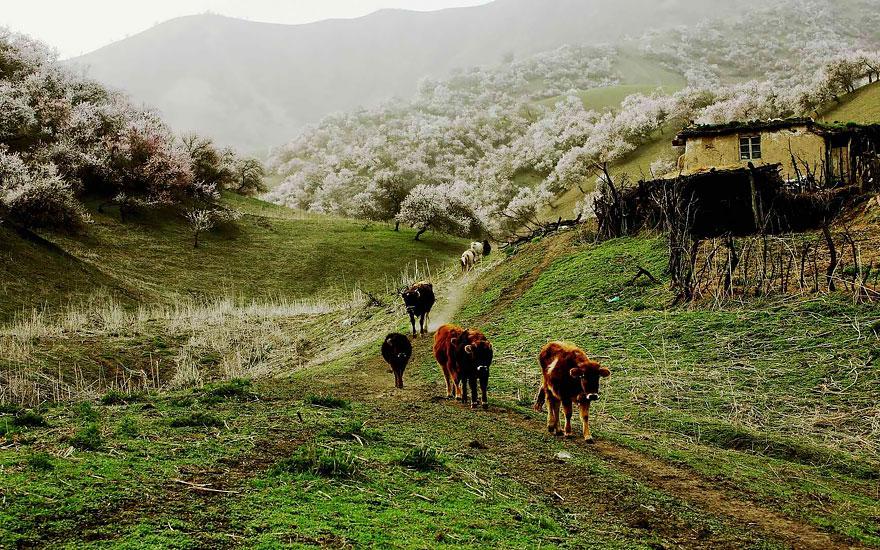
Ili Valley apricot blossoms in spring. April visitors can combine blossom viewing at lower elevations with an early-season look at the Kax valley.
Where to stay
In the valley: Family-run guesthouses and yurt camps cluster around the ticketed sections and near the hot spring area. We paid 260 CNY for a clean twin room with electric blankets in September 2025. Yurt stays run 100 to 150 CNY per person with dinner extra. Book nothing in advance except in the last week of June; just look at two or three places and choose.
Nilka town: Standard Chinese business hotels from about 150 CNY. Less atmosphere, more reliable hot water. Note that some smaller hotels cannot register foreign guests; ask before checking in, and have a backup.
Hot springs: The valley has several developed hot spring pools attached to hotels. The one we tried was simple, outdoors and very hot, and cost 68 CNY. After a day of gravel side roads it was exactly right.
Food in the valley
Meals here are herder food, and that is a compliment. Expect boiled lamb, laghman noodles, home-baked nan and endless milk tea. The kazy, a smoked horse sausage the Kazakh families make for winter, appears on tables from late September. Kunsulu’s version, cut thick and eaten with raw onion, was the best single thing I ate on either trip. Trout farms along the Kax River supply a grilled cold-water fish you will see advertised outside restaurants near the gate areas; around 88 CNY per fish, enough for two. If Kazakh household food interests you beyond the plate, our piece on Kazakh culture in the Tianshan gives useful context for what you will see in the camps.
Practical tips
- Carry cash for honey, yurt stays and small restaurants. Signal drops in the gorge sections, so mobile payment sometimes fails at the worst moment.
- Fuel up in Nilka town. There is no reliable petrol station deep in the corridor.
- Bring layers even in July. The valley floor is warm; the side valleys are not.
- Ticket policy has changed more than once. Some years the through road is free and only side attractions charge; some years there is a corridor ticket. Budget 60 CNY per person and be pleased if it is less.
- Foreign passports are uncommon here. Police checkpoints were quick and polite on both my trips, but allow a few extra minutes.
- If you cannot decide between grassland destinations: Nalati has better infrastructure and bigger views, Bayanbulak has the famous river bends, and Tangbula has the fewest people per kilometre. The quieter Gongliu and Xinyuan grasslands sit just across the mountains and combine well with Tangbula on a longer Ili loop.
A sample two-day plan from Yining
Day 1: Leave Yining by 9:00, coffee stop in Nilka town, enter the corridor before noon. Slow drive east with photo stops, late lunch at a trout restaurant, soak in a hot spring, overnight in a valley guesthouse or yurt camp.
Day 2: Early light on the river, walk up one side valley for an hour or two, then either return to Yining by evening or, in summer, continue east to Qiaoerma and join the Duku Highway southbound.
FAQ
Is Tangbula worth it if I have already seen Nalati?
Yes, if you value quiet over facilities. The scenery is a river gorge rather than an open plateau, so it does not feel like a repeat.
Can I visit without a car?
Realistically no. Bus to Nilka, then a hired car, is the minimum. There is no shuttle system inside the corridor as of my 2025 visit.
Are the hot springs open year round?
The hotel-based pools generally are, but access in deep winter depends on road conditions. Call ahead through your accommodation.
Do I need a permit?
No special permit beyond normal ID checks applied on my visits. Rules can change, so confirm in Yining before setting out.
How does it connect to the Duku Highway?
The corridor’s eastern end meets the Duku near Qiaoerma. In the open season you can enter or exit the Duku here, which many drivers use to break up the long northern section.
Disclaimer: Prices, ticket policies and road conditions in this article reflect my visits in June 2024 and September 2025 plus checks against official Ili prefecture tourism announcements, and they change often in this region. Verify current conditions locally, especially Duku Highway opening dates, before committing to a route. This article contains no sponsored content.
About the author: Sanne Vermeulen is a Dutch travel writer from Utrecht who specialises in river valleys and slow overland routes across Central Asia and western China. She has made five trips to Xinjiang since 2021 and visited the Tangbula corridor twice, in different seasons, paying her own way throughout.