Published: July 28, 2026 | Author: Karl Huang, with field notes from guest contributor Sigrún Halldórsdóttir
I have walked on ice for a living. For nineteen years I guided visitors across Sólheimajökull and the outlet glaciers of Vatnajökull in southern Iceland, so when my brother Einar suggested we spend three weeks in the Tianshan in July 2025, my first question was the obvious one: can we actually get on the ice? The honest answer about Xinjiang glacier hiking is more complicated than most tour websites admit, and that is exactly why I wanted to write this down. Some of the most famous Tianshan glaciers are closed to visitors, for good reasons. Others can be seen from a road at close range, and a small number can be approached on foot with a local guide. This guide covers what we actually managed to do, what we were turned away from, and what I would tell a fellow ice person planning the same trip.
One thing before we start. Xinjiang holds roughly 18,000 glaciers by the standard Chinese glacier inventory, close to half of China’s total glacial ice. Almost none of that is set up for tourism. If you arrive expecting Iceland-style crampon walks with rental gear and hourly departures, you will be disappointed. If you arrive expecting big mountain scenery, glacier snouts across a valley, and long moraine walks at altitude, you will do very well.
Quick reference: Xinjiang glacier hiking at a glance
| Item | Details |
|---|---|
| Best months | June to September; July and August for high passes |
| Walking on glacier ice | Rarely permitted; most treks reach moraines and snouts only |
| Urumqi Glacier No. 1 | Closed to tourists since 2016 for conservation |
| Realistic options | Duku Highway viewpoints, Bogda viewpoint hikes from Tianchi, guided Tailan Valley trek near Wensu |
| Guide cost | 600 to 900 RMB per day; pack horse around 300 RMB per day |
| Altitude range | Glacier tongues sit at 3,400 to 4,000 m, plan acclimatisation |
What I learned the hard way: the closed glaciers
I had read about Urumqi Glacier No. 1, the most studied glacier in China, sitting at the headwaters of the Urumqi River about 120 km from the capital. In Iceland we watched Sólheimajökull retreat year by year, so I understood immediately when our driver explained that the whole area has been closed to tourism since 2016. The glacier lost close to a fifth of its area in recent decades, and the authorities decided that thousands of visitors were not helping. A research station still works up there. Tourists do not go. Several agencies in Urumqi will still happily sell you a “Glacier No. 1 tour” that ends at a checkpoint far from the ice, so ask very precise questions before paying anyone.
The same applies to most named glaciers in the central Tianshan. There is no equivalent of the Icelandic guiding industry, no ice axe rental huts, no marked routes onto the ice. I carried my own microspikes across half of Asia and never once clipped them on. Take that as the honest baseline.
Where you can actually get close to the ice
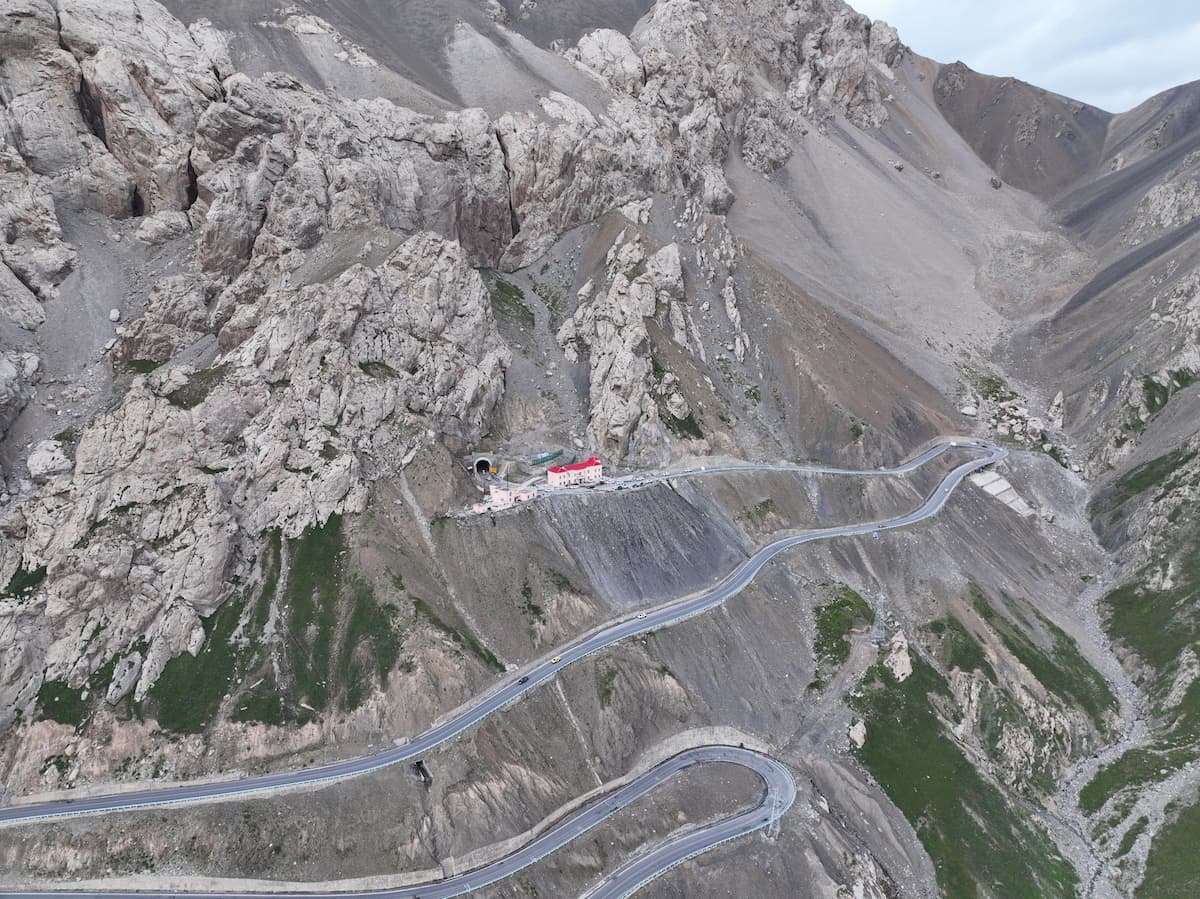
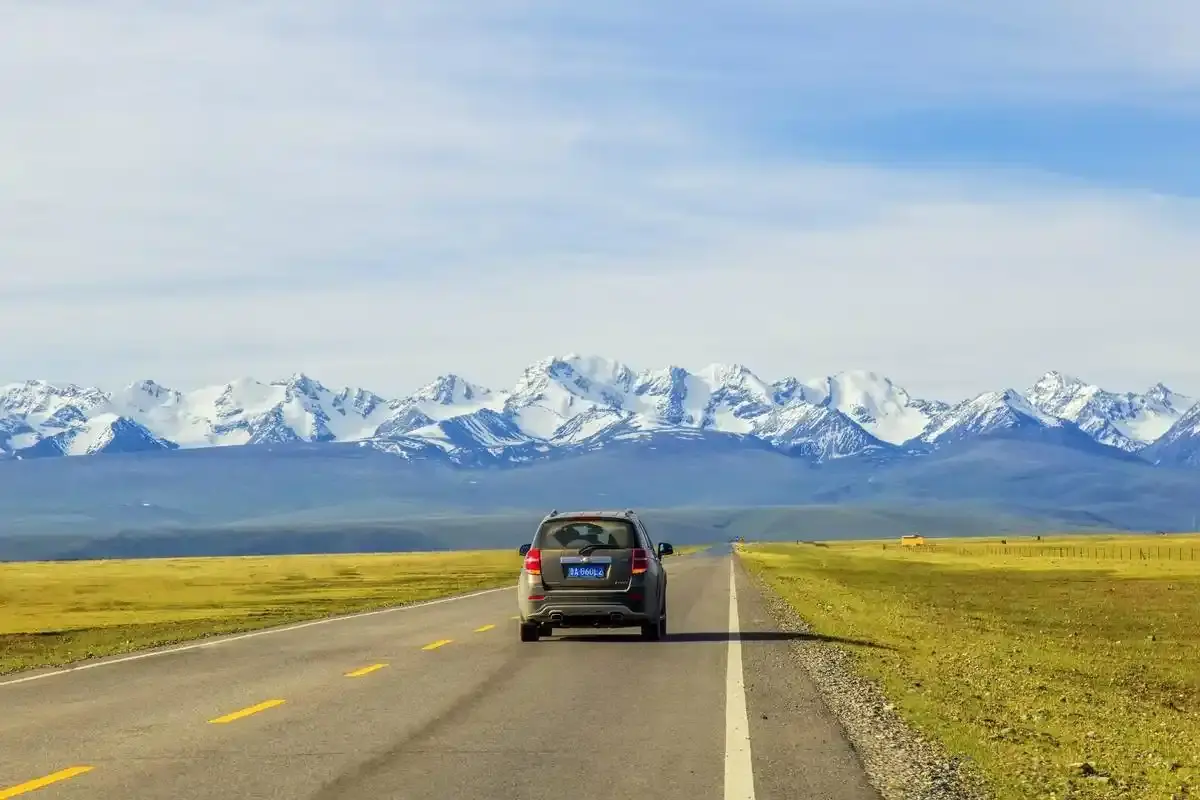
The Duku Highway. This 560 km road cuts straight through the Tianshan between Dushanzi and Kuqa, and its middle section climbs past 3,400 m where hanging glaciers sit almost above the tarmac. Near the Hashilegen tunnel we stood at a pullout and watched a glacier snout across a valley perhaps two kilometres away, close enough to see the dirty ice bands with binoculars. It is a road trip rather than a hike, but for glacier viewing per hour of effort, nothing else in Xinjiang comes close. Check conditions before you commit, because the road only opens from roughly June to early October; our notes on Xinjiang road conditions and driving distances explain the seasonal closures.
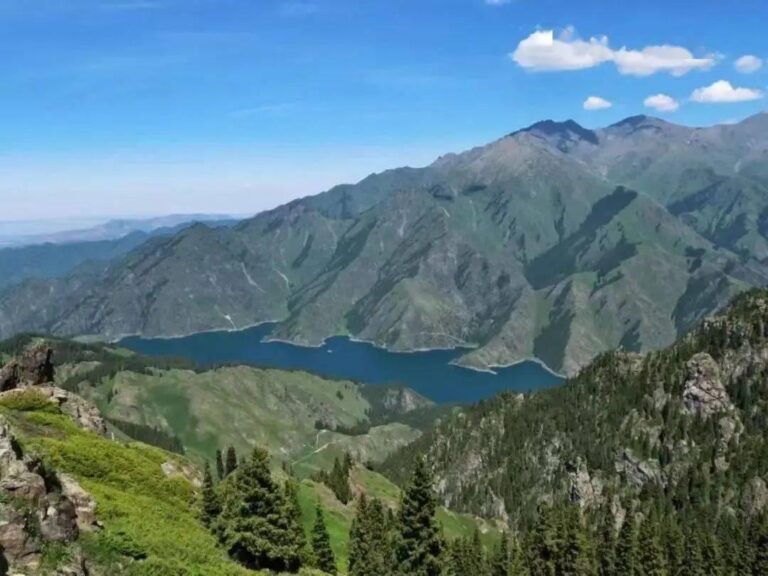
Bogda Peak viewpoints from Tianchi. From Tianchi Lake you can walk the lakeshore paths and, on a clear morning, see the glaciated north face of Bogda Peak (5,445 m) reflected in the water. Day hikers can climb toward the ridgelines south of the lake for a wider view of the ice fields. The full Bogda circuit trek exists but requires a registered guide, camping gear and four to six days; we settled for the day walk and did not regret it.
Tailan Valley near Wensu. This was our real glacier moment. From Wensu county outside Aksu, a rough track runs up the Tailan River toward the south side of Tomur Peak, at 7,443 m the highest mountain in the Tianshan. We hired a Kazakh guide named Yerlan through our Aksu hotel, paid 800 RMB per day plus 300 RMB for a pack horse, and walked two days up the valley to a camp below the terminal moraine. You do not step onto the glacier itself, which is heavily crevassed and absolutely not a casual walk, but you stand on rock that the ice released within living memory, with the grey snout groaning in front of you. Yerlan’s family has grazed that valley for three generations, and his stories matched everything I know about how herding people read ice. Reading about Kazakh culture in the Tianshan beforehand made those two evenings around the stove much richer.
Xiata Valley in Zhaosu. We did not have time for it, but the Xiata ancient pass trail follows a glacier-fed river toward views of Khan Tengri’s satellite peaks and ends near hot springs, which sounds like a fair trade for tired legs.
Getting there and getting around
Urumqi is the hub. For the Duku Highway, hire a car with driver from Dushanzi or Kuqa; expect 1,200 to 1,600 RMB per day for the vehicle. For Tailan Valley, fly or take the train to Aksu, then a local car to Wensu town (about an hour). There is no public transport up the valley itself, which is precisely why it stays quiet. For Tianchi, buses and tours leave Urumqi daily and the trip takes under two hours each way. Self-driving foreigners face rental restrictions, so nearly everyone uses drivers, and the arithmetic of splitting costs is covered in our Xinjiang travel cost breakdown.
When to go
July and August give you open passes, green valleys under the ice, and the warmest camps. June and September are quieter with colder nights; we had frost on the tent in Tailan Valley in late July at 3,000 m, so pack accordingly whatever the month. Winter glacier travel in the Tianshan is expedition territory and outside the scope of any tourist trip. If you are weighing Xinjiang against other high-altitude destinations, our comparison of Xinjiang vs Tibet for plateau adventures is a sensible starting point.
Where we slept
In Urumqi and Aksu, ordinary business hotels took foreign passports without fuss at 250 to 400 RMB. In Wensu we found one acceptable hotel near the bazaar for 220 RMB. Up the Tailan Valley you camp; Yerlan provided a canvas tent and thick felt mats, and my Icelandic sleeping bag finally justified its place in the duffel. Along the Duku Highway, book Dushanzi or Nalati accommodation ahead in July and August because the road’s popularity has exploded among Chinese drivers.
Eating at altitude
Wensu surprised us. The night market grills lamb skewers over poplar coals for 5 RMB each, and the laghman noodles, hand pulled to order, were the best of our whole trip at 18 RMB a bowl. In camp, Yerlan cooked rice with dried lamb and onions in a single blackened pot, and made milk tea with a slab of butter that I initially declined and then requested every morning after. Carry chocolate and nuts for the trail; nothing resembling energy bars exists in county-town shops.
Practical tips from a professional ice person
- Never walk onto Tianshan glacier ice without a rope team. These are temperate glaciers with hidden crevasses under summer snow, at altitudes where rescue is slow or impossible. In Iceland I pulled two tourists out of moulins over the years. Here nobody would have reached them.
- Acclimatise. Glacier viewpoints sit at 3,000 to 3,500 m. Sleep a night at moderate altitude before walking high, drink more water than feels natural, and descend if a headache worsens.
- Sun protection matters more than warmth in July. Ice and snow reflect UV brutally; I watched Einar burn the underside of his chin in one afternoon.
- Carry cash for guides and horsemen in remote valleys. No signal means no mobile payment.
- Buy insurance that covers trekking above 3,000 m and read the fine print; our guide to Xinjiang travel insurance and safety preparation covers the details.
- For broader route planning beyond glaciers, the overview of Xinjiang’s best hiking trails puts these valleys in context.
A realistic 8-day glacier-focused itinerary
- Day 1: Arrive Urumqi, sleep low, sort supplies.
- Day 2: Day trip to Tianchi, lakeshore walk with Bogda glacier views, return to Urumqi.
- Day 3: Fly to Aksu, car to Wensu, arrange guide and horse.
- Days 4-5: Two-day Tailan Valley walk to the moraine camp below Tomur Peak and back.
- Day 6: Rest in Wensu, night market, transfer toward Kuqa.
- Days 7-8: Drive the Duku Highway north from Kuqa with glacier viewpoint stops, end in Dushanzi, return via Urumqi.
Xinjiang glacier hiking FAQ
Can I actually walk on a glacier in Xinjiang?
In practice, no, not legally and not safely as a tourist. Treks reach moraines and snout viewpoints. Mountaineering permits for peaks like Muztagh Ata are a separate, expensive process through registered expedition agencies.
Is Urumqi Glacier No. 1 open?
No. It has been closed to tourism since 2016 for conservation. Do not pay for tours claiming otherwise.
Do I need a permit for Tailan Valley?
We registered passports at a checkpoint at the valley entrance, arranged by our guide. Rules change, so confirm locally a day or two ahead.
How fit do I need to be?
The walks described here are moderate: 10 to 15 km days on rough tracks with 500 to 800 m of gain, made harder by altitude. Any regular hill walker can manage them after acclimatising.
Is it worth it compared to Iceland or the Alps?
Different product entirely. You trade easy ice access for scale, emptiness and cultural depth. I would go back tomorrow. More general planning questions are answered in our Xinjiang travel FAQ.
Disclaimer
This article describes personal experiences from a July 2025 trip and is provided for general information only. Glacier environments are hazardous; conditions, access rules, checkpoint requirements and prices change without notice. Nothing here is mountaineering instruction. Always hire qualified local guides for valley treks, never venture onto glacier ice without proper training and equipment, verify current access rules with local authorities, and carry insurance appropriate for high-altitude trekking. We have no commercial relationship with any guide, hotel or operator mentioned.
About the contributors: Sigrún Halldórsdóttir spent nineteen years as a certified glacier guide on Sólheimajökull and the Vatnajökull outlet glaciers in southern Iceland before retiring to Vík. She travelled through Xinjiang with her brother Einar in July 2025, paying their own way throughout. Her field notes were edited and fact-checked for publication by Karl Huang, who has travelled extensively across Xinjiang and runs this site’s on-the-ground research.