Published: September 6, 2026 | Author: Karl Huang, founder of Xinjiang Attractions
On our first drive through northern Xinjiang in 2019, we treated Bole as a fuel stop: ninety minutes, a full tank, and back on the road to Sayram Lake. A second visit in June 2025 with three days to spare showed how much we had skimmed past. Bole is the seat of Bortala Mongol Autonomous Prefecture, and it keeps getting written off as a transit town. This guide covers the city and the prefecture around it: the two Mongol migrations that shaped the valley, a granite boulder field most visitors have never heard of, a canyon of spruce and birch, and the practical business of arriving by rail, road and a busy little airport.
Why trust the details? We have traveled and written about Xinjiang since 2019; every price, distance and timetable below was paid for by us or checked against official sources in August 2026.
Bole and Bortala: quick facts
| Location | Northwest Xinjiang, seat of Bortala Mongol Autonomous Prefecture |
| Distance from Urumqi | 524 km by road; 426 km by air |
| Prefecture population | About 500,000 across 35 ethnic groups; Bole city roughly 296,000 |
| Border with Kazakhstan | 372 km prefecture-wide; 69.2 km along Bole city alone |
| Train | Bortala station, 2.45 km from downtown; about 5 pairs of trains daily |
| Airport | Bole Alashankou (BPL), 18 km east of downtown |
| Best months | June to early September; late May for the cycling race |
| Two-night budget | Roughly 900 to 1,400 yuan per person, excluding flights |
What Bole is, and why it ended up on the map
The name is Mongolian, usually glossed as “silver-grey grassland”; Bortala, the prefecture, borrows the same root, and the History of Yuan records the place as Boluotuotuo’er. A county was created here in 1920, the prefecture in 1954, and the county became a city in 1985.
The numbers behind the quietness matter. The prefecture covers 27,200 square kilometres, about 1.7 percent of Xinjiang, with 372 kilometres of border shared with Kazakhstan; Bole city takes 7,500 of those kilometres and 69.2 of that border. Roughly 500,000 people live here across 35 ethnic groups, 296,000 of them in Bole. The city sits 524 km from Urumqi, 219 km from Yining, and only 76 km from Alashankou, China’s largest land port. Our guide to Alashankou covers that border town.
Two Mongol migrations wrote this valley’s history
Bole’s Mongol character is not decorative. It comes from two population movements that the local museums trace carefully.
The first went west. Between 1762 and 1764 the Qing court moved 2,000 Chahar Mongol soldiers from the Zhangjiakou garrison to the frontier with their families; around 1,800 settled along the Bortala River and Sayram Lake as the Chahar Banner, farming and holding the border. Many valley families still trace their grandparents to that transfer.
The second went east. In 1771 the Torghut leader Ubashi led roughly 169,000 people out of the Volga steppe; fighting, hunger and disease killed most on the road, and about 70,000 reached the Qing frontier. In 1775 the court split the survivors into four routes, and the western one, some 400 households, was settled near Jinghe; the Chahar banners took in 500 Torghut households and taught them cultivation. Around 6,000 Torghut descendants live in Bortala today, mostly in Jinghe, and the region still trades on their metalwork: knives, saddles, bridles. Our page on Jinghe picks up that story, and the Wikipedia entry on the Torghuts covers the longer arc.
A morning in the city: river, bridge and the snow line
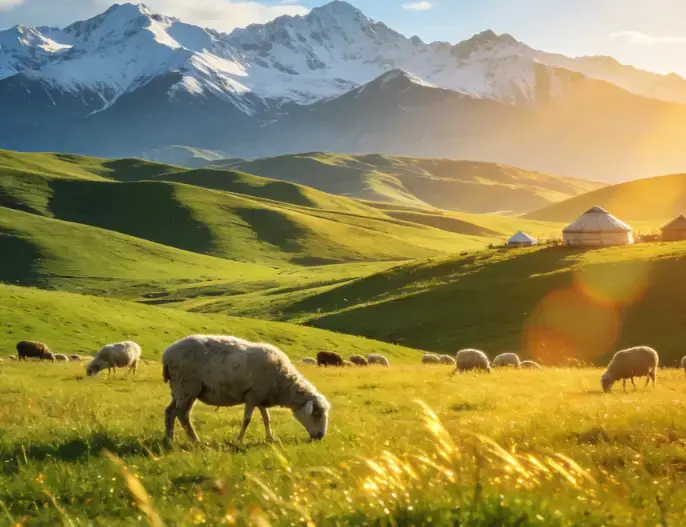
Bole is small enough to walk across in half an hour, and the Bortala River runs through it. The main bridge takes its silhouette from Silk Road caravan motifs, and Dongfanghong Avenue runs straight to the new railway district. On the clear June mornings we had, the snow line of the Alatau was visible from the riverbank before eight o’clock, not what you expect from a prefecture capital this size.
Hubei province has been Bole’s paired-assistance partner since the 1990s, bringing investment and, from 2016, a Wuhan air route. The city took National Garden City status in 2016 and National Civilized City status in 2020, and both show in the street trees and riverfront parks. Breakfast works best at the morning market: baked buns and milk tea, eaten standing with shift workers and herders in town for the day.
Guaishiyu, the granite boulder field most travelers skip
About 38 km northeast of the city (some listings say 48; road distance depends on the gate), Guaishiyu sprawls across roughly 230 square kilometres at the foot of the Shalatao hills, a spur of the Alatau. Chinese sources call it the largest granite-porphyry boulder field of its kind, and the rocks do look manufactured: mushrooms, camels, stacked plates, walls of rounded stone. Kazakh herders call it Koytas, “stones like sheep”, which is what the smaller boulders resemble from the road.
The sculptor is wind. The valley sits at the mouth of the Alashankou corridor, one of the windiest channels in China, and sand-laden gales have polished the granite for ages. Entry was 65 yuan in June 2025 plus a 15 yuan shuttle; the site opens 9:00 to 20:00. There is almost no shade, so go early, carry water, and give it half a day. We had the General Valley nearly to ourselves on a Tuesday morning.
Haritu Rege: seven bridges up a spruce and birch canyon
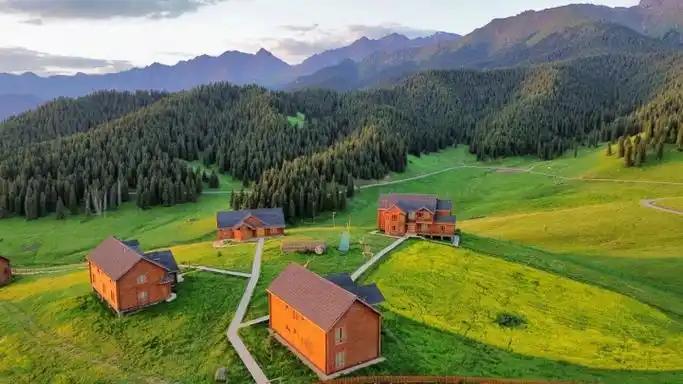
Forty kilometres northwest, on the southern slope of the Alatau, the Haritu Rege canyon runs 15 to 20 km into the mountains. The name is Mongolian, “where the black eagles fly”. A national forest park since 2004 and free to enter, it is threaded by the Khara-Turuk River, which after 54 km becomes the drinking water supply for both Bole and Alashankou. Surveys count more than 1,000 plant species here.
The walk is organized around seven wooden bridges, each with a named scene: snow peaks and rapids at the first, birch groves at the second, a gateway of cliff walls at the third, a waterfall at the fourth. Past the seventh bridge the road turns to gravel for another 20 km, and most visitors hire a driver from the village at the trailhead. In 2020 the canyon drew 210,000 visits, about eight percent of Bole’s tourism, and on our weekday visit we shared it with a few picnicking families.
Sayram Lake sits inside Bole’s city limits
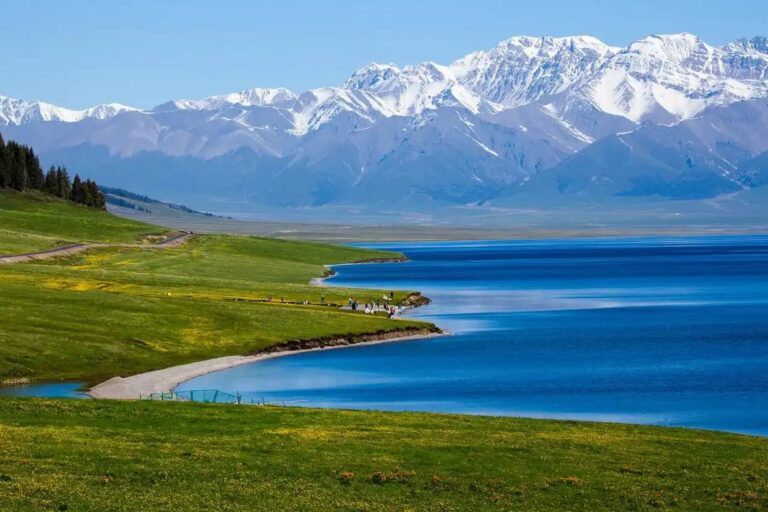
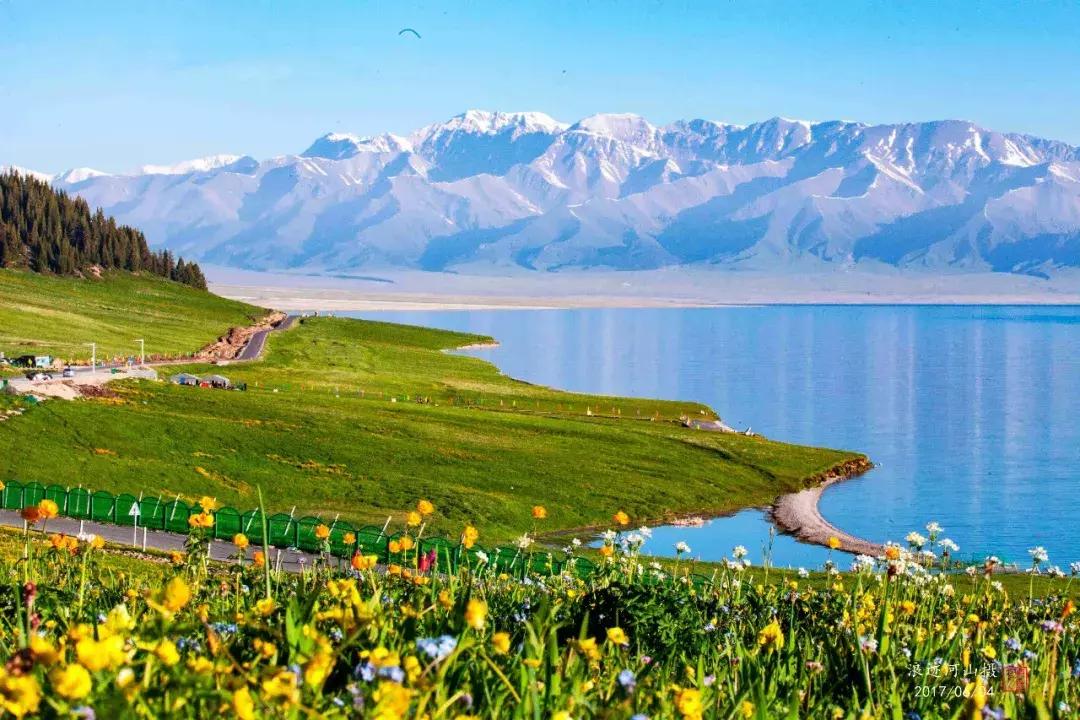
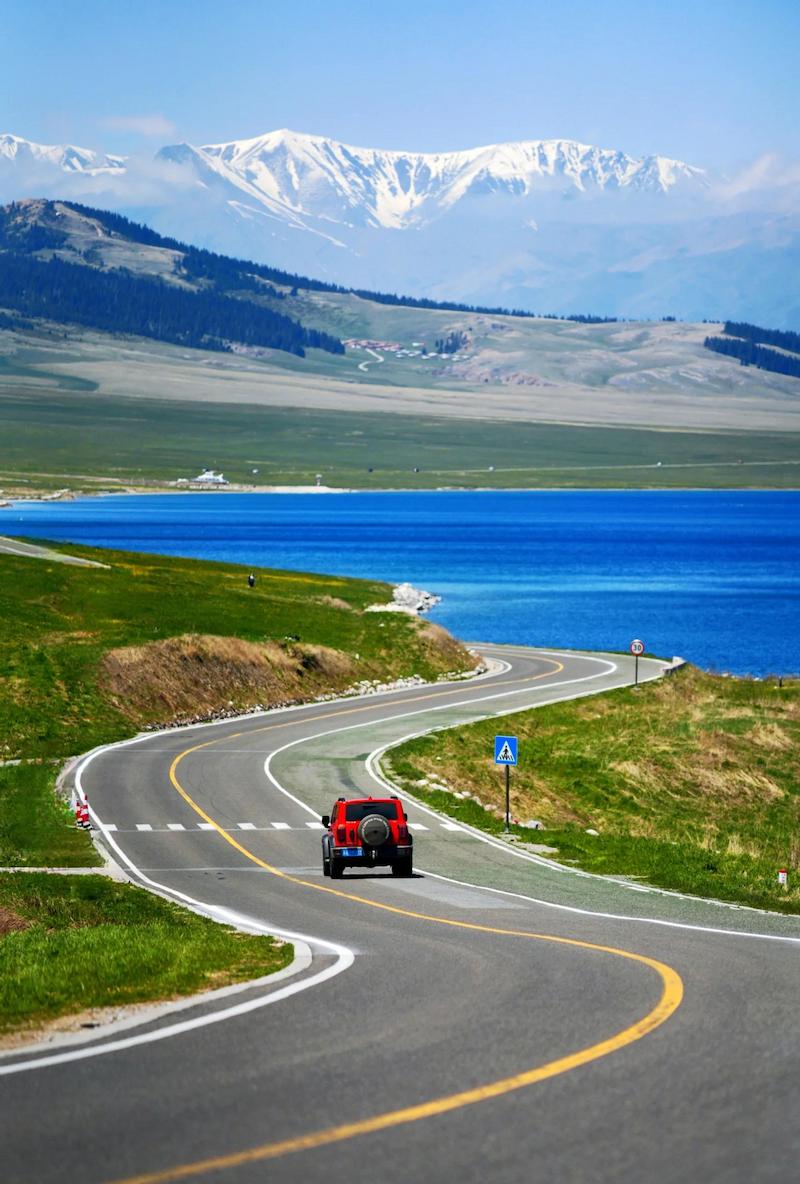
Foreign travelers meet Sayram Lake first and Bole second, if at all. Administratively it is the other way round: the lake lies inside Bole’s boundary, 92 km from downtown. The numbers are large for an alpine lake: 457 square kilometres at 2,074 metres, ringed by a 90 km road. Entry is 70 yuan; a private car costs another 75 yuan per person for 24 hours, or take the shuttle combination for 130.
The lake has a food story too: it had no fish until 1998, when cold-water whitefish (Coregonus peled) were introduced from Russia, and the first harvest came in 2000. Steamed whitefish at the lakeside restaurants runs 88 to 168 yuan a plate and is worth it. Our guide to Sayram Lake covers the ring road, and if you are torn between lakes, read our comparison of Kanas and Sayram.
Getting to Bole, Xinjiang: trains, flights and roads
Until 2019 this was one of the most inconvenient county-level cities in China: the old Bole station opened in 1990 about 50 km from downtown, the farthest city-station separation in the country. In September 2019 a 50 km branch line opened into the city, and the new Bortala station, 2.45 km from downtown, took over passenger work, with a 3,000-seat waiting hall and about five pairs of trains daily, three of them 160 km/h Fuxing express sets.
The airport grew faster still. Bole Alashankou airport (BPL), 18 km east of downtown, opened in July 2010 for 200,000 passengers a year; in 2025 it handled 568,900, up 43.4 percent, across 23 routes by eight airlines, with direct flights from Chengdu, Wuhan, Xi’an, Shanghai, Lanzhou and Zhengzhou, plus 17 Xinjiang cities including Urumqi, 426 km and about 75 minutes away. By road, the G30 runs 524 km from Urumqi, about six hours, and Yining is 219 km over the Guozigou pass. A new tunnel at Dabate also means the run west to the hot-spring country no longer squeezes through the lake gate; our page on Wenquan county covers that route.
When to go, and what the wind does here
Bole’s climate is continental and dry. The annual mean is 6.8 degrees Celsius; January averages minus 15.7 and has touched minus 36.2, July averages 23.8 and can reach 40. Rain is scarce, about 200 mm a year against more than 1,500 mm of evaporation, with roughly 2,735 hours of sun. Pack for the spread.
The wind deserves its own paragraph: the prefecture sits at the western mouth of the Alashankou corridor, and spring gales can close roads and sandblast paint. We plan trips for June, when the lakeshore flowers are out and the cycling race runs, or September, when the farms turn gold. Winter is genuine minus-thirty territory, though the blue-ice weeks at Sayram have their own following.
Where we stayed and what it cost
Bole’s hotel stock is better than its size suggests. A Hilton Garden Inn and a Ji Hotel operate downtown, and mid-range rooms in June ran 240 to 380 yuan a night, below comparable Urumqi rates. Book early for late May, when the cycling race fills the town, and for July and August. In summer a few yurt camps operate near the lake; a July night in one dropped close to 5 degrees before dawn, so take real bedding, not Instagram assumptions.
Eating in Bole: baked buns, milk tea and lake whitefish
The city eats well for its size. Aisha Jiang Dawuti’s shop on Xinhua Road turns out the best baked buns (samsa) we had in northern Xinjiang, crisp shells and juicy lamb. The Bole Milk Tea House by the riverside park serves salted milk tea in copper pots with hand-held mutton. Putaoji on the food street does a fierce chili-pepper laghman and tandoor kebab, and stone-baked mutton, cooked with heated river stones in the pot, is the old Torghut method on several menus.
After dark, pick a night market. The Grassland Night food court adds khoomei throat singing and horse-head fiddle sets to the grills, while the Modern City market runs 180 stalls past midnight. Souvenirs are easy: Jinghe wolfberries, whitefish blocks, and dairy candy from the pasture counties.
A three-day plan that actually works
Day one, arrive and settle: walk the river and the Silk Road bridge, eat at the milk tea house, finish at a night market. Day two goes north, Guaishiyu in the cool of the morning, then Haritu Rege after lunch, walking as far as the fourth or fifth bridge. Day three is the lake: leave by eight, drive the ring road clockwise, and exit toward Yining or back for the evening train. With a fourth day, add Alashankou’s port town, the hot springs of Wenquan, or the quieter corners in our overview of Bortala prefecture.
Small things that will save you time
Take a windproof layer even in July; the corridor gale can drop the afternoon temperature ten degrees in an hour. Fill the tank before the lake road and download offline maps, because coverage dies on the north shore. Border roads near the Alatau have checkpoints, so carry your passport and keep the camera down around any military post. Some map apps list Guaishiyu under its old name, Guaishigou, which confuses drivers enough already.
FAQ
What does the name Bole mean? It is a short form of Bortala, Mongolian for the silver-grey grassland; both names refer to the same valley.
Is Bole worth more than one night? Yes, if you plan to see Guaishiyu or Haritu Rege. Both are half-day trips from town, and squeezing either into a Sayram detour means driving after dark.
Can foreign travelers fly into Bole and use the border roads? The airport handles domestic flights and foreign passengers use it like any Chinese airport. Border roads toward Kazakhstan have passport checkpoints, and photography of military installations is prohibited. Confirm conditions locally before setting out.
Disclaimer
This article reflects our own visits, most recently in June 2025, and research current to August 2026. Prices, timetables and border regulations in Xinjiang change without much notice. Verify details with official sources before you travel; treat this guide as experienced advice, not a guarantee.
About the author
Karl Huang has traveled and written about Xinjiang since 2019 and is the founder and editor of Xinjiang Attractions. He has crossed the region by train, shared van and rental car from Khorgos to Hami, and specializes in field-checked guides for independent travelers.