Published: August 25, 2026 | Author: Karl Huang
Most people planning a trip to Xinjiang worry about distances, permits and weather long before they wonder whether their phone charger will even fit the wall. We made that mistake on our first visit, and it cost us a half-day in Urumqi hunting for a plug that matched our devices. This guide to Xinjiang power sockets, voltage and adapters is built from what we actually met on the ground across Urumqi, Kashgar, the Pamir Highway and the trains between them, not from a generic “electricity in China” page.
Quick Reference: Xinjiang Electricity at a Glance
| Standard voltage | 220 volts |
|---|---|
| Frequency | 50 Hz |
| Plug standards | Type A (two flat pins) and Type I (three flat pins, Chinese national standard GB 2099) |
| Wall sockets you’ll see | Most accept Type A and Type I; many hotels use universal sockets that also take Type C |
| UK (Type G) / European Schuko (Type F) | Will not fit; you need an adapter |
| Phone and laptop chargers | Almost always 100–240V (dual voltage) — safe to use |
| Hair dryers and straighteners | Often single-voltage (110V); check the label before plugging in |
| Where to buy adapters | Urumqi airport shops, electronics markets, malls, convenience stores — ¥10 to ¥30 |
| Power banks | Carry in hand luggage only; follow CAAC capacity rules |
What We Found on the Ground
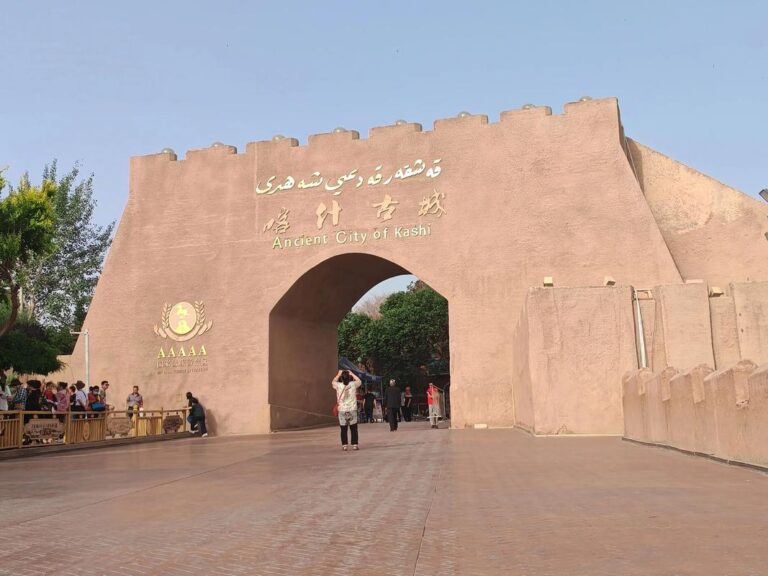
When we landed in Urumqi the first time, our Australian laptop charger (Type I) slotted straight into the hotel desk socket, which was a small relief after eleven hours of flying. What caught us out was the guesthouse in Kashgar: every socket was the two-flat Type A, and our three-pin adapter was still in the checked bag. We ended up buying a ¥15 universal adapter from a shop near the Id Kah Mosque that accepted every plug we carried. On the overnight train from Urumqi to Kashgar, the newer carriage had a Type A socket and a USB port right below the window seat; the older carriage we rode back on had none, and the power bank we had almost left behind became the only way to keep the phone alive for maps.

Plug Types You Will Actually Meet
Mainland China runs on two plug shapes. Type A is the two flat parallel pins you know from North America and Japan, usually ungrounded. Type I is three flat pins arranged in a triangle, the Australian-style connector that is also written into the Chinese national standard GB 2099.1. The two-round-pin Type C still turns up in older buildings but is fading fast. Most hotels, airports and malls now fit universal sockets that swallow Type A, Type I and often Type C at the same face.
If you arrive from the UK (Type G, three rectangular pins) or from mainland Europe with a Schuko plug (Type F), neither will go in. Pack one compact universal travel adapter that explicitly includes Type I, and you will cover every socket we found from Urumqi to Tashkurgan.
Voltage and Frequency: Will Your Devices Survive?
The grid here supplies 220 volts at 50 Hz, the same as most of Europe, Australia and almost all of Asia. Travellers from North America (120V) and Japan (100V) need to pay attention. The good news is that nearly every modern phone, tablet and laptop charger prints “Input 100–240V ~ 50/60Hz” on the brick, which means it works everywhere without a voltage converter.
The bad news is small heating appliances. Many hair dryers, curling irons and straighteners are built for a single voltage and will either refuse to heat or quietly burn out on 220V. We learned to either pack a dual-voltage model or just buy a cheap dryer locally. The 50 Hz vs 60 Hz difference rarely matters for switched-mode chargers, but it can make old electric clocks and some motorised devices run a little fast or slow.
Buying Adapters and Chargers in Xinjiang
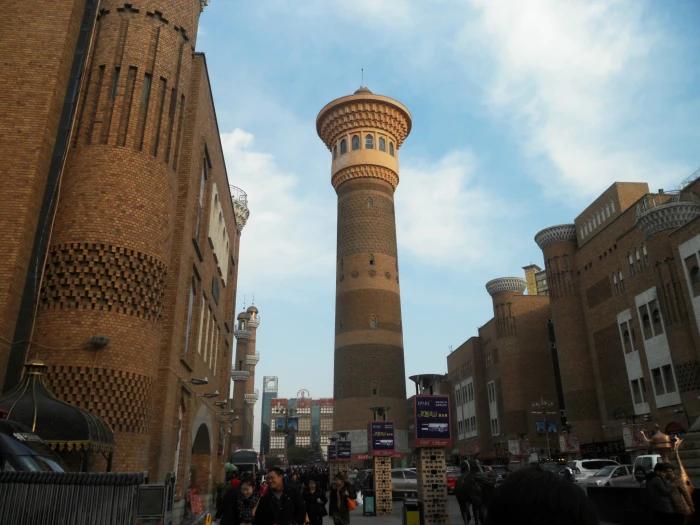
Forgetting your adapter is not a crisis. Urumqi Diwopu airport has shops selling them, the electronics stalls around the International Bazaar stock them for ¥10–30, and even some convenience stores carry a basic universal plug. We picked up a spare in Kashgar for less than the price of a cup of tea. As we explain in our guide to money and payments in Xinjiang, the smallest stalls often prefer Alipay or cash, so keep a little of both handy for the ¥15 purchase.

Charging on Trains, Buses and Long Drives
Xinjiang is big, and you will spend hours moving between regions. On the high-speed services (D and G trains) we had a power outlet at the seat — Type A plus a USB-A port — through the whole eleven-hour Urumqi to Kashgar run, which our high-speed rail guide covers in more detail. Older Z, T and K trains are hit or miss: newer cars put sockets near the window seats, but older ones only have them at the carriage ends, so do not count on them.
Long-distance buses, including the tourist coaches into the mountains, usually have no outlet at all. Self-drive and rental cars almost always give you a 12V socket (the old cigarette lighter) and frequently a USB port, so a car charger is worth tossing in the bag. When in doubt, the power bank does the work.
Power Banks, Cameras and Drones
A 10,000 to 20,000 mAh bank became our most-used item. In hotels across the region wall power is reliable, but mid-day charging is hard once you are out on the Pamir or in a desert town, and cold weather drains batteries faster than you expect. Camera shooters should carry two or three spare cells and charge them overnight; drone flyers need to check local flight rules separately, since battery rules are a different conversation from sockets.
One firm rule: power banks travel in your hand luggage, never in the hold. Chinese civil aviation (CAAC) lets you carry banks under 100 watt-hours with no approval, requires airline approval between 100 and 160 Wh, and bans anything above that. The capacity must be clearly marked on the unit, or security may refuse it.

Practical Tips We Wish We’d Had
- Pack one universal adapter for every two devices. Sockets near the bed are rare; most are at the desk or behind the TV.
- Bring a short 1-to-3 extension strip (Type I). A single hotel socket suddenly feeds laptop, phone and camera with no juggling.
- Check the voltage label on every heating appliance before you plug it in. Chargers are safe; dryers usually are not.
- Use a quality charger. The ¥10 adapters we bought did the job but offered no surge protection, so we charged laptops through our own brick.
- Download offline maps before you leave wifi. As our notes on staying connected with a SIM card point out, signal drops in the mountains even when your battery is full.
A Simple Electronics Packing Checklist
If you want the short version, our fuller Xinjiang packing list goes season by season, but for power alone bring: one universal travel adapter that includes Type I, a second Type A-to-I adapter, two dual-voltage USB-C or USB-A chargers, a 10,000–20,000 mAh power bank, a short extension strip, and spare camera or drone batteries. Skip the voltage converter unless you are genuinely bringing a single-voltage appliance.
Frequently Asked Questions
Do UK plugs work in Xinjiang?
No. UK Type G plugs will not fit local sockets. You need a Type G-to-Type I (or Type A) adapter, which you can buy in Urumqi or carry from home.
Is the voltage the same as in Europe?
Yes. China supplies 220V at 50Hz, identical to most of continental Europe, so European dual-standard devices work without a converter.
Can I buy an adapter at the airport?
Yes. Urumqi Diwopu International Airport has shops selling travel adapters and chargers, though the bazaar and malls in the city are cheaper.
Are there power outlets on the trains?
On high-speed D and G trains, yes, at your seat. On older regular trains the coverage is patchy, so keep a charged power bank regardless.
Can I bring a power bank on the plane?
Yes, in your carry-on, as long as the capacity is marked and within CAAC limits (under 100Wh without approval).
Disclaimer
This article reflects our personal travel experience and the standard Chinese electrical specifications in force at the time of writing: the GB 2099.1 plug standard and the State Grid 220V/50Hz supply. Socket designs, train configurations and shop inventories change, and individual hotels vary. Always read the voltage label on your own device before plugging it in, and check current power-bank rules with your airline and the Civil Aviation Administration of China. We are travellers, not electricians; when something looks uncertain, ask hotel staff or a licensed professional. Nothing here is electrical advice, and you use your devices at your own risk.
About the Author
Karl Huang is a travel writer who has spent several seasons documenting Xinjiang for international visitors. He focuses on practical, first-hand information that helps foreign travellers avoid the small but real headaches of overland travel in Northwest China — from plugs and trains to permits and packing.