Published: 15 October 2026 | Author: Karl Huang
Most visitors to Turpan drive past the walled compound on the eastern edge of the city without a second look, pulled instead toward the Flaming Mountains or the Grape Valley a few kilometres off. The Turpan Prefect Mansion (吐鲁番郡王府, Turpan Hui-bu Jasak Doroi Cin Wang Fu) is easy to overlook for the very reason it matters: it sits quietly beside the Emin Minaret, behind an unmarked gate, and it holds the story of the one Turpan family that helped draw the modern map of Xinjiang. I went in expecting a small restored house and left re-reading the region’s whole chronology.
This is a first-hand account from a paid visit, not a rewritten tourism leaflet. I verified the dates, the noble title and the site layout against Turpan municipal records and heritage listings, and where the present building is a reconstruction rather than the original I say so plainly.
| Item | Detail |
|---|---|
| Formal name | 吐鲁番回部札萨克多罗郡王府 (Turpan Hui-bu Jasak Doroi Cin Wang Fu) |
| Who it honours | Emin Khodja (额敏和卓), a Qing-loyal Turpan Uyghur ruler |
| Where | Munar Village (木纳尔村), Putao Township, about 2 km east of Turpan centre, beside the Emin Minaret |
| Original built | Qianlong era, 18th century (roughly 300 years ago) |
| Destroyed | 1933, by fire |
| Rebuilt | 2005 from historical records; opened to visitors in 2007 |
| Size today | About 22 mu (roughly 14,700 sq m site), around 2,500 sq m of buildings |
| What is inside | Council hall, a family mosque, a bedroom hall and an underground chamber (dadi gong) |
| Hours | Peak 21 Apr to 20 Oct 08:00 to 21:00; off 21 Oct to 20 Apr 10:00 to 18:30 |
| Ticket | About 20 yuan; plan roughly one hour |
Who Was Emin Khodja, and Why a Mansion?
The name on the gate belongs to Emin Khodja (额敏和卓), a leader of the Turpan Uyghurs in the mid-1700s. At a moment when the Dzungar confederation controlled much of the north and the Afaq Khoja faction fought for the south, Emin chose to throw his weight behind the Qing court. His troops helped the Qianlong emperor’s armies break the Dzungars and later put down the “two Khojas” rebellion, and the bargain paid off: the court granted him the hereditary title of Junwang, a rank often rendered in English as “prefect prince” or “commandery prince,” together with the estates and command that went with it.
That title is why the building carries the word “Prefect.” It was the seat of a hereditary noble who answered to the emperor while ruling locally. Emin’s loyalty bought his family unusual durability: of his eight sons, seven were rewarded, the second, Sulayman, inheriting the title, and another, Iskandar, going on to govern Kashgar and travel to Beijing. Through the eighteenth century the compound was the political, military and cultural command centre of the Turpan Uyghurs under Qing rule.
Inside the Turpan Prefect Mansion: What the Rooms Hold
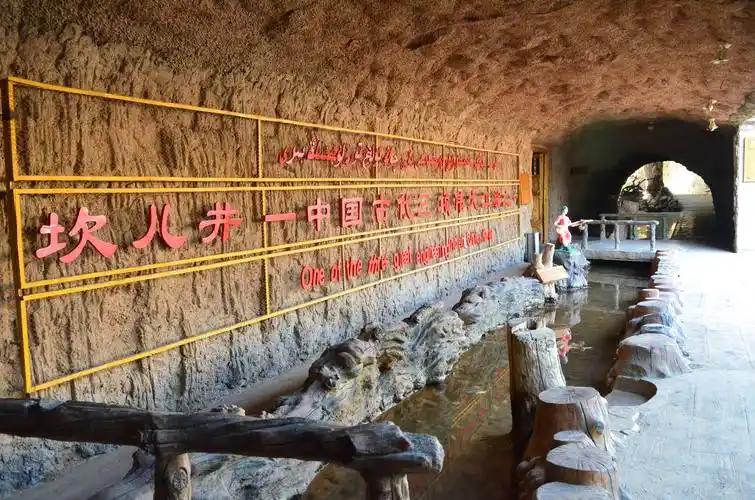
The present compound is a reconstruction completed in 2005 and opened to visitors two years later, built from historical descriptions after the original was lost. Plan on roughly twenty-two mu of walled ground, a little under fifteen thousand square metres, with about twenty-five hundred square metres of roofed buildings. What survives as a coherent set of rooms is modest but legible: a council hall where the noble received and ruled, a small mosque for the family’s daily prayers, a bedroom hall, and the underground chamber that gives the place its oddest claim to fame.
The council hall is the anchor of the visit. It is a high, cool room with a raised dais and a row of cushioned seating along the walls, the kind of space where a local ruler would have heard petitions and hosted Qing officials. The mosque beside it is plain and domestic rather than monumental, sized for a household, not a congregation. The bedroom hall shows the family’s living quarters in stylised form. None of it is furnished as a museum of objects; the interest is in the spaces themselves and the way they were shaped for heat rather than display.
Walking Through the Gate: Our Visit
When we visited, the first thing that struck us was the silence. You step off a road busy with trade and instantly drop into a walled garden of grapes and fruit trees, with the desert light cut down to a green shade. The gate is low and broad rather than tall and forbidding, built in a style that reads as Islamic from the street and settles into something more mixed once you are inside.
We spent the better part of an hour, which is about right, because the compound is small enough to see without rushing. On the morning we went, a small group of visitors was being walked through by a relative who remembered the older building from stories. That oral layer, the “my grandfather said,” is half the charm: the mansion is a frame onto which the town pins its memory of Emin Khodja.
The Underground Passage and the “Dadi Gong”
The feature that lingers longest in memory is the underground part. The site includes what is labelled a dadi gong, an “underground palace,” reached by a flight of steps that drops you below the courtyard into a cool, dim chamber. Local guides tell a plainer version too: that the original compound sat above a long tunnel used for storage and, if needed, escape, a sensible precaution in a region where power changed hands by force more than once.
Whether you take the romantic “palace” label or the practical “tunnel” reading, the effect is the same. The air turns several degrees cooler the moment you descend, which in Turpan is no small thing, and the thick earthen walls make the surface noise disappear. It is a short walk, not a spelunking expedition, and it suits almost any visitor, but it is the one part of the site that feels old rather than restored.
Islamic and Han Details You Can Spot
The building is a lesson in how cultures met on this frontier. From the street the gate and perimeter read as Islamic: pointed arches, a restrained colour wash, a silhouette from the mosque tradition of the Tarim basin. Step inside and the timber frame, the tiled rooflines and the hall layout borrow from Han courtyard practice, the sort you would recognise in a northern Chinese official’s residence.
The decoration is where the two meet most openly. The eaves, railings and archways carry Uyghur woodcarving and pressed gypsum floral work, fine, repetitive and frankly ornamental, while the structure underneath follows a Chinese post-and-beam logic. Look up at the ceiling of the council hall and you get both at once: a Chinese frame dressed in Islamic pattern. It is not a grand monument like the great mosques of Kashgar, but as a single building that holds two traditions in one skin, it repays a slow look.
Getting There from Turpan Town
The mansion is on the eastern side of Turpan, about two kilometres from the city centre and immediately beside the Emin Minaret, so the two are almost always visited together. A taxi from the centre costs very little and takes ten minutes at most; there is also a public bus that runs out this way, though the walk from the stop is longer and the midday heat makes the taxi the easier call. From Urumqi, the high-speed train to Turpan North takes a little over an hour, and the drive on the expressway is roughly two and a half hours, which makes the mansion an easy half-day add-on rather than a destination in itself.
Carry your passport. Like most attractions in Xinjiang, the site records visitor identity at the entrance, and foreign guests should expect the check rather than be surprised by it. Payment is smoothest by WeChat Pay or Alipay, with a little cash as backup.
Pairing It With the Emin Minaret Next Door
You cannot really separate the mansion from the Emin Minaret (苏公塔), the tall, unornamented brick tower that stands a few hundred metres away inside its own walled court. The two are one story told in two buildings: the minaret was commissioned in the 1770s by Sulayman, Emin Khodja’s son, in memory of his father, so the tower you see is effectively the son’s monument to the man whose mansion you have just walked. Visit both on the same ticket-and-taxi loop and the family’s arc, from loyal noble to commemorated father, snaps into focus. Our Emin Minaret guide explains the tower’s design and the best angle for photographs.
For the wider picture, the full Turpan travel guide strings the mansion, the minaret, the Grape Valley and the Flaming Mountains into one route, while the Turpan city guide covers the older quarters worth a wander between sites. The Grape Valley and the Flaming Mountains sit within a short drive and round out a day.
When to Go and How Long to Spend
Turpan’s tolerable windows are spring, roughly April to May, and early autumn, September to October, when you can walk courtyards without wilting. The site keeps long hours in the warm season, generally 08:00 to 21:00 from late April to mid-October, and shorter, 10:00 to 18:30, in the cold months. Give yourself about an hour for the mansion alone, and two to three hours if you fold in the Emin Minaret next door.
High summer is brutal on the surface, temperatures regularly passing forty degrees, but the thick earthen walls and the underground chamber stay cool, so the mansion is one of the more comfortable stops on a hot day. Winter is quiet and the gardens bare, yet the buildings and the underground part stay open, and you will often have the courtyard to yourself.
Tickets, Hours and Practical Notes
Entry is cheap: the standard ticket is about 20 yuan, which makes the mansion one of the better-value stops in Turpan. Hours and prices shift with the season, so treat the figures above as a planning guide and confirm on the day. Foreign visitors should carry a passport for the entrance check, and comfortable shoes help on the earthen surfaces.
Dress for two climates in one site. The courtyard can be scorching while the underground chamber is cool and a little damp, so a light layer you can pull on below ground is the most useful thing to bring. There is no café inside, so carry water for the above-ground parts, and keep a little cash in case card or phone payment is down at the gate.
A Half-Day Walking Route
Our own rhythm worked well and needs no rush. Arrive mid-morning, when the light is soft and the courtyard is empty, and give the rooms and the underground chamber a slow hour. Walk the few hundred metres to the Emin Minaret and climb or circle it, then take a taxi back toward the centre for lunch. That fills about half a day. If you have more time, push on to the Grape Valley in the afternoon for the green contrast, or save the Flaming Mountains for the last hour of daylight, when the ridges glow.
Frequently Asked Questions
Is the Turpan Prefect Mansion original or rebuilt?
The standing building is a reconstruction finished in 2005 on the site and from the records of the original, which was destroyed by fire in 1933. The underground chamber and the layout follow the historical description, but treat the woodwork and finishes as modern craft in an old form.
How is it different from the Emin Minaret?
They are two parts of one family story. The mansion was Emin Khodja’s seat; the Emin Minaret nearby was built by his son Sulayman in his memory. The mansion is a walled residential compound, the minaret a single monumental tower, and they are usually visited on the same short loop.
How long should I plan for?
About an hour for the mansion on its own, and two to three hours if you include the Emin Minaret next door. It is a small site, so there is no risk of it eating a whole day.
Is it worth visiting if I only have one day in Turpan?
Yes, if you care about the region’s history rather than only its landscapes. It is quick, cheap and immediately next to the Emin Minaret, so it slots into almost any Turpan day without costing you the Flaming Mountains or the Grape Valley.
Disclaimer
Opening hours, ticket prices and the condition of the exhibits can change, and Turpan’s summer heat and winter schedule affect the site from time to time, so confirm the details before you travel. This article is a personal travel account checked against Turpan municipal and heritage sources, not official advice, and I am not responsible for a changed price, a closed section or a visit that does not match what is described here.
About the author
Karl Huang is a China-based travel writer who covers Xinjiang’s history, landscapes and practical logistics. He writes about places he has visited and checks figures against regional government and heritage sources rather than second-hand blogs.