Published: October 15, 2026 | Author: Karl Huang
The first time we drove past the turnoff to Tianshan Shenmu Garden, we kept going. Our map showed a red-rock canyon an hour further on, and that was the plan. It was only when a retired teacher in Wensu town heard our route and said, “You will regret skipping the trees,” that we turned back the next morning. Tianshan Shenmu Garden, or Kulumishi Atam Mazari in the local telling, is a cluster of more than a hundred ancient trees growing out of a green pocket in the Gobi, about 60 kilometers northwest of Wensu county town in Aksu Prefecture. Some of those trees are said to be over a thousand years old. We have now made the trip twice, once in spring and once in early autumn, and both times left convinced it is one of the least-explained sights in southern Xinjiang.
This is a first-hand account, not a brochure. The historical details below come from on-site plaques, the Wensu county record, and public travel sources we cross-checked before writing. I am a travel writer, not a botanist or a historian, and where the record is uncertain I say so.
| Fact | Detail |
|---|---|
| Full name | Tianshan Shenmu Garden (Chinese: 天山神木园), also Kulumishi Atam Mazari (库尔米什阿塔木麻扎) |
| Location | Sawafuqi Pasture, Wensu County, Aksu Prefecture, Xinjiang |
| Distance | about 60 km northwest of Wensu town; about 75 km from Aksu city |
| Altitude | around 1,700 meters |
| The trees | more than 100 ancient trees, some estimated at 300 to over 1,000 years old |
| Setting | a green oasis pocket in the Gobi, at the southern foot of the Tianshan near Tomur Peak |
| Entry | around 40 RMB for adults; reduced rates for students and seniors; under-1.2m children and over-70s free |
| Hours | roughly 10:00 to 19:00 in season |
| Getting there | no public transport; self-drive or hired car only |
| Best window | April to October; September is the most comfortable month |
The trees that define Tianshan Shenmu Garden
You approach across flat, fox-colored Gobi and then the road tips up onto a low earthen mound maybe fifty meters high, and the grey desert abruptly turns green. That mound is the Mazari, the burial complex, and the trees grow on and around it. What strikes you first is the shape. These are not upright park trees. Decades of wind from a single direction have bent and twisted them into coils and spirals, so a trunk might run along the ground for meters before turning upward, or split into a crown that looks more like a thrown net than a canopy.
Local caretakers point out named specimens, and the names tell you what to look for. There is the pair of lover trees, an old apricot and a poplar grown so close their trunks have fused; the nine-dragons willows, several trees braided together like a knot of serpents; the rootless tree, whose base has rotted into a hollow yet still throws a full green crown; and the antler tree, its bare branches splaying like the horns of a deer. A fallen giant has rotted into a natural arch you can walk through. Between the trees run a dozen small springs, clear and cold, feeding shallow streams that keep the grass underfoot soft.
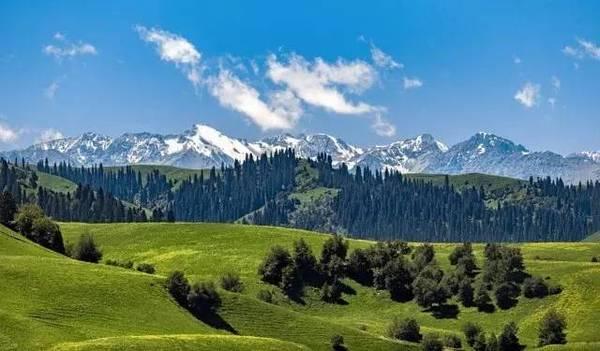
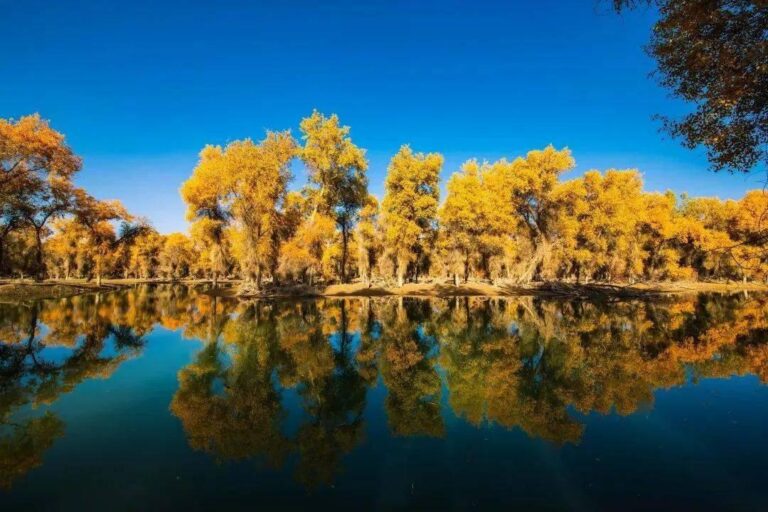
On our October visit the leaves were just turning, and we spent the better part of two hours walking slowly and saying little. A caretaker who has worked the site for years told us the largest trees predate the Ming dynasty, which may be tradition more than measurement, but standing inside one of those hollow trunks you do not argue the math. The garden covers only about seven hundred mu, a little under fifty hectares, so it is easy to take in on foot without rush.
Driving out to the Sawafuqi pasture
There is no bus, no train, and no tour sign in English. You go by car. From Aksu city it is roughly 75 kilometers and about ninety minutes; from Wensu town about 60 kilometers and an hour. The whole road is paved and a normal sedan handles it fine, but signage is in Chinese only, so load the route on an offline map before you leave the city. A chartered car from Aksu will run a few hundred RMB for the round trip and saves you the worry of a breakdown in the heat.
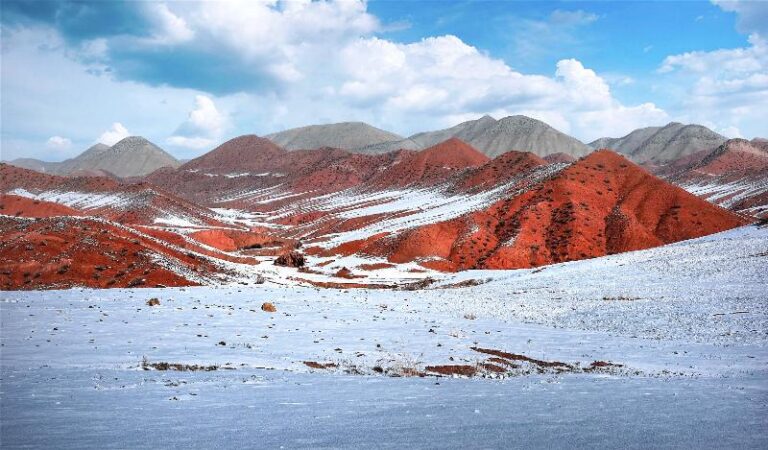
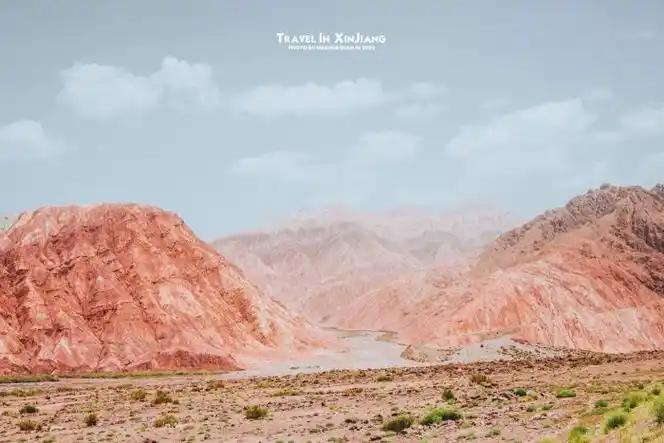
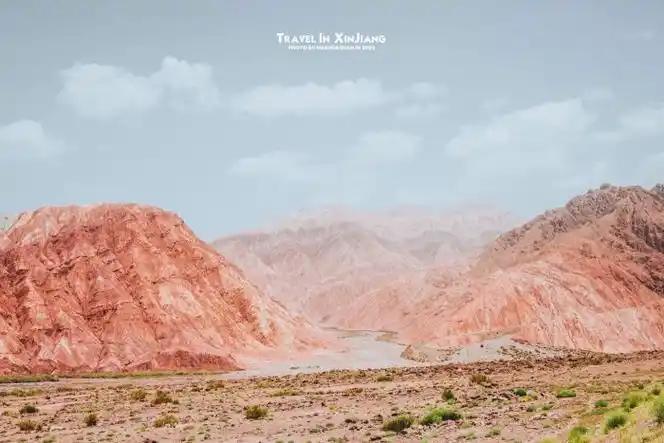
The garden sits at the northern edge of the Taklamakan, where the Tarim River system threads the desert, so keep the fuel tank topped in Aksu. If you want to make a fuller day of it, the Wensu Grand Canyon lies on a different road, so the two can be combined without backtracking.
When the desert heat finally breaks
Because the site sits at the southern foot of Tomur Peak, the highest mountain in the Tianshan, you might expect cool air, but the Gobi around it bakes. Summer afternoons here regularly pass thirty-five degrees, and there is almost no shade among the trees. Spring, from April, and autumn, through October, are the times to go. We traveled once in late April, when a steady wind kept the dust moving and the new leaves were a thin green, and once in early October, when the air was calm and the older trees had gone gold and red. Avoid the depths of winter, when cold and occasional closure make the drive unpleasant.
Where we slept: Aksu, not the garden gate
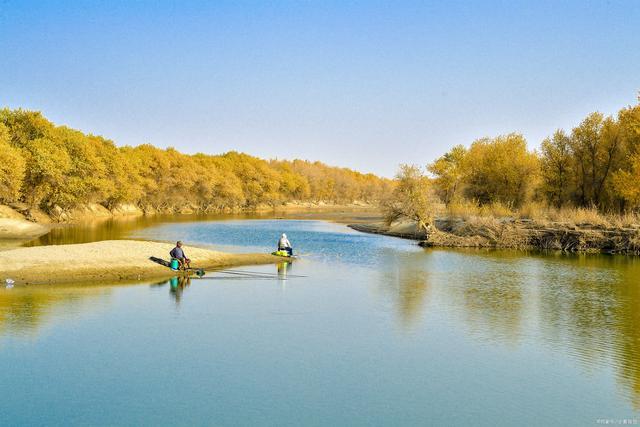
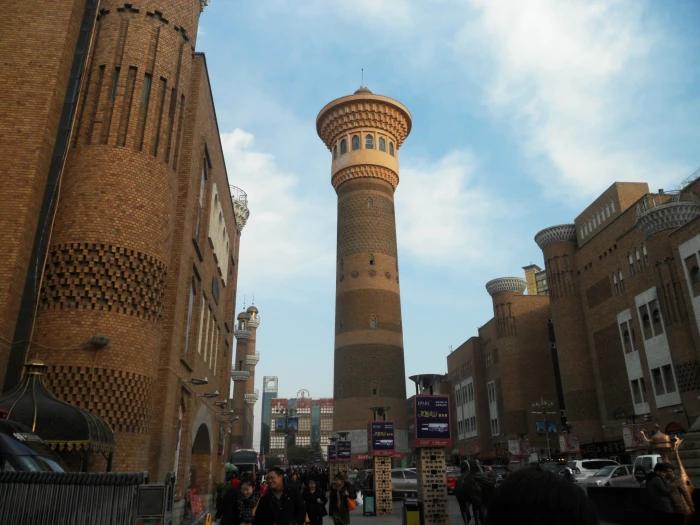
There is no lodging at the site and nothing like a hotel for many kilometers. The practical bases are Aksu city, which has the better hotels, an airport, and more choice of food, or Wensu town, which is closer and plainer. We stayed in Aksu both times, in clean mid-range hotels running roughly two to three hundred fifty RMB a night, and drove out in the morning. While in Aksu, the Aksu National Wetland Park makes an easy half-day before you head out to the garden, and it shows the other face of the region, where Tianshan meltwater meets the desert.
Eating between Aksu and the gate
Bring your own water. The garden has at most a small stall, and on a hot day you will want more than it can supply. We ate a late breakfast in Aksu, hand-pulled noodles with mutton and a plate of fried green peppers, then carried bottles and a couple of flatbreads for the drive. Back in the city the Uyghur restaurants do the usual solid work: zhua fan pilaf with raisins and carrot, kebabs off the charcoal, and flaky samosa-like pastries. Stock up on dried apricots and walnuts at a bazaar before you leave town, because once you are on the Wensu road the options thin out fast.
Five things the signs do not tell you
1. This is an active Muslim holy site. The Mazari is still visited by pilgrims, so keep your voice down near the tombs and dress modestly; shoulders and knees covered is the safe choice.
2. Phone signal is weak to absent once you leave the main road. Screenshot the route and tell someone where you are going.
3. There is little shade at midday and the Gobi sun is punishing. A hat, sunglasses, and two liters of water per person are not excessive.
4. The “one thousand year” ages are local tradition and estimate, not all lab-dated. Enjoy the story; do not quote it as fact.
5. There are few bins. Carry out what you bring, because the green pocket stays green only if visitors leave it that way.
A half-day loop through Tianshan Shenmu Garden
We left Aksu at half past eight, reached the gate by ten, and were parked by the arch. From there the walk is a loose loop: through the natural wood arch, past the antler tree, to the rootless tree, then the lover trees, the nine-dragons willows, down to the spring, and finally up to the Mazari complex itself. That took us about two hours with photo stops. By one we were driving back, and on the October trip we added the Wensu Grand Canyon on the return, which filled the afternoon without a single repeated kilometer. If you only have the morning, the garden alone is a complete, quiet half day.
Things first-time visitors ask
Is it just a small forest park?
No. It is a protected oasis and an active mazhar, compact enough to walk in two hours, with a cultural and religious layer most parks lack.
Can I get there by public bus?
Not directly. You need a car, either your own or a chartered one from Aksu or Wensu.
I have already seen Kanas. Is this different?
Completely. Kanas is alpine lake country in the north. This is desert-edge, dry, historical, and almost empty of tourists.
How long should I plan for?
A half day from Aksu, or a full day if you add the Wensu Grand Canyon.
A note before you set out
The details above come from our own visits and public sources we checked in 2026. Entry fees, opening hours, and road conditions in this part of Xinjiang change, and the site sits in a border-prefecture area where access rules can shift without notice. Confirm the current status with the Wensu County tourism office or a licensed local operator before you travel. This is a travel account, not an official source, and nothing here should be read as legal or safety advice.
About the writer
Karl Huang is a travel writer focused on Xinjiang’s quieter corners. He has driven the southern Tarim rim and the Tianshan foothills across several seasons, and prefers unmarked side roads to crowded viewpoints. He publishes independent, first-hand travel guides at Xinjiang Attractions.