Published: 9 November 2026 | Author: Karl Huang
When people ask whether you can drive an electric car across Xinjiang, the short answer is yes, and we have done stretches of it ourselves. The longer answer is that yes comes with a set of rules that do not exist in Europe, North America or most of Asia. Xinjiang EV charging runs on a different plug standard, a different set of operator apps, and a payment system that assumes you already have a Chinese phone number. None of this is hard once you know it, but the first driver who arrives at a charger with a CCS cable and no app tends to learn it the hard way. This guide is the briefing we wish someone had handed us before our first long electric run out of Urumqi.
Xinjiang EV charging in plain numbers
| What | Rough picture |
|---|---|
| National plug standard | GB/T 20234 for both AC and DC |
| DC fast-charge power you will meet | 60 kW to 120 kW at highway stations, lower in county towns |
| Realistic buffer to keep | Top up before dropping below 25 percent |
| Cities with solid coverage | Urumqi, Korla, Yining, Kashgar, Turpan, Aksu |
| Apps you will actually open | State Grid, TELD, Star Charge, plus one aggregator |
The numbers above are a planning skeleton, not a guarantee. Charger counts move every few months, and a station shown as working in an app is occasionally offline in person. Treat the table as the shape of the problem rather than a live map.
The plug your car actually uses in China
Mainland China settled on the GB/T 20234 connector for both alternating-current and direct-current charging. If your car at home uses CCS2, Type 2, CHAdeMO or the North American NACS plug, it will not physically fit a Chinese DC post without an adapter, and adapters for high-power DC are uncommon and expensive. Most foreign visitors who want to drive electric here simply rent a car that is already GB/T native, which is what nearly every rental EV in Xinjiang is. If you are importing your own vehicle, the practical questions are which adapters you can carry and whether the charger you plan to use will even recognise your car’s handshake. The State Grid explainer on the standard is worth a read before you commit: State Grid Corporation of China.
What a non-Chinese EV needs to plug in
For a rented local EV, nothing. You arrive, you plug the GB/T gun in, you tap the app, and it charges. The complications start only if you bring your own car. In that case you need a GB/T DC adapter rated for your vehicle, and you should test it at a low-power AC post before trusting it on a highway run. We have watched a friend spend a cold morning at a Korla charger arguing with a machine that refused his imported car’s communication protocol. The fix was an adapter he had left in the hotel. Carry it, and test it early.
Who runs the chargers: the operator map
Charging here is not one network but several. The State Grid (Guojia Dianwang) runs the backbone of public DC stations, especially along highways and in county seats, and you reach it through the Wangshang Guowang app. TELD (Telaidian) and Star Charge (Xingxing Chongdian) operate dense urban networks in the bigger cities and many petrol-station sites. In XPCC (Bingtuan) towns and some border areas you will see chargers run by the corps’ own grid company. NIO runs battery-swap stations in larger cities including Urumqi, which is a different solution entirely: instead of waiting for electrons, you swap a depleted pack for a full one in a few minutes. For the average visitor the takeaway is simple. Download two or three operator apps before you leave the city, because the charger in front of you may belong to a company you have never heard of. TELD’s network map is at teld.cn.
The apps you cannot do without
This is the part that trips up confident travellers. To start a charge you usually scan a QR code on the post and pay through the operator’s app, which wants a Chinese mobile number to register. A tourist eSIM bought at the airport or online can receive the verification SMS, and that single step unlocks most of the network. Once registered, the apps show live availability, let you start and stop a session, and email a receipt. An aggregator such as Lianxing Yichong or the mapping inside Gaode pulls several operators into one screen, which saves you installing half a dozen apps. We keep three installed and have rarely needed a fourth.
How payment works without a Chinese bank card
You do not need a Chinese bank account to charge, but you do need a payment method the apps accept. Alipay now lets many foreign visitors bind an international card, and some State Grid posts accept Alipay directly, which covers a surprising share of stops. Where that fails, the operator app often supports WeChat Pay with an international card attached, or prepaid credit loaded in the app with a foreign card. The friction is real but solvable, and it is far less painful than it was two years ago. The fuller walkthrough of mobile payments is in our guide to paying in Xinjiang with WeChat, Alipay and cash.
Where the network is dense, and where it thins out
Within Urumqi and the other regional capitals, public charging is easy: shopping malls, hotel basements, government car parks and highway service areas all have posts, and you can usually find one within a few kilometres. The further you go toward the southern rim, the more the map spreads out. Kashgar, Aksu, Hotan and Korla are well covered, but a small county such as Makit or Ruoqiang may have only one or two public chargers, sometimes at a single hotel or government compound. Plan those legs around a confirmed charge, not around hope. The northern circuit through Yili is denser than the southern desert loop, which is one reason we steer first-time electric travellers toward the north.
The desert highways do have chargers, with caveats
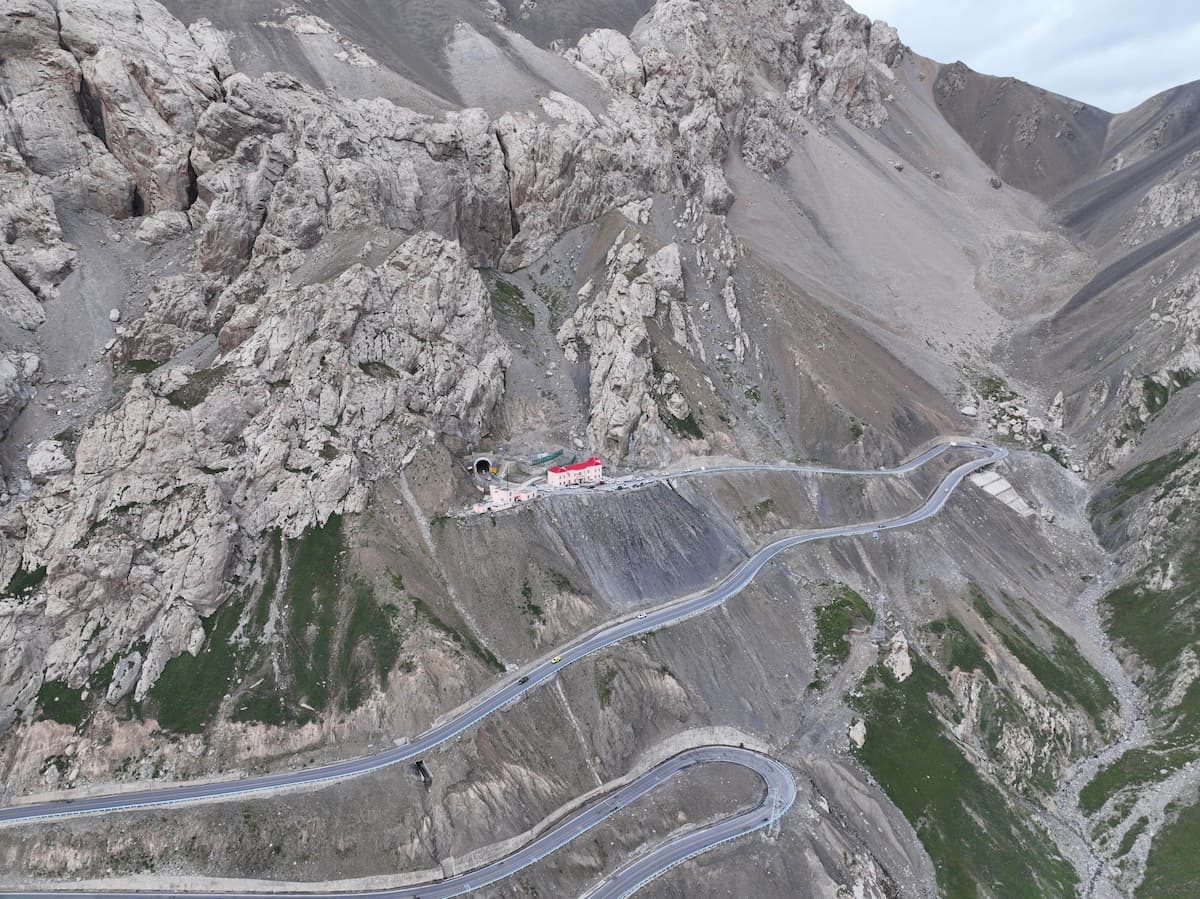
The roads that cross the Taklamakan are the ones people worry about, and the reassuring news is that the major desert highways, including the Tarim Basin loop and the old Lunnan to Minfeng crossing, have DC chargers at service areas. The caveats are spacing and reliability. Stations can be 80 to 150 kilometres apart, and a service area that looks open on the app may have one working post and a queue. When we crossed a southern stretch, we treated every charger as possibly the last for a while and never left a stop below 80 percent. That habit, more than any app, is what kept the trip uneventful.
Cold weather and range: the number that moves
Xinjiang winters are long and hard, and battery chemistry does not like them. At minus twenty, the usable range of a typical EV can fall by a third or more, and the car will also burn energy heating the cabin and the battery. Precondition the pack while still plugged in, keep a larger buffer than you would in summer, and expect DC speeds to drop when the battery is cold. If you are travelling in the cold months, the notes in our winter driving guide cover the tyre and road side of the same trips.
A method for planning any Xinjiang EV route
You do not need to memorise the network if you follow a method. First, sketch the route in an aggregator app and note the gap between consecutive chargers; if any gap exceeds your comfortable buffer, dig deeper or reroute through a city. Second, charge to about 80 percent at each DC stop, because the last 20 percent is slow and expensive in time. Third, arrive at a charger with at least 25 percent left, so a closed station means a short tow or a slow AC top-up rather than a stranded night. Fourth, book accommodation with its own charger where you can, since overnight AC charging is cheap and removes the morning rush. Our where to stay guide covers which kinds of lodging make that easy.
A northern ring sample: Urumqi, Yining and Sayram
To make the method concrete, here is a loop we have actually driven. Leave Urumqi on the G30 and charge at Shihezi or Kuitun, both of which have multiple operators. Reach Yining, the hub of the Ili valley, and charge overnight. From Yining, run up to Sayram Lake near Bole, charge in Bole, and return via the same corridor. The whole ring is well served, the scenery is the green side of the region rather than the desert, and the longest single gap is short enough that a 25 percent buffer is comfortable. If you want the driving detail for the wider region, our self-drive Xinjiang guide lays out distances and road conditions, and our foreign driver’s guide explains whether renting or bringing your own car makes sense.
Questions drivers ask us about charging in Xinjiang
Can I bring my own EV from another country? Technically yes, but you need GB/T adapters and patience with charger handshakes. Most visitors rent a local EV instead, which removes the problem.
Do I need a Chinese SIM to charge? For app registration, yes, and a tourist eSIM handles the verification SMS. Without it you will struggle to start most posts.
Is the desert highway safe to drive electric? Yes, with planning. Chargers exist at service areas, but keep a buffer and expect the odd closed station.
How much does it cost? Public DC charging is cheap compared with petrol, often a few tens of yuan for a meaningful top-up, plus a small parking or service fee at some sites.
A note on accuracy and your responsibility
Charger availability, app requirements and payment rules in Xinjiang shift faster than any article can track, and stations go offline without notice. The details here reflect our checks through late 2026 and should be confirmed against the operator apps on the day you travel. We have no commercial relationship with any charger operator, car rental firm or hotel mentioned on this page.
About this guide’s author
Karl Huang has driven and charged across Xinjiang in multiple vehicles since 2018, splitting time between a rented local EV and long highway runs. He writes practical, experience-led guides to moving around the region and has planned electric routes for travellers who arrived expecting the same plugs they use at home.