Published: July 28, 2026 | Author: Marta Kowalska, with the Xinjiang Attractions editorial team
I spent thirty-one years as a school librarian in Kraków, and the last ten of them running a Saturday story circle for children. So when my husband Piotr suggested we spend our October holiday somewhere along the old Silk Road, I had one condition: I wanted to go where the stories are. That search led us to Xinjiang folktales, a tradition I had only met through a battered Polish translation of the Afanti tales that sat on my library shelf since the 1980s. Two weeks in Urumqi, Turpan and Kashgar taught me that the stories are not museum pieces. People still tell them, sing them and argue about them over tea. This guide covers where we actually heard them, what each tale is about, and how you can plan a trip around Uyghur folklore without speaking a word of Uyghur or Mandarin. Everything below comes from our own trip in October 2025, cross-checked afterwards against published folklore collections where I could find them.
Quick reference: Xinjiang folktales and where to hear them
| Tale or tradition | What it is | Best place to encounter it |
|---|---|---|
| Afanti (Nasreddin Effendi) stories | Comic wisdom tales about a trickster on a donkey | Kashgar teahouses; statues in Turpan |
| Journey to the West episode | The Monkey King borrows a magic fan to quench the burning mountains | Flaming Mountains scenic area, Turpan |
| Queen Mother of the West | Ancient legend of a goddess hosting King Mu at a jade lake | Tianchi (Heaven Lake), near Urumqi |
| Fragrant Concubine (Iparhan) | Contested legend of a Kashgar noblewoman at the Qing court | Apak Khoja Mausoleum, Kashgar |
| Dastan narrative songs | Long verse epics performed with dutar accompaniment | Muqam performances; some Kashgar restaurants |
| Bazaar storytelling | Informal anecdotes, proverbs and jokes traded between stalls | Any Sunday market, if you have a translator |
The trickster on the donkey: chasing Afanti
Every culture keeps a fool who is wiser than the king, and in Xinjiang he is called Afanti, known elsewhere in the Turkic and Persian world as Nasreddin Hodja or Effendi. He rides his donkey backwards, outwits greedy landlords, and delivers punchlines that children repeat two centuries later. My library copy contained forty tales. Our guide Adiljan, a Kashgar native in his fifties, knew easily a hundred more, and he told them the way they should be told: slowly, with a pause before the last line, watching your face for the laugh.
The one I keep retelling at home goes like this. A rich man demands payment from Afanti because Afanti enjoyed the smell of his kitchen. Afanti shakes a bag of coins next to the man’s ear and says the sound of money is fair payment for the smell of food. Adiljan told it in a teahouse off Ostangboyi Road in Kashgar’s old town while three men at the next table nodded along. They had clearly heard it a thousand times. That is the point. These stories work like handshakes.
If you want context on how storytelling fits into the wider culture, our overview of Uyghur culture and daily life is a good starting place before your trip.
The mountains that burn: a Monkey King story in Turpan
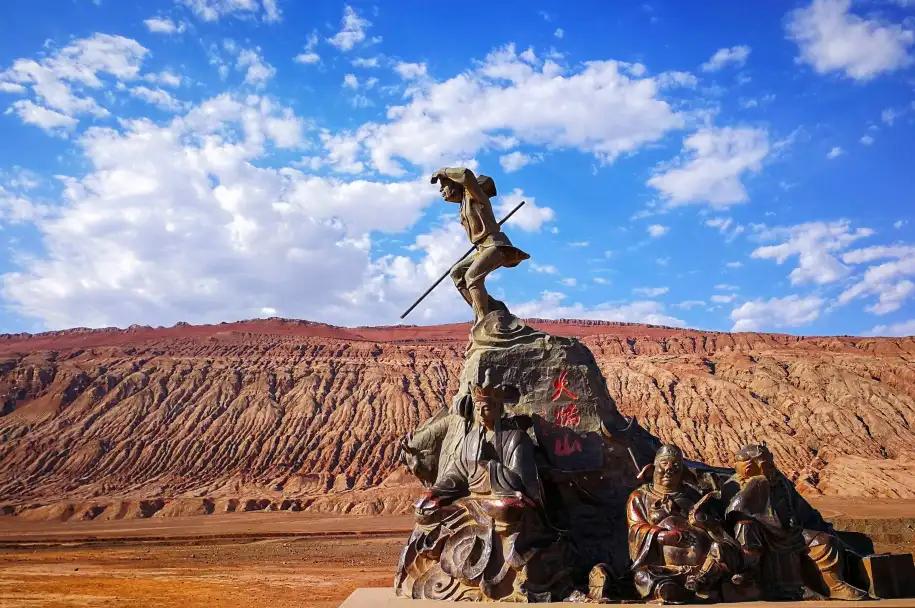
Turpan gave me the strangest reading experience of my life. The Flaming Mountains east of the city are real red sandstone hills that ripple in the heat, and Chinese literature has folded them into the sixteenth-century novel Journey to the West. In the story, the pilgrim monk Tang Seng cannot pass because the mountains burn without end, so the Monkey King tricks Princess Iron Fan into lending her magic palm-leaf fan, puts the fire out with three great swings, and the party continues toward India.
At the scenic area there is a giant golden statue of the Monkey King, a thermometer sculpture recording ground temperatures that can pass 70 degrees Celsius in July, and crowds of Chinese visitors who grew up on the television adaptation the way I grew up on Sienkiewicz. Piotr, who had never heard of the novel, was baffled for about twenty minutes and then completely won over. We paid 40 RMB each for entry in October 2025. Go early; even in autumn the site has no shade worth mentioning. Our separate Flaming Mountains visiting guide covers tickets, timing and the nearby Bezeklik caves in detail.
A goddess by the lake: the legend of Tianchi
North of Urumqi, at about 1,900 metres in the Tianshan range, sits Tianchi, the Heaven Lake. The legend attached to it is older than anything else in this article. The Queen Mother of the West, a goddess from early Chinese mythology, is said to have received King Mu of Zhou here around three thousand years ago, feasting him beside the jade water and asking him to return. He never did. Standing at the shoreline on a cold, clear October morning, with Bogda Peak white above the spruce forest, I found the story easy to believe. Some places simply feel like they were built for myths.
There is a small Taoist temple dedicated to the goddess on the lake’s eastern side. Most visitors skip it in their rush to photograph the water, which is a mistake if stories are what you came for. Practical details, including the shuttle system and entry fees, are in our Tianchi Lake travel guide.

Sung stories: dastan epics and the Muqam
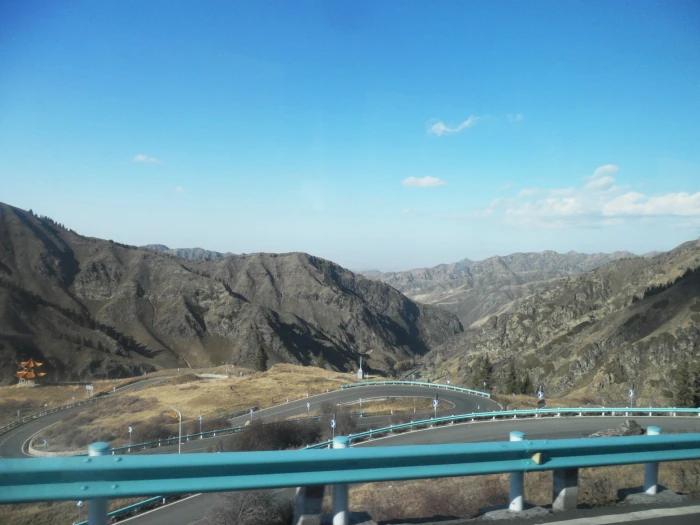
Not all Xinjiang folktales are spoken. The long ones are sung. A dastan is a verse epic, sometimes hours long, performed from memory with a two-stringed dutar. Love stories such as Gherip and Sanam survive this way, carried inside the larger musical tradition of the Twelve Muqam, which UNESCO listed as intangible heritage in 2005. We caught a forty-minute staged performance in Kashgar, and even filtered through a tourist setting, the moment when the singer’s voice cracked on a lament silenced the whole room.
If the musical side interests you more than the narrative side, read our pieces on the Xinjiang Muqam heritage and on the dutar and rawap instruments that accompany these epics. Dance often carries story too; the Dolan traditions described in our Xinjiang folk dance guide began as hunting narratives acted out in the round.
Getting there and around
Urumqi Tianshan International Airport connects to every major Chinese city and a handful of international hubs. From Urumqi, high-speed trains reach Turpan North in about an hour (from roughly 50 RMB second class), and Kashgar is a 90-minute flight or an 18-hour sleeper train. We flew out and took the sleeper back, which I recommend in that order: the train gave us a full day of desert scenery and a compartment-mate who contributed two Afanti stories of her own via a translation app. Within cities, taxis and Didi (the Chinese ride-hailing app) are cheap; our longest Kashgar taxi ride cost 15 RMB.
Best time for a folklore trip
We chose mid-October and would choose it again: daytime temperatures around 15 to 20 degrees in Turpan, cold mornings at Tianchi, thin crowds everywhere. May and September are similarly comfortable. July and August bring serious heat to Turpan, regularly above 40 degrees, though evening life in the bazaars runs later. Winter cuts services at Tianchi but concentrates indoor storytelling; teahouses do not close. If your goal is hearing people talk rather than photographing landscapes, season matters less than you might think.
Where we stayed
In Urumqi we took a mid-range chain hotel near the Grand Bazaar area for about 320 RMB a night, chosen purely for walking distance to evening performances. In Kashgar we splurged slightly on a courtyard guesthouse inside the old town, around 450 RMB a night in October, and it was the best decision of the trip. Falling asleep to the sound of the neighbourhood and waking to bread ovens meant we were inside the story world at all hours. Book old-town guesthouses at least two weeks ahead in high season; there are few of them and tour groups block-book.
What to eat while you listen
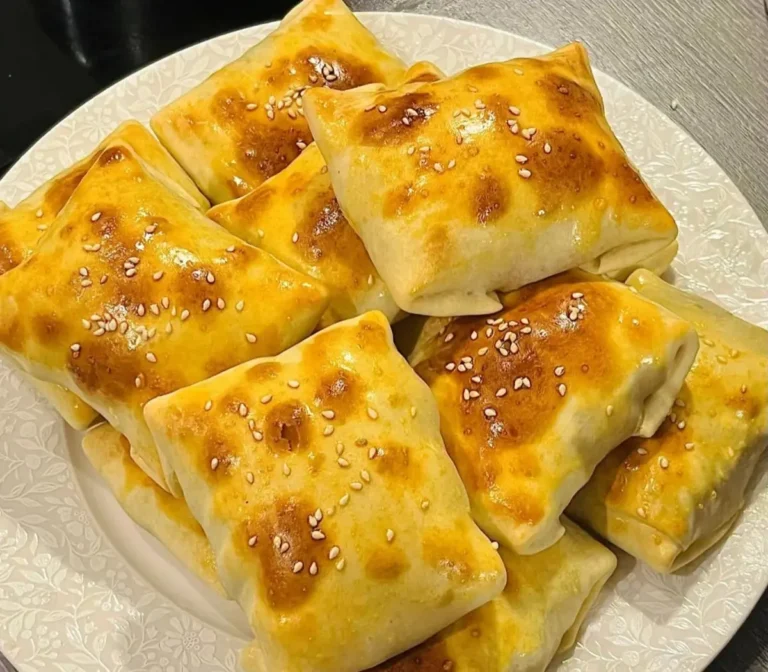
Teahouse culture and story culture are the same culture. Order a pot of medicinal tea (about 10 RMB, refills free), a plate of samsa (baked lamb pastries, 5 RMB each), and you have bought yourself a seat for as long as you like. Laghman noodles, polo rice with carrots and mutton, and fresh figs from market stalls fuelled the rest of our days. The food stalls at the Kashgar Sunday Market deserve a morning of their own, and the market itself is the closest thing to a living anthology of jokes, proverbs and haggling theatre that I have ever walked through. What markets mean beyond commerce is a subject our bazaar culture article explores at length.
Practical tips from our trip
- Hire a local guide for at least one day. The tales live in people, not plaques. We paid Adiljan 600 RMB for a full day in Kashgar and consider it the best money we spent.
- Ask permission before recording. I asked before taping Adiljan’s stories for my library circle. He said yes with pleasure, but assuming would have been rude.
- Read one version before you go. Any Nasreddin collection works. Recognising a tale mid-telling is a joy no first hearing can match.
- Translation apps handle Mandarin far better than Uyghur. Budget patience, or route conversations through your guide.
- Carry cash in small notes. Teahouses and story-friendly market stalls often prefer 5s and 10s, though most now accept Alipay.
- Treat contested legends gently. The Fragrant Concubine story is told differently by different communities. Listen more than you comment.
A five-day storytelling itinerary
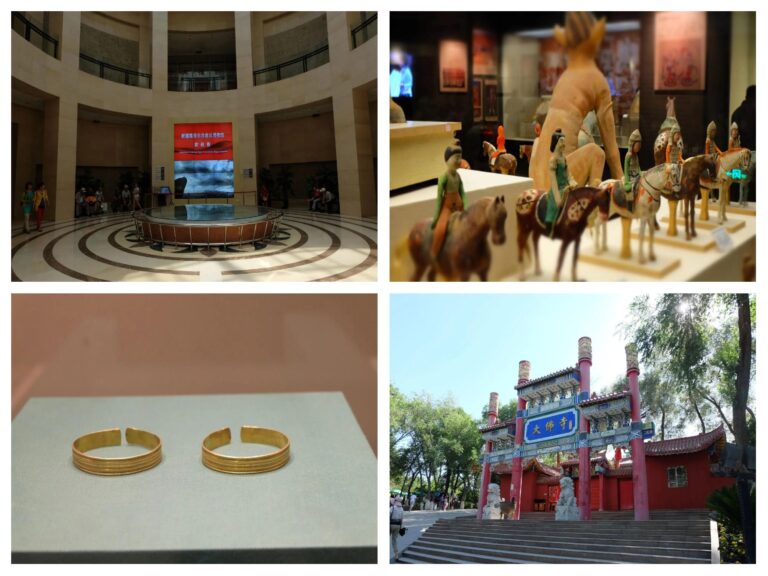
Day 1, Urumqi: arrive, visit the Xinjiang Regional Museum (the Tarim mummies come with legends of their own), evening at the Grand Bazaar.
Day 2, Tianchi: day trip to Heaven Lake, seek out the temple of the Queen Mother, return to Urumqi.
Day 3, Turpan: morning high-speed train, afternoon at the Flaming Mountains with the Monkey King, evening under the grape trellises.
Day 4, fly to Kashgar: sunset walk in the old town, staged Muqam and dastan performance after dinner.
Day 5, Kashgar: guided storytelling day with teahouse stops, Apak Khoja Mausoleum for the Iparhan legend, night flight or sleeper train out.
FAQ about Xinjiang folktales
Can I hear Xinjiang folktales in English?
Rarely in the wild. Hire an English-speaking guide, or attend staged performances where printed summaries are sometimes available. Reading translations beforehand transforms what you get out of live tellings.
Are the Afanti stories Uyghur or Turkish?
Both, and neither exclusively. The Nasreddin figure spans from the Balkans to western China. Uyghur tellers have shaped their own repertoire around him for centuries, and UNESCO recognised the tradition across multiple countries in 2022.
Is Journey to the West a folktale?
Strictly it is a literary novel, but it absorbed older oral traditions and has flowed back into popular retelling so thoroughly that at the Flaming Mountains the line between book and folklore has effectively dissolved.
Do children’s versions of these stories exist?
Yes. Chinese bookshops in Urumqi stock illustrated Afanti collections, some bilingual. I brought four back for my library and they circulate constantly.
Is it appropriate to retell these stories at home?
In my view, yes, with attribution. Folktales travel by being retold. Naming the tradition and the place you heard them honours the tellers.
Disclaimer
This article reflects a personal trip taken in October 2025. Prices, opening hours and transport schedules change; verify current details before travelling. Folktale versions vary between tellers and communities, and the summaries here are simplified retellings, not authoritative texts. Some legends, notably that of the Fragrant Concubine, are interpreted differently by different groups; we present them as travel context only. We received no free services or payments from any business mentioned.
About the author
Marta Kowalska is a retired school librarian from Kraków, Poland, who ran a children’s story circle for ten years and travelled through Xinjiang with her husband in October 2025. This article was edited and fact-checked by the Xinjiang Attractions editorial team, who have covered the region’s culture and destinations since 2024. All opinions are the author’s own.