Published: August 13, 2026 | Author: Karl Huang
Most travelers treat Yining as a fuel stop on the way to the Ili grasslands and never walk its oldest neighborhood. I did exactly that on my first visit, and I regretted it. Kazanqi Yining is the blue-painted old town on the southern side of the city, and on a return trip it became the place in Xinjiang I think about most. This write-up comes from two separate stays, a handful of wrong turns, and conversations with people who actually live there.
Why you can rely on this guide
I run a Xinjiang-focused travel desk and have routed well over a hundred visitors through the Ili Valley. The streets, prices, and timing below are pulled from my own walks through Kazanqi, not from a tourism leaflet. Numbers change, so read anything about fares or opening hours as a 2026 starting point and check on the ground.
Kazanqi Yining at a glance
| Detail | What to know |
|---|---|
| Location | Southern Yining, Ili Kazakh Autonomous Prefecture, about 4 km from the city center |
| Main draws | Blue wooden houses, horse-carriage lanes, Liuxing Street radial layout, local food |
| Entry | The lanes are open and free to walk; carriage rides and some courtyards charge fees |
| Best months | May to October; apricot bloom in April, golden leaves in October |
| Time needed | Half a day on foot, a full day if you add the Ili River sunset |
| Getting around | Walk the core; taxi or ride-hailing from central Yining takes 10 to 15 minutes |
Our walk through the blue lanes
We rolled into Yining on an overnight train and dropped our bags at a courtyard guesthouse inside the old town. By nine in the morning the lanes were already alive: a woman sweeping the pavement in front of a turquoise door, the smell of fresh naan from a corner bakery, and a horse carriage clopping past with tourists balanced on the bench.
Kazanqi got its name from Uyghur pot and cauldron makers who once worked here, and you can still see the craft in the heavy iron woks sold along the side streets. What stops people is the color. Nearly every house is washed in blue, teal, or green, with carved wooden shutters and grape vines trained over the gates. Nobody we asked could pin down a single reason for the blue. Some said it keeps the wood cool through the summer, others said it is simply what their parents painted, and a few credited Russian and Tatar settlers who carried the taste here a century ago.
The part I did not expect was the mix of people. In the space of one block we passed a Russian-style brick villa, a Tatar bakery, a Xibe family’s courtyard, and a Hui noodle shop. Kazanqi is less a museum than a working neighborhood, and that is exactly why it works. A short drive south is Qapqal, the Xibe homeland, and our Qapqal guide explains the unusual history of the people who settled there.
At the heart of the district sits Liuxing Street, laid out in the 1930s as a radial plan with six roads fanning out from a central plaza. Standing in the middle and turning slowly, you see the lanes shoot off like the spokes of a wheel. It is the kind of detail that does not show up in photos but makes the place feel planned rather than accidental.
Getting to Kazanqi Yining
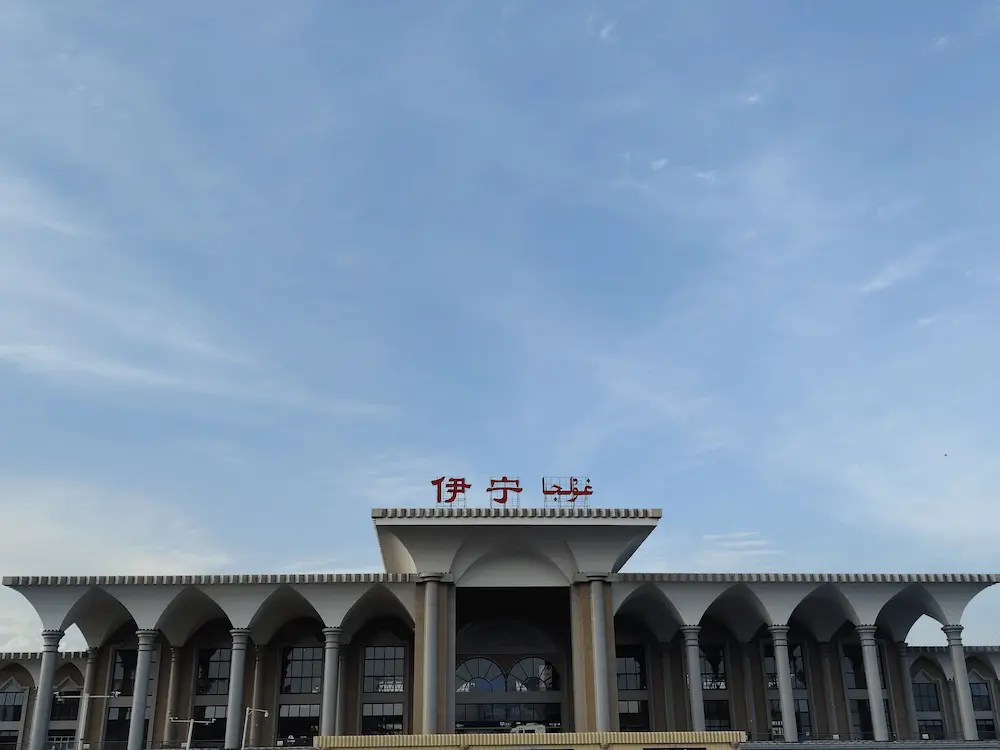
Yining Airport (IATA: YIN) has daily flights from Urumqi and seasonal links to a few other cities. From the terminal, a taxi to the old town runs about 25 to 35 yuan and takes 20 minutes depending on traffic. The train is the cheaper play: an overnight soft-sleeper from Urumqi to Yining Station puts you in the city before sunrise for a fraction of a flight’s cost, and the station is only a short ride from Kazanqi.
Within Yining, ride-hailing apps work the same as anywhere in China, and regular taxis are easy to flag near the bazaar. City buses reach the edge of the district for a couple of yuan if you want the local experience. If you drive yourself, note that cars cannot enter the pedestrian core, so park at the edge and walk. The Yining travel guide I wrote covers the wider city and how to string Kazanqi together with the grasslands further out.
The best time to visit
Late April brings apricot blossom across the Ili Valley, and the blue walls look almost painted against the pale pink trees. June through August is warm and green, with long daylight that lets you walk until ten at night. September and October are my favorite window: the heat drops, the grapes come in, and the leaves on the lane-side trees turn gold. Winter is cold and quiet, but the blue doors under snow make for striking photos if you do not mind the chill.
If your schedule is flexible, pair the trip with a longer loop. The Yili Valley itinerary lays out a route that folds Kazanqi in with Sayram Lake, Nalati, and the smaller grassland towns.
Where to stay
You have two reasonable choices. The first is a courtyard homestay inside Kazanqi itself, where you step out of your room straight into the lanes. These fill fast in summer, so book ahead. The second is a standard hotel near Yining’s center, which gives you more choice and lower prices but means a short commute each morning.
I lean toward staying in the old town at least one night. The morning light on the blue plaster, the call from the nearby mosque, and the breakfast stalls that only locals seem to know about are worth the slightly thinner walls. For a broader look at sleeping in historic neighborhoods across the region, see our notes on Xinjiang guesthouses in the old towns.
What to eat
Kazanqi eats like the crossroads it is. Start with a fresh Xinjiang naan from a lane bakery, still warm and faintly smoky. Hand-pulled ice cream, churned in copper pots and called shougonghua locally, is a specialty you will see made by hand, and it tastes nothing like the tub stuff back home. Then there is kvas, a lightly fermented malt drink of Russian origin that Ili took as its own; it is sweet, faintly sour, and dangerously easy to keep ordering.
Around the lanes you will also find laghman noodles, samsa baked in the tandoor, grilled kebabs at tiny charcoal stalls, and plates of oily pilaf studded with raisins and carrot. Most dishes run from 10 to 40 yuan. Sit where the families are sitting and you will rarely go wrong. The dried-fruit shops are worth a slow browse too: apricots from the valley, walnuts, and chewy raisins sold by the kilogram.
Practical tips
- Carry cash. Some carriage drivers and small bakeries do not take cards or foreign apps.
- Ask before photographing people. Most residents are friendly, but a quick smile and gesture goes further than a lens in their face.
- Wear flat shoes. The lanes are paved but uneven, and you will walk more than you plan.
- Learn two phrases: “rahmet” (thank you) and “qandaq” (how much). They open more doors than a guidebook.
- Go early. The light is better and the tour groups have not arrived yet.
- Bargain gently at the craft stalls. A smile and a joke land better than hard negotiation.
A one-day sample itinerary
09:00 Walk in from the eastern gate and follow the main lane to Liuxing Street, the hexagonal plaza laid out in the 1930s with six roads fanning out from the center.
10:30 Take a horse carriage (hadik) loop through the side streets; negotiate the fare before you board.
12:00 Lunch on laghman and kebabs at a family stall, then rest at a tea house with a bowl of milky tea.
14:00 Browse the cauldron workshops and the small folk-craft shops for a hand-made copper piece.
16:30 Taxi to the Ili River bridge for the sunset; the water goes flat and orange and the locals come out to walk.
19:00 Dinner back in the old town, then a slow walk home under the street lamps.
FAQ
Is Kazanqi free to enter?
The neighborhood is open and free. You pay only for carriage rides, specific courtyards, or food and souvenirs.
How long should I spend?
Half a day covers the core on foot. Add the Ili River sunset and you have a full, relaxed day.
Can I visit independently or do I need a tour?
You can absolutely walk it yourself. A guide helps with language and history, but the lanes are safe and easy to explore alone.
Is it worth staying overnight?
Yes, if your trip allows it. Mornings and evenings in the old town feel different from the midday crowd.
Disclaimer
This article reflects personal travel experience and was accurate to the best of our knowledge as of 2026. Prices, schedules, and access rules change, and some details may differ by season or after publication. Always confirm transport, lodging, and entry conditions with official sources before you travel, and respect local customs and regulations during your visit.
About the author
Karl Huang is a travel writer and operator who has spent the last several years documenting Xinjiang for foreign visitors. He focuses on practical, first-hand guidance and works with local partners across the region. He can be reached through the XinjiangAttractions editorial desk.