Published: August 14, 2026 | Author: Karl Huang
Why you can trust this guide
I have driven the main Xinjiang highways in three separate winters, most recently a January loop from Urumqi west to Sayram Lake and back through Karamay. This is not a list copied from a rental-agency brochure. It is what actually happened on the road, plus the rules the traffic police and the car-hire desks told us to follow. Conditions up here change within a single night, so wherever a decision depends on live road status I have pointed out exactly where to check before you set off.
Winter driving in Xinjiang at a glance
| Best window to drive | December to February for snow scenery; March is still icy on shaded sections |
|---|---|
| Highways that stay open | G30 Lianhuo (Urumqi–Khorgos) and G3014; the Duku Highway closes roughly November to May |
| Legal tyres | Winter tyres are fine; studded (spiked) tyres are banned on public roads in China |
| Snow chains | Allowed on snow and ice; must be taken off once you reach clear pavement |
| Fuel discipline | Keep the tank above half — stations can sit 150 km or more apart |
| Numbers to know | 122 for traffic accidents, 12122 for the highway assistance line |
| Documents | Passport plus a temporary driving permit; an International Driving Permit alone is not valid |
What it is actually like: our January loop
We left Urumqi on a Tuesday when the thermometer outside the rental office read minus 19°C. The SUV we booked came on all-season tyres, and the desk added a set of steel-link snow chains to the boot without us asking — a small gesture that turned out to matter. The G30 was ploughed and salted for the first stretch, but the long descent toward the Guozigou bridge was a different story: a sheet of black ice sat under a thin film of meltwater, invisible until the wheel tugged. We slowed to 40 km/h, left three car-lengths of space, and kept the steering dead straight.
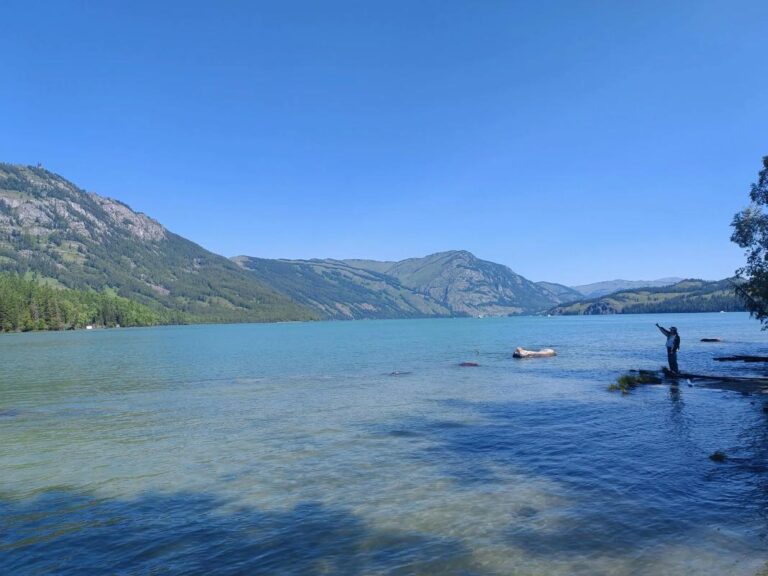
At the Kuitun service area we fitted the chains for the final climb toward Sayram Lake. It took ten cold minutes with gloves that were already useless, and the clatter on the tarmac told us exactly when we were back on clear road and could stop to remove them. Sayram itself was frozen solid — a pale blue disc ringed by snow, with the wind lifting spray that froze on contact. We had seen the postcard version in summer; the winter lake was stranger and quieter, and getting there by car taught us more about the region than any guidebook page.
Getting there: car, train, or fly-and-drive
Most visitors base a winter drive out of Urumqi, where every major car-hire company has a desk at the airport and in the city center. Ask specifically for winter tyres or at least confirm the tread depth before you sign; some agencies keep a small fleet of 4WD SUVs for the cold months and these are worth the upgrade on mountain passes. Foreigners need a temporary driving permit issued alongside a Chinese licence — arrange this through the rental company or the traffic-management office, because an IDP on its own will not get you past a checkpoint.
If you would rather not drive the whole way, the train is a sane alternative for the long hauls: you can ride the refuelling rules for a self-drive trip mindset even when you are a passenger, and rent a car only for the final scenic legs. Either way, read up on ID checks at checkpoints so the stops feel routine rather than surprising.
Best time to take the wheel
Deep winter (late December through January) gives the best snow scenery and the famous frozen lakes, but also the hardest driving and the coldest temps in the north. February is a good compromise: snow remains, services are steadier, and the worst of the minus-thirty weeks has usually passed. Avoid assuming any high pass is open — the seasonal mountain-pass closures change year to year with snowfall, and the Duku Highway is reliably shut for the whole winter. Always check the night before and the morning of departure.
Where to sleep on a winter route
Stick to the bigger towns and you will find heated chain hotels with guarded parking — Urumqi, Shihezi, Kuitun, Karamay and Bortala all have dependable options. Book a day ahead even in low season, because some smaller guesthouses and the yurt camps around Sayram close from November until spring. We liked overnighting in Kuitun: it splits the Urumqi–Sayram drive into two manageable halves and the parking is lit and warm enough that the windscreen was not a block of ice at dawn.
Food and what to keep in the car
Carry a vacuum flask of tea or coffee, plus raisins, walnuts and the flat naan that keeps well in the cold. Service areas on the G30 serve hot noodles and mutton skewers, but in winter their hours shrink and the last cooked meal may be earlier than you expect. Do not leave water bottles in the boot — they freeze and split. A small cooler bag inside the cabin actually works better as a keep-warm box for road snacks than as a fridge.
Practical winter-driving rules
The tyre law is the part most first-timers get wrong. Winter tyres (marked with the snowflake symbol) are legal and recommended. Studded tyres, the kind with metal spikes, are prohibited on public roads in China because they scar the surface — bring chains instead, and only fit them on snow or ice. Before any winter trip, check tread, cold-inflation pressure (tyres lose pressure as temperatures drop) and that the spare is actually inflated.
On the road, the rules are mostly about restraint. Brake early and gently so the ABS does its job; never yank the wheel on a skid; use a lower gear on long descents so the engine helps slow you. Black ice loves bridges, tunnel mouths and the shaded north side of a mountain — the spots that look dry are often the slickest. Keep a kit in the cabin: a folding shovel, a tow strap, sand or cat litter for traction, a torch, spare power bank, and a blanket. None of it is heavy, and all of it is cheaper than waiting for a recovery truck at minus twenty.
For anything longer than a day trip, also review medical preparedness for cold-weather travel — frostbite and hypothermia start quietly, and a warm layer you can reach without unpacking the boot is worth more than the one buried at the bottom.
A 5-day winter driving itinerary
Day 1 – Urumqi. Land, collect the car, fit winter tyres or load chains, and provision at a supermarket. Keep the first day short so you are rested for the cold starts.
Day 2 – Urumqi to Kuitun (about 250 km). A straight run on the G30. Overnight in Kuitun; top up fuel here.
Day 3 – Kuitun to Sayram Lake (about 350 km). West on the G30 through the Guozigou bridge. Fit chains for the final climb if there is fresh snow. Spend the afternoon on the frozen lake shore, then overnight in Bortala.
Day 4 – Sayram to Karamay (about 300 km). Head north on the G3014. If the weather holds, detour to the wind-carved Ghost City nearby before dark. Overnight in Karamay.
Day 5 – Karamay to Urumqi (about 330 km). A final G3014–G30 run back to the city. Return the car with a full tank and the chains cleaned and folded.
Frequently asked questions
Do I need a special licence to drive in winter? No special winter licence exists, but foreigners must hold a temporary driving permit alongside a Chinese licence. Winter experience matters more than paperwork.
Are studded tyres legal? No. Studded tyres are banned on public roads in China. Use winter tyres or snow chains.
Is the Duku Highway open in winter? No. It closes for the season, roughly November through May, because of snow at the high passes.
Can I rent a car with winter tyres? Many Urumqi agencies offer them, especially the SUV fleet, but always confirm when booking and again at the desk.
What if I slide off the road? Stay with the vehicle, switch on hazard lights, call 122 or 12122, and use the emergency kit. Do not walk far into the cold looking for help.
Disclaimer
This article is based on personal winter trips and on-the-ground advice from local hire desks and traffic authorities. Road conditions, closures, permit rules and weather in Xinjiang change without notice. It is not a substitute for professional driving instruction or for checking official sources before you travel. Always confirm current road and permit status with the relevant authorities, and drive within your own ability and the law.
About the author
Karl Huang is a travel writer who has covered Xinjiang across four seasons, with a particular interest in overland and self-drive routes. He has driven the region’s highways in summer heat and winter ice, and writes practical, first-hand guides for independent travellers. His work focuses on real road conditions, local rules and the kind of detail you only learn by being stuck behind a snowplough at dawn.