Published: November 1, 2026 | Author: Xinjiang Attractions Editorial Team
Ask any long-haul driver in Xinjiang what they eat at noon and the answer is almost always the same: a bowl of Xinjiang banmian. These hand-pulled belt noodles, dressed in a hot stir-fried sauce, are the default road meal from the G30 corridor to the Pamir foothills. This guide comes from years of pulling into the small 拌面馆 that line the region’s highways, and it explains what the dish is, how to order it, and where the road serves the best bowls.
| Item | Detail |
|---|---|
| Local names | banmian (拌面), latiaozi (拉条子); Uyghur: laghman |
| What it is | Hand-pulled wheat belt noodles with a hot stir-fried sauce |
| Typical price | 15 yuan (plain) up to 35 yuan (meat toppings) |
| Best time | Lunch, 1–2 p.m.; most shops cool the wok by mid-afternoon |
| Free extra | 加面 (jia mian): a free refill of plain noodle to finish the sauce |
| Where to find | Roadside 拌面馆 along the G30, in Toksun, Qitai, the Turpan fringe, and Ili |
Why banmian answers to two names
The same belt noodle you order as banmian in a Chinese-speaking 拌面馆 is called laghman in a Uyghur kitchen. They are not two recipes but two languages for one dish: a chewy strand of wheat dough pulled by hand into a flat ribbon, then topped or tossed with a savory stir-fry. We cover the Uyghur side in our piece on Uyghur laghman, but the banmian experience is its own thing. The banmian counter is usually a no-frills roadside stop run by Hui or Han cooks, where speed matters more than ceremony and the wok never rests during the lunch rush.
Knowing the name saves confusion at the counter. 拌面 literally means “mixed noodles,” and in Xinjiang it points to the belt-shaped strand, also called 拉条子 (latiaozi, “pulled strips”). Say either word and you will get the same bowl.
Why Xinjiang banmian fuels every road trip
There is a reason banmian dominates the highway. It is fast, filling, and built for a traveler who still has three hundred kilometers to drive. A cook can pull, boil, and sauce a bowl in under five minutes, and the wheat gives the slow energy a long desert stretch demands. On our drives we have watched whole tour buses empty into a 拌面馆 at the same hour, everyone out and back in twenty minutes with a full stomach.

It also travels well in memory if not in the bowl. The sauce stays hot, the noodle keeps its bite, and a bowl costs about what a snack would elsewhere. For a region where towns can sit an hour apart, that math matters more than the menu.
A Toksun junction we still remember
The stop that hooked us was outside Toksun, on the G30 east of Turpan. We had driven through the wind and the heat, and a hand-painted sign reading 拌面 15元 pulled us off the road. Inside, a single wok, a mountain of rolled dough, and a cook who never looked up from the pull. When the bowl landed it was wider than the plate, glossy with onion and pepper, and we understood why trucks queue here. That was the day banmian stopped being “just noodles” and became the meal we plan routes around.
Toksun carries a real reputation for it. Locals will tell you the town’s water and wheat make a softer strand, and whether or not that holds up, the cluster of good 拌面馆 along the G30 off-ramp is no accident.
The roadside 拌面馆: what to expect inside
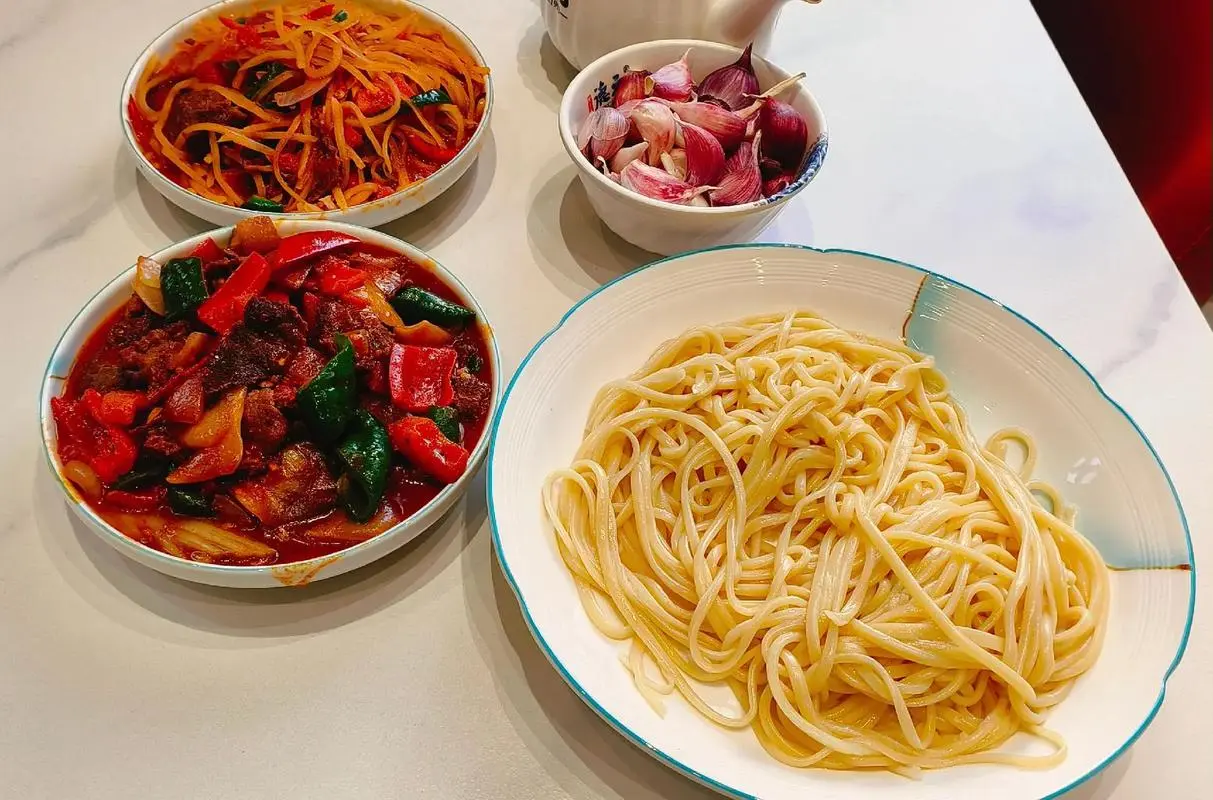
Walk in and the routine is nearly the same everywhere. You order at the counter, take a seat, and within minutes a bowl arrives with the noodle buried under sauce. There is no menu ballet. Most places list toppings on a board behind the wok in Chinese only, with prices climbing from a plain tomato-egg version to a meat-heavy house special. Tea usually sits free in a big thermos on the table.
Do not wait for a waiter to bring the check. In the smaller stops you pay at the counter on the way out, and the cook is often the owner, the cashier, and the dishwasher at once.
The free refill that catches newcomers off guard
Here is the custom that surprises first-timers: when you finish the noodles, you can ask for 加面 (jia mian) and receive a fresh portion of plain boiled noodle, free, to mop up the leftover sauce. Many road crews eat one bowl of sauce and two rounds of noodle. We have seen travelers hesitate, sure it was a upsell, then grin when the second helping lands with no charge. If the bowl is clean and you are still hungry, just say 加面 and point at your plate.
This is not a gimmick. It is the dish’s answer to a working lunch: the sauce is the meal, the extra noodle is the filler, and the road does not care how many rounds you take.
Reading the board: toppings that define a bowl
The sauce is where banmian shows its range. A few standards appear on nearly every board:
- 过油肉 (guo you rou): sliced pork or lamb flash-fried with pepper and onion. The reliable default.
- 皮牙子 (piyazi): simply onion, often with egg, for a lighter plate.
- 辣皮子 (la pi zi): Xinjiang’s dried chili strips, fried into a deep red, smoky sauce. Order this if you like heat.
- 番茄鸡蛋 (fan qie ji dan): tomato and egg, the safe choice for kids or egg-eating vegetarians.
- 土豆丝 (tu dou si): shredded potato, cheap and crunchy.
Point at the board or name the topping in Chinese; either works. If you are unsure, 过油肉 is the one locals reach for, and it tells you what a proper banmian should taste like: peppery, a little oily, and loud with onion.
The highway junctions worth a detour
Banmian is everywhere, but a few spots have earned a name on the road:
- Toksun (托克逊): just off the G30 east of Turpan. The classic first stop out of the east, known for a soft strand and busy lunch counters.
- Qitai (奇台): north of the Tianshan toward the Junggar edge, with a local claim to a “Qitai banmian” brand and a thicker, chewier pull.
- Dahuang (大河沿) and the Turpan fringe: small stops where drivers refuel and then refuel again with a bowl.
- Ili (伊犁): in the west, where the sauce leans greener with more pepper and the portions run large.
None of these are tourist sites, and that is the point. You go for the noodle, not the view. Pair the stop with the other road staple in our Xinjiang polo guide if you want to compare the two fuels of the region.
A half-day loop built around banmian
If you want to make a meal of the meal, run a short drive: leave Turpan in the morning, take the G30 to Toksun for a banmian lunch, then loop north toward the Tianshan foothills and back. Four hours of driving, one unforgettable bowl, and plenty of road left. For longer routes, our notes on hiring a car and driver cover how to string stops together without watching the clock, and the where to stay guide helps if you turn the loop into an overnight.
When the road is hungriest
Banmian is a lunch dish first. Most 拌面馆 open from late morning and peak between 1 and 2 p.m.; arrive at 3 and the wok may be cold. In summer the hot bowl feels wrong until you remember the air conditioning inside, while in winter it is the best thing on a frozen highway. If the heat gets to you, the cold liangpi noodles we write about are the cooler cousin from the same kitchens.
Notes for first-time road eaters
A few things we wish we had known: carry small cash for the tiny stops, though most now take phone pay; the chili sauce is hotter than it looks; and the free 加面 only covers plain noodle, not a second sauce. Vegetarians can ask for 番茄鸡蛋 or 皮牙子 and request no meat, but cross-contamination in a single wok is likely, so treat it as preference, not promise. Wash up with the thermos tea rather than the sometimes-questionable sink.
Questions that come up at the counter
Is banmian the same as laghman? Same noodle, different kitchen and name. Banmian is the Chinese-speaking roadside version; laghman is the Uyghur one.
How much does it cost? Plain versions start around 15 yuan; meat toppings run 20 to 35 yuan depending on the stop and the town.
Can I get it without the chili? Yes, ask for 微辣 (mild) or 不辣 (no chili); the cook will hold the pepper strips.
Is it safe to eat at small roadside stops? Generally yes; the high turnover means fresh oil and fast service. Use the same judgment you would at any busy local eatery.
A straight word on what to expect
We describe banmian from our own road stops, not from a restaurant review system. Prices, boards, and even the free 加面 custom vary by town and by year, so treat the specifics above as a starting point and confirm at the counter. This article is travel guidance, not a recommendation of any single shop, and we are not affiliated with any 拌面馆 we mention.
Who wrote this banmian road guide
This guide was compiled by the Xinjiang Attractions Editorial Team, a small group of writers who have driven the region’s highways across multiple seasons. We eat at the counters we write about and update pieces when the road changes. If a stop has closed or a price has moved, tell us and we will fix it.