Published: August 7, 2026 | Author: Hugh Prentice, hot-climate travel writer
This Turpan travel guide is built around one idea that took me two visits to accept: in Turpan, the schedule matters more than the sightseeing list. The basin sits below sea level, gets under 20 mm of rain in a year, and evaporates more than 3,000 mm off its surface in the same period. Those two numbers explain the grapes, the underground water channels, the mud-brick ruins that never washed away, and why my first trip here was mostly a sweaty failure.
Why you can trust this page: I write about hot-climate destinations for a living and have spent three separate stays in Turpan — one in late April, one in the second week of August, one in November. Entrance fees and train times below reflect what I paid and rode; both change, so I say where to re-check rather than pretending my numbers are permanent.
What this guide covers, and what it hands off
Turpan has more written about it on this site than almost anywhere else in Xinjiang, so let me be clear about the division of labour. This page is the planning layer: geography, transport, how many days, seasons, lodging, and a schedule that works around the sun.
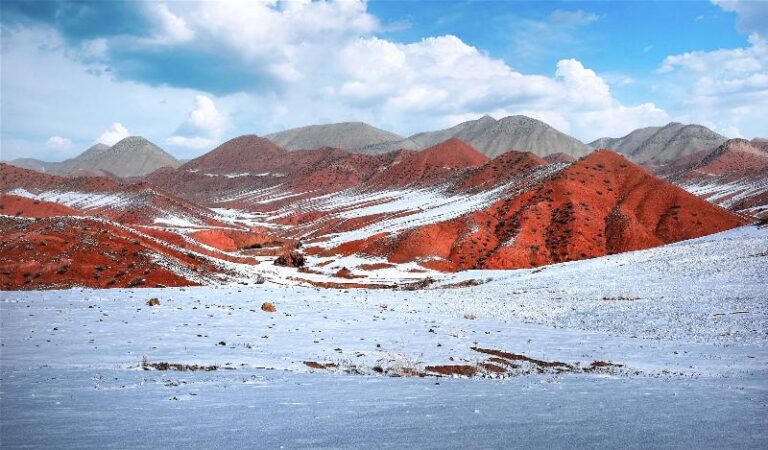
For the individual places, go to the dedicated pages: Jiaohe Ancient City for the archaeology, Gaochang Ruins for the Buddhist capital that followed it, the Flaming Mountains for the red sandstone ridge, and Grape Valley for the harvest. If you want the texture of the modern town rather than the ruins — markets, evening streets, ordinary neighbourhoods — that lives in the Turpan city guide.
Quick reference
| Item | Detail |
|---|---|
| Where | Eastern Xinjiang, roughly 180 km southeast of Urumqi |
| Elevation | City around sea level; basin floor drops to -154 m at Aydingkol Lake |
| Getting in | High-speed train from Urumqi to Turpan North, about 1 hour |
| Comfortable months | April–May and late September–October |
| Grape harvest | Late July through August |
| Days to allow | Two full days; three if you want Tuyoq or the desert |
| Local prefecture | Gaochang District plus Shanshan and Toksun counties, about 690,000 residents |
The depression: why Turpan is hot, low and sweet
Turpan sits in a fault basin on the southern flank of the Tianshan. Air sinking into a closed depression compresses and warms, and no water body is large enough to moderate it. The result is an official extreme of 49.6°C, with ground surface temperatures passing 70°C on bare rock in July. Uyghur speakers named the place something close to “fertile land”; Chinese sources have called it the Fire Land for centuries. Both are accurate, which is the interesting part.
The low point is Aydingkol Lake at -154.31 m, the lowest land in China. One correction worth making, because I have seen it repeated in print and in an earlier version of this page: Turpan is not the second-lowest place on Earth. The Dead Sea shoreline is far lower. Turpan holds the Chinese record, which is impressive enough without inflating it. To stand at the bottom, Aydingkol Lake has its own page.
The heat plus meltwater running off the Tianshan is what makes the fruit work: huge daily temperature swings and relentless sun push sugar into grapes and melons in a way milder places cannot match. Every superlative about Turpan traces back to the same basin.
Getting there: the one-hour train from Urumqi
Almost everyone arrives from Urumqi. The high-speed service to Turpan North takes about an hour and I have never used anything else on that leg. Conventional trains run the same route more slowly and cheaply; long-distance buses take three to four hours for little saving.
One warning I wish someone had given me: Turpan North station is well outside town, so budget 30–40 minutes and a taxi fare to reach the centre. Coming from the south, Korla is roughly five to six hours by train; from Kashgar it is an overnight, or a flight to Urumqi and the train back down.
Once here, the sites are scattered across a wide plain and public transport between them is poor. Hiring a car with a driver for the day is standard practice and, split two or three ways, beats repeated taxis. Agree the route and the waiting time before you set off, not at each stop.
How many days you actually need
Two full days covers the headline sites without rushing. One day is possible and I have done it, but you spend the middle of it in a vehicle regretting your choices. Three days lets you add Tuyoq village or the Shanshan dunes. Many tour itineraries treat Turpan as a half-day stop, which buys you a car-park view of the Flaming Mountains and a bag of raisins.
Heat is a scheduling problem, not a reason to stay away
My August visit began badly. I reached Gaochang at about 13:30, walked perhaps 400 metres in, and turned back with a headache that lasted the rest of the day. There is no shade out there and the ground radiates heat upward at you.
The fix is not avoiding summer, it is treating midday as unusable. Locals have organised life around this for generations: out early, indoors from roughly noon to five, out again in the evening. Do the ruins and the mountains between 07:00 and 10:30, spend the hot hours in the museum or the karez tunnels, and come out after 18:00 when the light turns the sandstone properly red.
Carry more water than feels sensible; I drank close to four litres on a moderate August day, with salt added. Wear a brimmed hat rather than a cap, and long sleeves rather than bare arms. Our Xinjiang summer guide covers heat management across the region.
Karez: the underground rivers that made the oasis possible
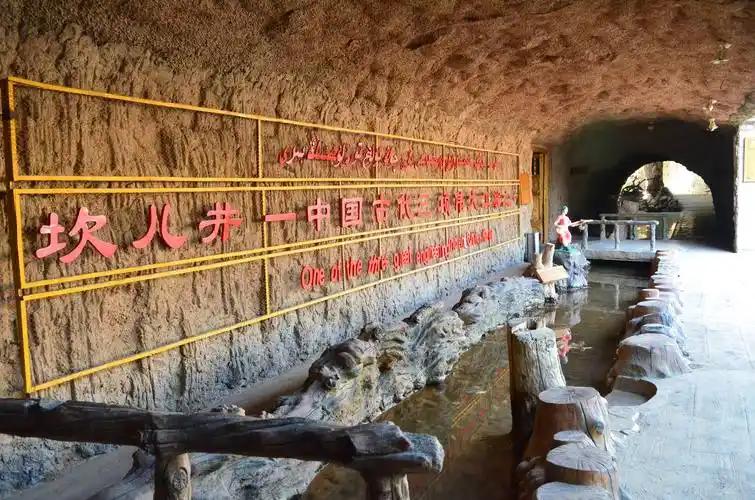
If you only understand one thing about Turpan, make it the karez. Chinese tradition ranks it alongside the Great Wall and the Grand Canal as one of the three great engineering works of the ancient world, and unlike the other two it is still doing its job.
The system has four parts: vertical shafts sunk every 20 to 30 metres, an underground channel connecting their bases, an open channel where the water finally surfaces, and a holding pond. Because the flow runs underground on a gentle gradient, gravity does all the work and almost nothing evaporates on the way. In a basin losing 3,000 mm a year to the air, that is the whole ballgame.
Around 1,100 karez lines were dug across Turpan, totalling more than 5,000 kilometres, and somewhere over a hundred still carry water. The Karez Folk Park near Jiaohe lets you descend into a lit section; the temperature drop on the way down is startling. Wear shoes with grip, because the stone is wet and polished by a lot of feet.
The ruins circuit
Jiaohe and Gaochang are usually done as a pair, in that order. Jiaohe occupies a leaf-shaped loess plateau where two rivers meet, about 10 km west of town, and was the capital of the Cheshi kingdom from roughly the second century BC. Its buildings were carved down into the earth rather than built up from it, which is why so much survives.
Gaochang, east of the city, came later and was larger: a walled Buddhist capital on the trade route. It is more ruined and far more exposed, so give it the early slot in warm weather.
The Astana tombs sit between the two and hold Tang-dynasty burials preserved by the dry air. The Turpan Museum on Munar Road is a national first-class museum with over 20,000 objects across five permanent galleries, and entry is free. Put it on your list even if museums bore you: it is air-conditioned, and the documents recovered from Astana make sense of everything else you have walked through.
Grape Valley, and the drying houses nobody photographs
Grape Valley is a green gorge in the flank of the Flaming Mountains, irrigated and pergola-shaded, and in August the fruit hangs overhead as you walk. It is also the most commercial thing in Turpan.
The part I find more interesting is free and everywhere: the drying houses. Those square mud-brick structures with pierced walls, on every ridge and rooftop, are how grapes become raisins here. Hot dry air moves through the gaps, no sun touches the fruit, and it takes several weeks.
This matters when you shop. Naturally shade-dried raisins are dull green or brown with a faint white bloom on the skin. The bright translucent yellow ones have been treated with sulphur. The seedless white variety is the classic, but ask for mare’s-teat and black currant types too. Buy from the drying-house end of the chain if you can.
Where to base yourself
The city centre, around Gaochang Road and the old town streets, keeps you near food and transport; chain hotels there ran roughly ¥150–350 a night when I last checked. Guesthouses inside Grape Valley cost more, around ¥200–500, and give you a room under a vine trellis with a cool night breeze.
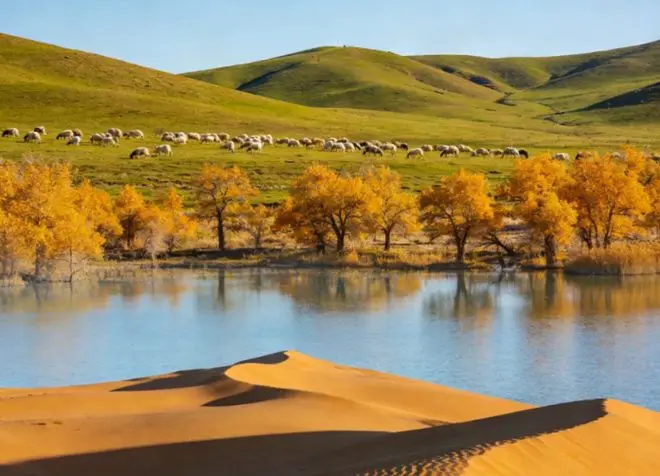
If you are continuing east to the Kumtag dunes, a night in Shanshan county town puts you at the sand’s edge and tends to be cheaper than either.
What to eat
Turpan’s signature detail is fuel: the naan pits here burn pruned grapevine, so meat baked against those walls picks up a faint fruitwood smoke you do not get elsewhere in Xinjiang. Ask for naan-pit lamb and eat it standing up. Look also for doudou noodles, a homely bean-and-tomato dish that rarely reaches English menus, alongside laghman, samsa and red-willow skewers. Fruit is not dessert here, it is the opening move. The Gaochang Road night market is where the town actually eats after dark.
Sand burial, the strangest hour I spent here
Sand therapy is a Uyghur medical tradition: you are buried to the neck in hot sand, usually to treat joint pain. The main centre is at Yar, about 10 km south of the city, and it is the largest regulated facility of its kind in Xinjiang. Informal patches near the Flaming Mountains exist; skip those.
I tried it in August, lasted twenty-five minutes and would not repeat it. It is not a tourist gimmick, though: everyone around me was a local with a treatment schedule. Drink beforehand, mention any heart condition, and let staff set the duration.
A two-day plan built around the sun
Day one. Leave by 07:00 for Jiaohe and have the plateau largely to yourself. Karez Folk Park next, underground and cool, around 10:00. Back to town for lunch, then the museum through the worst of the afternoon. Out again at 18:00 for the Emin Minaret in low light, then the night market.
Day two. Early start east to Gaochang, walking before 09:00. Astana tombs afterwards, then the Flaming Mountains viewpoint. Retreat to Grape Valley for the middle of the day, where the pergolas give real shade. Late afternoon, either a drying house visit or a run out to Aydingkol. Evening train onward if you are moving on.
If you have a third day, use it for Tuyoq — a canyon village of mud-brick houses and Buddhist caves that feels several centuries removed from the rest of the basin — or for the dunes at Shanshan.
Frequently asked questions
Is August too hot to visit? No, but it is too hot to visit badly. With an early start, a sheltered midday and an evening return, August works and the grapes are at their best. Without that discipline it is unpleasant and mildly risky.
Can I do Turpan as a day trip from Urumqi? Physically yes, with the hour-long train each way. You will manage two or three sites. I would rather spend one night and see it properly.
Do I need a guide? Not for logistics. But Jiaohe and Gaochang are large, hot and thinly signed in English, and an hour with someone who knows the layout changes what you notice. Guides can be arranged at the site entrances.
Is winter worth it? It is quiet, cold and cheap, and the ruins photograph well without heat haze. Some seasonal facilities close. I enjoyed November more than I expected.
A note on accuracy
Everything above reflects my own visits in April, August and November, checked against Turpan prefecture material and site signage. Transport times, opening hours and admission prices change, sometimes at short notice, so confirm anything time-sensitive locally. This page carries no sponsored placements.
About the author
Hugh Prentice writes about travel in hot and arid places and has been visiting Xinjiang since 2018. He also wrote this site’s companion piece on the modern town rather than the archaeological sites. Corrections and updates from recent visitors are welcome.