Published: July 27, 2026 | Author: Tobias Renner | Reading time: about 9 minutes
I have spent nineteen years working as a freight forwarder in Hamburg, which means customs paperwork is my day job. Even so, Xinjiang customs managed to surprise me twice: once in September 2024, when my wife Anke and I entered China overland at the Khunjerab Pass after three weeks in Pakistan, and again in May 2026, when we flew into Urumqi directly and left through Khorgos into Kazakhstan. This guide covers what Chinese customs officers actually asked us, what they opened, what they waved through, and the written rules behind all of it. If you are planning any entry or exit involving Xinjiang, the details below should save you some sweat at the inspection belt.
Quick reference: Xinjiang customs rules at a glance
| Item | Rule | Our experience |
|---|---|---|
| Cash | Declare over USD 5,000 (or equivalent); CNY capped at 20,000 in or out | Asked verbally at Khunjerab, nobody counted |
| Alcohol | 1.5 litres total (above 12% vol) duty free for visitors | Two wine bottles from Islamabad duty free shop, no questions |
| Tobacco | 400 cigarettes or 100 cigars or 500 g tobacco | Not checked |
| Drones | Legal to import in theory, frequently sealed or held in Xinjiang | A French traveller ahead of us had his sealed at Khunjerab |
| Satellite phones, GPS trackers | Prohibited without a permit | X-ray operators specifically look for them |
| Printed religious or political material | Risky; can be confiscated | Guidebooks were fine, both times |
| Fresh fruit, meat, dairy | Prohibited on entry | Anke lost two apples at Urumqi airport |
| Medication | Personal quantities with prescription; opioids and some sedatives restricted | Declared my blood pressure pills, took 30 seconds |
Two crossings, two very different experiences
Our Khunjerab entry in 2024 was the slow one. The Chinese border post sits at Tashkurgan, about 120 km inside the country, so the bus from Sost carried us for three hours before anyone stamped anything. Every bag went through the scanner. Officers asked us to switch on our phones and laptops, and one young officer scrolled briefly through my photo gallery. He was polite, spoke reasonable English, and returned the phone within two minutes. The whole procedure for our busload of 24 people took just under three hours.
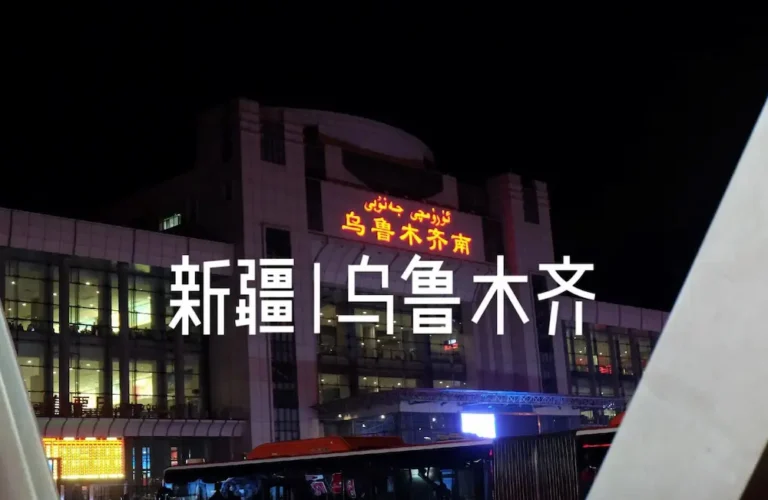
Urumqi airport in May 2026 was the opposite. We cleared immigration and customs in 25 minutes, and the only casualty was the fruit in Anke’s daypack. The declaration channel system works the same as any major Chinese airport: green channel if you have nothing to declare, red channel if you do. I walked the red channel to declare my medication out of professional caution, and the officer seemed mildly amused that anyone bothered.
The lesson we took away: land borders in Xinjiang run stricter and slower than airports. Budget half a day for any land crossing and treat the airport arrival as routine. For a rundown of every entry point, see our Xinjiang border crossings overview.
What you can bring into China duty free
The allowances for foreign visitors are generous enough that most tourists never pay a fen of duty. You may bring 400 cigarettes, 1.5 litres of alcoholic drinks above 12 percent, personal electronics in reasonable quantities (one laptop, one tablet, cameras for personal use), and gifts up to a value of CNY 2,000. Professional camera setups with multiple bodies and cinema lenses occasionally draw questions about commercial filming, though our two-body mirrorless kit never did.
Cash deserves attention. Anything above USD 5,000 in foreign currency, or its equivalent, must be declared on entry. Chinese yuan is capped at 20,000 in either direction. Since mobile payment covers nearly everything in Xinjiang now, we carried USD 1,200 as emergency backup and used less than a hundred of it. Our guide to travel apps that work in Xinjiang explains how to set up Alipay before you arrive, which reduces the cash question to almost nothing.
What to leave at home
Three categories cause real trouble. First, satellite communication devices: Garmin inReach, Zoleo, Thuraya handsets and similar gear are prohibited in China without a permit that tourists cannot realistically obtain. The X-ray operators at Tashkurgan clearly knew what these look like. Leave them at home, not in your checked bag.
Second, drones. Import is technically legal, but Xinjiang is not the place to test that theory. The French traveller ahead of us at Tashkurgan had his DJI Mini sealed in a numbered bag that he was told to present, unopened, when leaving China. Other travellers report outright temporary confiscation with a receipt. If aerial footage matters to you, research current practice for your specific crossing shortly before travel, and accept that the answer may still change on the day.
Third, printed material touching on religion or politics. A regular guidebook is fine; both our Lonely Planet and my German-language history paperback passed inspection twice without comment. Anything resembling missionary literature or political pamphlets is a genuine risk and simply not worth carrying.
Medication: declare and relax
China allows personal medication in quantities matching your trip length, ideally with the original packaging and a prescription or doctor’s letter. The restricted list includes strong painkillers containing codeine or other opioids, certain sleeping tablets, and ADHD medication containing stimulants. If you take any of these, carry the prescription, keep quantities modest, and use the red channel. My declaration at Urumqi took half a minute and produced a stamp on a form nobody ever asked to see again. Travellers on our 2026 trip confirmed the same painless experience at Khorgos. What you should not do is bury restricted medication deep in your luggage and hope; that converts a formality into a problem.
Taking souvenirs out: jade, knives and dried fruit
Exit formalities catch people off guard more often than entry. Three Xinjiang purchases need thought before you buy.
Jade from Hotan is legal to export in worked form with a shop receipt. Keep the receipt with the item. Raw or uncarved stone in quantity can be treated as a resource export and questioned, so buy finished pieces from established shops rather than river stones from a roadside seller.
Yengisar knives are beautiful and famously problematic. You cannot carry any knife on a domestic Chinese flight, checked or otherwise; the rules have tightened to the point where even checked blades are routinely refused in Urumqi. Shops in Kashgar offer freight shipping, which is the only reliable route home for a knife. We skipped the purchase entirely.
Dried fruit and nuts travel well and clear Chinese exit customs without any issue. The constraint is your destination country. Germany let our two kilos of Turpan raisins and Aksu walnuts through as sealed commercial packaging. Australia or New Zealand would likely be a different story, so check your own biosecurity rules. Buying sealed, labelled packets at the bazaar prices covered in our Xinjiang cost breakdown also makes the customs conversation easier than loose produce in a plastic bag.
Land border practicalities
Every land crossing we used or researched shares a few habits. Borders close for lunch, typically from about 13:30 to 16:00 Beijing time, and close entirely on Chinese public holidays; more than one cyclist has camped at Torugart because of a holiday nobody warned them about. Phone checks happen at land borders far more often than at airports, so know your unlock code and stay patient. Bags go through X-ray at least twice, once at the border building and once more at the first inland checkpoint. And officers at remote posts like Khorgos or on the Karakoram Highway may speak limited English, so a translation app with an offline Chinese pack does real work here.
One paperwork note: your passport needs six months of validity and the visa handles the rest. There is no separate Xinjiang entry permit for the main tourist areas, a point our Xinjiang visa and permits guide covers in full.
A realistic crossing timeline
Here is how our Khorgos exit ran in May 2026, for calibration. 09:10 arrival at the vast border hall on the Chinese side. 09:25 export customs, bags scanned, no questions. 09:40 immigration exit stamps. 10:05 shuttle bus across the neutral zone. 10:50 Kazakh entry complete. Total: an hour and forty minutes, and we were told this was a quiet day. On the Friday before a holiday week, drivers in the queue reported four to five hours. Plan accordingly and never book an onward connection tight against a land border.
FAQ
Do I need to fill in a paper customs declaration? Not in the green channel. Red channel declarations are a short bilingual form, and officers helped us with it.
Will customs search my phone? At land borders, possibly; it happened to us once and took two minutes. At Urumqi airport, nobody asked. Carry nothing you would struggle to explain and it remains a formality.
Can I bring a laptop and camera without registering them? Yes, personal quantities need no registration. I carried a laptop, a tablet and two cameras through four inspections without a single question.
Is there duty free shopping at Xinjiang borders? Urumqi airport has standard duty free. Land crossings have little or nothing on the Chinese side; Khorgos has a duty free zone geared to Kazakh shoppers.
What happens if I forget to declare cash over the limit? Undeclared excess currency can be seized and fined. Given that declaration takes minutes and costs nothing, it is the cheapest insurance in travel.
Disclaimer
Customs regulations and enforcement practice change without notice, and individual officers have discretion. This article describes personal experiences from September 2024 and May 2026 plus the published rules as we understand them. Verify current requirements with the Chinese embassy in your country or the General Administration of Customs of China (customs.gov.cn) before travelling. We are not affiliated with any government agency.
About the author: Tobias Renner is a freight forwarder from Hamburg, Germany, with nineteen years of professional customs experience across Europe and Asia. He has crossed into and out of China through Xinjiang twice with his wife Anke, overland via the Khunjerab Pass and Khorgos, and by air through Urumqi. All trips were self-funded; he has no sponsorships and no affiliation with any tour operator.