Published: August 19, 2026 | Author: Karl Huang
What this guide is built on
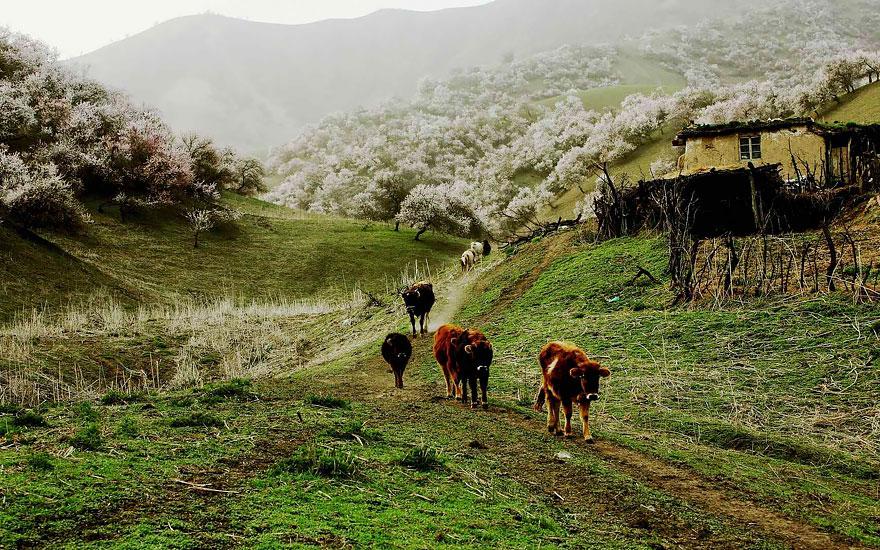
The Tuergen apricot valley in Xinyuan County gets summed up online as “a pink hillside in early April,” which is accurate for roughly eight days a year and misleading for the other 357. I have been out there twice. The first time, in the last week of March, I stood in a brown valley arguing with a shopkeeper about whether a cold spell had pushed the buds back. It had, by about nine days. The second time, on 8 April a couple of years later, I got the slopes I came for, plus the parking chaos, the drone queue and ankle-deep mud on the upper path.
The failed trip taught me more about planning this place than the good one did, so both are in here. Everything below is either something I watched or something I checked with people who live and work in Xinyuan, and where I am not certain I say so. Bloom timing, gate prices and shuttle arrangements in the Ili valley get adjusted year to year, with official notices published through the regional culture and tourism authority at xinjiangtour.gov.cn. Use my numbers as a planning baseline, then confirm.
Tuergen apricot valley at a glance
| Where | Tuergen township, Xinyuan (Künes) County, Ili Kazakh Autonomous Prefecture |
| What it is | Wild apricot forest spread across open grazing slopes, not a planted orchard park |
| Bloom window | Late March to mid-April; peak usually falls in the first ten days of April |
| Peak duration | About 7 to 10 days, shorter if it rains or the wind picks up |
| Nearest airport | Yining (YIN), roughly 190 km west, 3 to 3.5 hours by road |
| Base town | Xinyuan county town, about 30 km from the valley entrance |
| Gate fee | Modest, in the ¥30–60 range in recent seasons, sometimes plus an optional shuttle |
| Dawn temperature in April | 1–6°C on the slopes, 12–20°C by mid-afternoon |
| Time needed | One dawn session minimum, two mornings if you want insurance |
| Who it suits | Photographers, slow walkers, anyone happy to build a trip around one uncertain week |
Timing the bloom is most of the job
These are wild apricots, not a cultivated variety on a fixed schedule, and they open when enough warmth has accumulated on the south-facing ground. That means the calendar is a suggestion. In a mild spring the lower slopes can be white by 28 March. After a cold, wet March I have seen the same ground still bare on 5 April. The safest single date I would pick blind is 5 to 8 April, and I would keep the two days either side flexible.
Elevation buys you a second chance. The valley floor and the first low ridges open first, and the trees on the higher shoulders follow three to five days later. If you arrive at the tail end of the peak and the lower slopes look tired, walk uphill rather than driving away. On my good trip the best light of the morning was on a bank about twenty minutes above the main viewpoint, where nobody had bothered to climb.
For a live read, call ahead. A guesthouse in Xinyuan town will tell you honestly whether the flowers are out, because their April income depends on it. Chinese social platforms also fill with dated photos during bloom week, which is the fastest crowdsourced signal. If you are in Xinjiang in March instead, the apricot slopes near Toksun in the Turpan basin run two to three weeks earlier.
The morning that worked, and the afternoon that didn’t
We left Xinyuan town at 06:40 with cold hands and a bag of flatbread from the night before. The gate area was almost empty, two vans and a man sweeping. It was 3°C. The first fifteen minutes were the reason to be there: low sun coming across the valley onto the east-facing banks, frost still on the blossom, a flock of sheep working through the trees with a herder on a motorbike behind them. I got maybe forty minutes of that.
By 09:30 the coaches were in. By 11:30 the upper path had a line waiting to shoot the same frame from the same rock, three drones were up at once, and the light had gone flat and white. We came back at 16:00 hoping for warm evening light and got wind instead, strong enough to move the petals and haze the ridge with dust. This place is a morning subject; the afternoon belongs to snacks and sitting down.
The next day we skipped the main viewpoint and followed a side gully east of the entrance, where the trees are thinner but the grazing is active and it looks like a working valley rather than a queue. Fewer flowers per frame, better photographs.
Getting there from Yining without burning a day
Almost everyone comes through Yining. Fly Ürümqi to Yining in about an hour and twenty minutes, or take the overnight train if you prefer to sleep through the distance, then travel east up the Künes valley through Yining County and Gongliu to Xinyuan town. It is roughly 190 km and takes three to three and a half hours on decent road. From Xinyuan town the valley entrance is another 30 km or so, on a road that narrows as it climbs into the township.
Your realistic options, in the order I would rank them:
- Self-drive from Yining. Best control over dawn timing. Book early for bloom week, since Yining’s fleet gets thin. Paperwork, deposits and mountain-road habits are covered in our guide to renting a car in Xinjiang.
- Chartered car with a driver. What most domestic photography groups use. Negotiate a day rate that includes the early start; a driver who has done the run knows where to park once the lot fills.
- Bus to Xinyuan, then a local taxi. Cheapest. The bus from Yining takes around four hours; a taxi out to the valley and back with waiting time runs a few hundred yuan in season.
- Day trip from Yining. Possible, but it means a 03:30 start and seven hours in a vehicle. I would not do it again.
On peak weekends the last kilometre to the gate can back up badly, and traffic control sometimes diverts cars to overflow parking with a shuttle. Being there before 07:30 sidesteps all of it. If you are building a wider loop, the Yining travel guide covers the city end of the trip, and Xinyuan county has more than one reason to keep you an extra day.
Where we slept, and what it cost
Xinyuan county town is the sensible base. Ordinary business hotels there ran ¥160 to ¥320 a night on our April visits, the higher end on the peak weekend when photography groups take whole floors. Rooms are plain, hot water is usually fine, and you are close enough for a 06:40 departure.
Tuergen township has a handful of family guesthouses, roughly ¥120 to ¥200, some with shared bathrooms. Staying there cuts the morning drive to fifteen minutes. One caution for foreign visitors: small township guesthouses are not always set up to register non-Chinese guests, and being turned away at 22:00 is a bad end to the day. Confirm in advance, or sleep in the county town where larger hotels handle it routinely.
Nalati town, 90 km east, has more beds but points you the wrong way for dawn. Gongliu works as a fallback if Xinyuan sells out, at the cost of forty minutes of driving. Book two to three weeks ahead for the first ten days of April. When we got caught out, our guesthouse owner arranged a spare room in a neighbour’s house for ¥100: clean, cold, perfectly fine.
Eating around Xinyuan in April
This is Kazakh country and the food shows it. Smoked horse meat and horse sausage are the Ili valley’s signature, salty and dense, usually served sliced with flatbread. Beyond that you get the reliable Xinjiang lineup: hand-pulled laghman, rice pilaf with mutton and carrot, oven-baked nang, and milk tea that arrives salty rather than sweet. Stalls near the valley entrance sell dried apricots and apricot kernels from last summer’s harvest, which closes the loop on why the trees are there.
Two practical notes. Shoulder-season restaurants in the county town often stop serving by 21:00, so a late arrival can leave you with instant noodles. And nothing opens early enough for a dawn departure, so buy bread, eggs and hot water the night before. We carried a thermos both trips.
Nine things I would tell a first-timer
- Treat the bloom as a range, not a date. If your dates cannot flex by two days, accept that you may see buds or bare branches.
- Go at first light. The gap between 07:00 and 10:00 here is the gap between a valley and a car park.
- Wear boots you do not mind ruining. Snowmelt plus grazing turns the upper paths to mud, slick on the descent.
- Dress for two seasons: gloves at dawn, t-shirt by two in the afternoon.
- The slopes are working pasture and some plots are private. If a fence or a family is there, ask first. A nod usually gets you a yes.
- Check drone rules before you fly. Real-name registration runs through uom.caac.gov.cn, and staff may ground everyone when crowds are dense.
- Carry small cash. Mobile payment works nearly everywhere, but gate booths and village stalls prefer notes.
- Bring your passport and use hotels that can register you, per the note above.
- Do not stake the whole trip on flowers. Make the valley one morning inside a five to seven day Ili itinerary, and a late bloom becomes a shrug.
A three-day plan that survives a late bloom
Day 1. Arrive Yining, collect the car, eat lunch in town, drive east through Gongliu and reach Xinyuan by late afternoon. Buy tomorrow’s breakfast. Ask the guesthouse how the slopes looked today.
Day 2. Out by 06:40, at the gate for first light. Shoot until the light goes, walk twenty minutes higher than the crowd, then return to town for a long lunch and a nap. Late afternoon, drive the township back roads instead of re-entering the main area.
Day 3. Two choices. If the bloom is still improving, do a second dawn, because the second morning is usually better than the first now that you know the ground. If it has peaked, head for the wider valley instead: the meadows and river country around Nalati grassland to the east, or the forested slopes described in our piece on Gongliu and the Xinyuan grasslands back to the west. April grass is still short and pale, so go for the landform and the light rather than expecting summer green.
If you have more time, extend into May, when the Ili valley shifts from blossom to green and the passes start opening. We wrote about that transition in the guide to Xinjiang in May.
Questions people actually ask
What is the single best date to book? If forced to choose months in advance, I would land in Yining on 4 or 5 April and plan the valley for the 6th, keeping the 7th and 8th free as backup.
How long does peak bloom last? Roughly a week to ten days in a settled spring. A hard rain or a windy day can strip the lower slopes in an afternoon.
Is there an entrance fee? Yes, a modest one, in the ¥30–60 band during recent seasons, occasionally with a shuttle charge when the road is managed. Confirm at the gate; seasonal pricing is adjusted locally.
Can I visit as a day trip from Yining? Physically yes, sensibly no. A 03:30 start for first light and a long drive back the same evening is a hard day. Sleep in Xinyuan.
Is it worth going if the bloom is finished? Not on its own. Inside a broader Ili trip the valley is still a pleasant walk, but I would reshuffle toward grassland and river scenery.
How is it for older parents? The lower area is easy, mostly flat tracks near the entrance. The best high viewpoints need a real uphill walk on uneven ground, so plan for one of you to stay low.
What about weather forecasts? Mountain valley forecasts are rough. I check weather.cma.cn for the trend, then ask locally on arrival.
Accuracy, and where this could go out of date
Prices, opening arrangements and shuttle rules at seasonal scenic areas in Xinjiang change, sometimes between one spring and the next. The bloom dates here describe patterns I observed and heard locally, not a forecast: one warm or cold fortnight in March moves everything. This page is not a substitute for official notices from the scenic area administration or the regional tourism authority, and nothing here is advice on entry requirements or permits, which are set by government departments and can change quickly.
About the author
Karl Huang writes about travel in Xinjiang and northwest China, mostly from repeat trips made by rental car and long-distance bus. He has made two spring runs into the Künes valley for the apricot bloom, one badly timed and one lucky, and prefers guides that admit which is which. He takes no payment from tour operators or scenic area administrations.