Published: October 29, 2026 | Author: Karl Huang
Most Xinjiang itineraries are sold as scenery, but the trips that actually work are built around the region’s cities. The distances are vast — Urumqi to Kashgar is more than 1,400 kilometres — so picking the right base city decides how much of your holiday you spend in a car. This guide to the main Xinjiang cities is built from years of driving the region: where each city sits, what it is actually good for, and how travellers link them into a northern, southern or Silk Road loop.
Why the city you pick matters more in Xinjiang
Xinjiang covers about one sixth of China’s land area, and its attractions are scattered across two great basins, three mountain ranges and a string of oasis belts. The Taklamakan Desert splits the north from the south, and the Tian Shan splits the north again from the arid east. Unlike a compact province where you can day-trip from one hub, here the cities are the anchors and the sights are the spokes. Spend a night in the wrong town and you add half a day of driving; spend it in the right one and three day trips open up. The useful question is never “which city is best” but “which city is my launch pad for this region.” Accommodation standards also swing hard between cities: Urumqi and Kashgar have international-brand hotels, while smaller hubs may offer only basic clean rooms, so the base city partly decides your nightly comfort.
Urumqi — the unavoidable transport hub
Urumqi is where almost every trip begins, because it is the only city with a major international airport, the high-speed rail spine, and long-distance bus links to everywhere else. The Xinjiang Regional Museum and the Grand Bazaar are the standard half-day, and Heavenly Lake (Tianchi) is the classic nearby escape. Plan one or two nights: a morning at the Regional Museum, an afternoon at the Grand Bazaar for carpets and dried fruit, and a day trip to Heavenly Lake if the weather holds. The city’s real job is logistics — it is where you pick up a car, a driver or a train before the scenery starts. Our full Urumqi guide covers the museum, the bazaar and the day trips in detail. For food, the Uyghur quarter around the bazaar does laghman noodles, kebabs and polo rice cheaply and well, and the international hotels cluster near the museum if you want a quieter block.
Kashgar — the Silk Road old town
Kashgar is the reason many people come to Xinjiang at all. The old town (Kashgar Ancient City) is the most complete Uyghur old town left in the region, and it is the launch point for the Pamir Highway, Karakul Lake and the run down to the Pakistani border. The Sunday livestock market and the Id Kah Mosque sit inside the ancient city, and the Pamir run needs a border permit arranged in Kashgar a day ahead. Fly or take the train in, then treat Kashgar as a three- or four-night base. See the Kashgar guide for the old-town walk, the market and the Pamir logistics. Give the old town two mornings — it rewards slow wandering far more than a single rushed afternoon — and keep an evening free for the night market.
The Ili valley — Yining and the green west
Yining (Ghulja), in the Ili valley on the Kazakh border, is the watered counterpoint to the rest of Xinjiang. Tree-lined streets, Russian-influenced architecture and apricot blossom in May make it the most European-feeling city in the region. In June the fields around Huocheng turn purple with lavender, and Sayram Lake is a two-hour drive north, which makes Yining the natural base for the whole Ili valley. The Yining guide walks through the Kazanqi old town and the best season to come.
Turpan — oasis, heat and ruins
Turpan sits in a depression below sea level, famous for grapes, the Flaming Mountains and the Jiaohe and Gaochang ruins. The Grape Valley, the Jiaohe ruins (abandoned to the wind two thousand years ago) and the karez underground channels that keep the oasis alive are the three anchors. Summer temperatures pass 40 Celsius, so spring and autumn are kinder. The high-speed train from Urumqi takes about an hour, which makes Turpan the easiest second city on any northern trip. The Turpan guide covers the ruins, the karez and how to handle the heat.
Northern oil country — Karamay
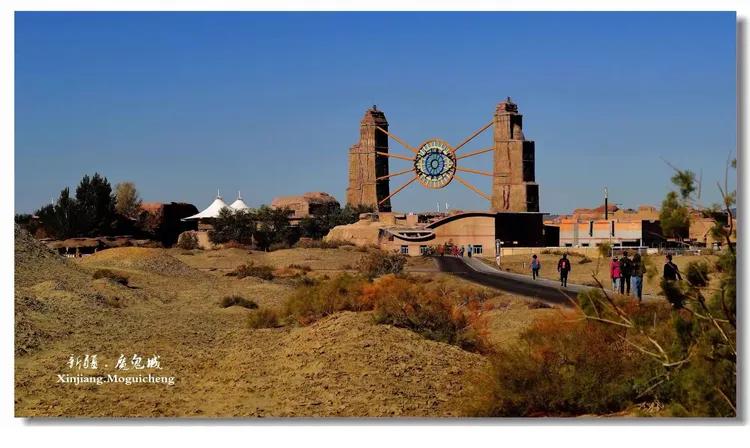
Karamay is the modern oil city of the north and the base for the Urho Ghost City, a field of wind-eroded sandstone about 100 kilometres out. The Black Oil Hill, where oil still seeps from the ground, and the manicured Karamay Riverfront are the in-town sights; the Ghost City is the out-of-town one. Give it a night between Urumqi and the north, or use it as a Duku launch pad — the scenic highway actually begins in Karamay’s Dushanzi district. The Karamay guide has the Ghost City timing and the drive logistics. The Ghost City at sunset is the headline, but the city museum explains why a patch of desert became a metropolis, which makes the landscape make sense.
The southern hubs — Hotan, Aksu, Korla, Kuqa
The south is strung along the Tarim Basin rim. Hotan is the jade city at the end of the southern Silk Road, known for its jade market and its Uyghur carpet workshops. Aksu is the quiet oasis gateway and the jumping-off point for the Tomur glaciated peaks. Korla is the modern capital of the south and the rail hub where the northern and southern lines meet. Kuqa is the Qiuci-culture ancient city, backed by the red Kuqa Grand Canyon and close to the Kizil caves. These four are the bases for a southern loop, linked by the Tarim desert highway and the southern rail line. We cover each in its own guide: Hotan, Aksu, Korla and Kuqa.
Border towns — Khorgos, Alashankou, Tacheng, Bortala
If your trip touches Central Asia, the border cities matter. Khorgos and Alashankou are the two working China–Kazakhstan crossings, and Kazakhstan’s visa-free rule (up to 30 days for many passports) makes Khorgos a genuine day trip into Almaty’s orbit. Tacheng is the Russian-flavoured northern border town; Bortala is the quiet corner by the Kazakh line and the road to Sayram Lake. See the Khorgos guide and the Alashankou guide for crossing details, and the Tacheng and Bortala guides for the towns themselves.
How to choose your base
Rule of thumb: one base per region. North Xinjiang (Kanas, Ili, the Ghost City) anchors on Urumqi plus a night in Yining or Karamay. The Silk Road west anchors on Kashgar for a week. The southern Tarim loop anchors on Korla or Kashgar and runs the desert highway. Covering all three in one trip takes two weeks and a driver. A realistic 10-day first trip: three nights Urumqi (with a Turpan day), three nights Yining (with Sayram Lake), two nights Kashgar, then home — or swap the Ili leg for a Kashgar-and-south run if the Pamir is the draw. Two regions done well beats three regions rushed. If you only have a week, drop the south and do Urumqi plus Kashgar, or Urumqi plus Yining; both are satisfying on their own.
Getting between the cities
Air links connect Urumqi to every prefecture capital, often several times a day, and the high-speed rail reaches Turpan, Korla and the Ili valley. For the scenic northern routes — the Duku Highway, the Ili loop — a car or driver is the only realistic option, and the Duku closes from November to May. Long-distance buses fill the gaps the trains do not reach. Our Urumqi guide has the airport and rail primer to start from.
Practicalities: permits, registration and cash
A few rules apply across every Xinjiang city and are worth knowing before you build the route. Foreign visitors must register with the police at the hotel on check-in; international-brand and larger Chinese hotels do this automatically, but small guesthouses in remote towns may not, so carry your passport. The Pamir run from Kashgar needs a border permit issued in Kashgar a day ahead, and some sensitive border counties limit independent travel. Cards work in the big cities but cash still wins in markets and on buses, so keep a stack of small bills. A local SIM or eSIM keeps maps and translation working in places where the signal thins out.
What visitors ask before building a route
Which Xinjiang city should I fly into? Urumqi, almost always — it is the only major international gateway.
Can I see Xinjiang without visiting a big city? Not really; even the wilderness trips stage from Urumqi, Kashgar or Yining.
Is Kashgar or Urumqi the better base? Urumqi for transport and museums, Kashgar for the Silk Road and the Pamir.
How many cities can I cover in 10 days? Two regions — for example Urumqi plus the Ili valley, or Kashgar plus the south.
About the author
Karl Huang is a Xinjiang-based travel writer who has driven the region’s northern, southern and Silk Road routes across multiple trips. He writes the city and route guides for Xinjiang Attractions from first-hand experience on the ground.