Published: 23 August 2026 | Author: Karl Huang
Most visitors to Xinjiang meet Wusu beer before they ever hear the town’s name. We did. On our first night in Urumqi, a 620 ml red-labeled bottle landed on our table at the Erdaoqiao night market within five minutes of sitting down, and it kept getting refilled until we learned the local word for “no more.” This guide comes from three summers of travel across the region, roughly forty night markets, and a long chat with a brewery worker in Wusu town who explained why the bottles are the size they are. It is a practical, honest look at the beer itself and the drinking customs that surround it.
Wusu beer at a glance
| Attribute | What you need to know |
|---|---|
| Brand founded | 1986, in Wusu City, northern Xinjiang |
| Owner today | Carlsberg China (stake acquired in the mid-2000s) |
| Bottle size | 620 ml, larger than the usual 330–500 ml Chinese lager |
| Strength | About 4% ABV, noticeably stronger than most mass-market lagers at 2.5–3.5% |
| Local nickname | 夺命大乌苏 (“Deadly Da Wusu”), a joke about the hangover |
| Typical price | ¥6–8 in a shop, ¥10–15 at a night market |
| Best with | Lamb kebabs, big-plate chicken, hand-pulled laghman noodles |
| Best season | May–October for the open-air night markets |
The first bottle: what actually surprised us
The thing nobody warns you about is the size. A standard Chinese lager comes in a 330 ml bottle or a 500 ml can. Wusu comes in 620 ml, and at a Xinjiang table that single bottle is treated as a personal portion, not something to share. Our friend from Henan, who had driven up from the interior, laughed at our surprise and said the bottle was the whole point: you are not meant to sip.
The taste is a straightforward European-style pale lager, malty rather than hoppy, with a clean finish that works in the dry summer heat. What makes it memorable is the context. Served ice-cold from a chest of meltwater at a roadside 大排档, with smoke from the kebab grill drifting past, it tastes like the evening itself. We have since drunk it in Yining, Kashgar, Karamay and a dozen highway towns, and the ritual is identical everywhere: bottle on the table, glasses filled to the brim, and someone declaring it is time to “走一个” (do one).
Getting to Wusu and the brewery town
Wusu (乌苏) sits in northern Xinjiang, in Tacheng Prefecture, roughly 260 km west of Urumqi on the corridor that runs past Shihezi and Karamay toward the western border crossings at Khorgos and Alashankou. We passed through on the drive to Khorgos and saw the brewery’s sign from the highway, a reminder that this small industrial city is the source of a drink now sold across the whole northwest. If you want the full story of the place itself, our separate guide to Wusu, the town behind Xinjiang’s famous beer covers the history and how to visit.
For most travelers, though, the beer is encountered far from the brewery. It is on every menu in Urumqi, and it follows you down the Karakoram Highway and out to the oasis towns. You do not need to detour to Wusu to enjoy it; you mostly just need to sit down somewhere with a grill.
When to go for the night-market season
The open-air night markets run from late spring through autumn. May is when the first tables appear; June, July and August are the peak, with the longest hours and the biggest crowds; September and October stay pleasant in the south. We found early June and September the most comfortable, warm enough for a plastic chair on the pavement but not so hot that the ice melts before the first toast.
In winter the scene moves indoors. Urumqi and the bigger cities keep heated beer houses and basement 大排档 running through January, and a hot pot or grilled fish with a cold Wusu is its own kind of comfort when the temperature sits at minus twenty. The beer is a year-round drink; only the seating changes.
Where to stay if you want the late nights
If the night market is the point of your trip, stay within walking distance of one. In Urumqi that means the area around the International Bazaar and Erdaoqiao in the south of the city, or the Wuyi (五一) night-market district closer to the center. Both put you among the grills by dusk and let you walk back to the hotel instead of bargaining for a taxi at midnight. In Yining, look for rooms near the Hanren Street night market; in Kashgar, the old city and the adjoining bazaar area are the obvious base. Book ahead in July and August, when domestic tourism fills the mid-range hotels first.
What to eat with Wusu beer
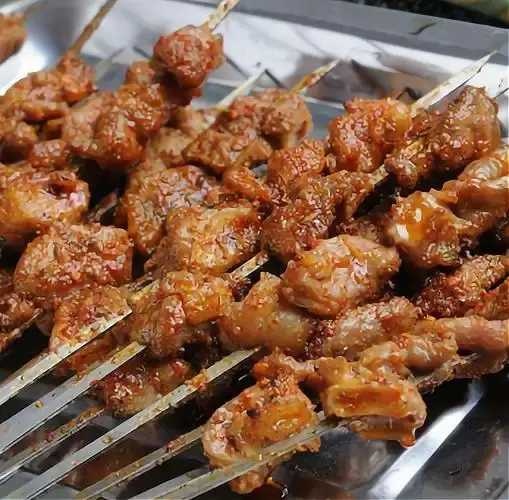
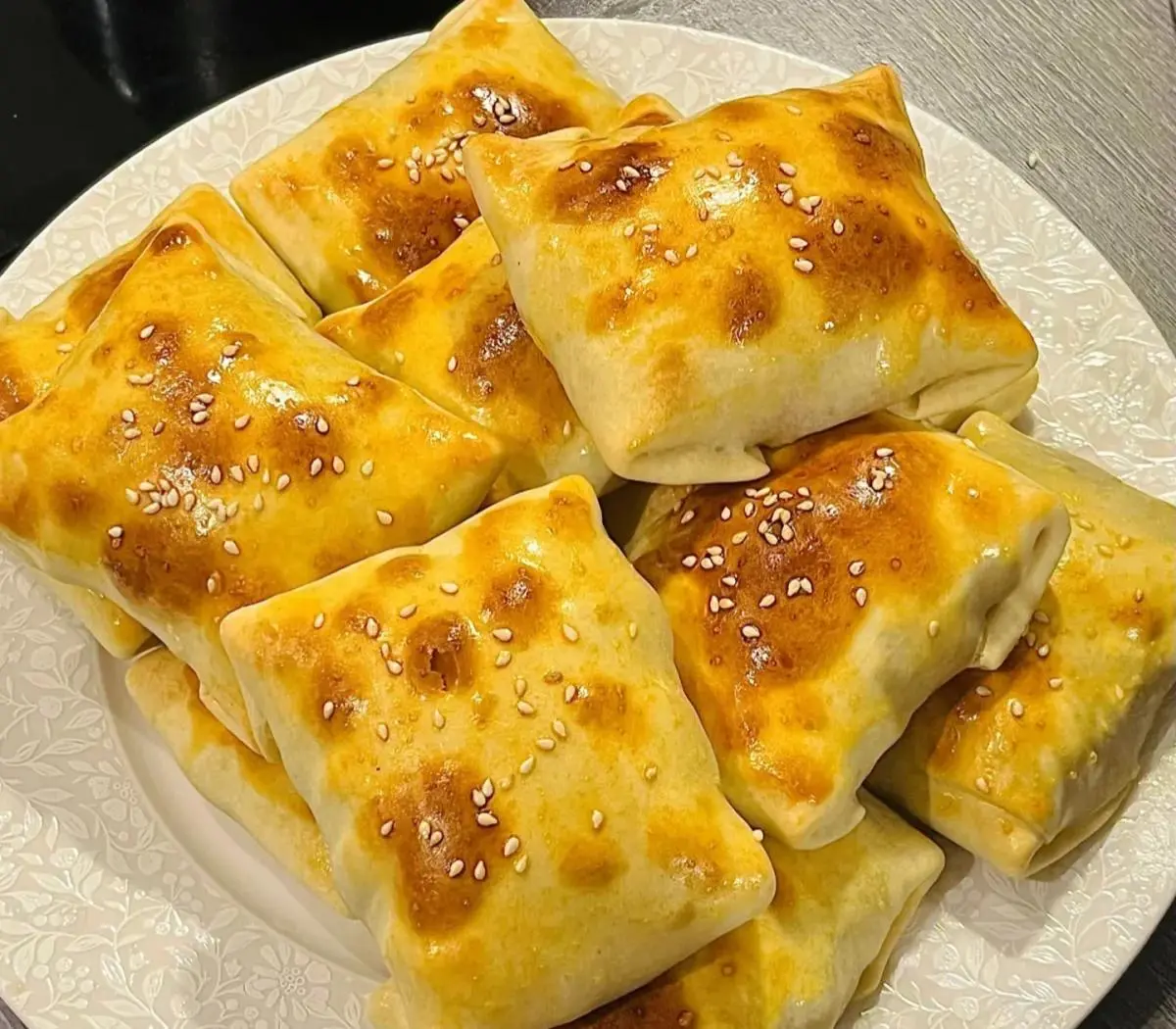
The pairing is not subtle, and that is the appeal. Lamb is the natural partner. Xinjiang kebabs threaded with fat and cumin, cooked over charcoal until the edges char, are the default order, usually by the dozen. Big-plate chicken (大盘鸡) arrives in a cast-iron basin with belt-thick noodles underneath, built for sharing and for slowing the drinking down. We also leaned on 拌面 (hand-pulled laghman), 抓饭 (rice with carrot and lamb), 馕 (the flat bread that soaks up everything), and 烤包子, the crisp baked pockets of spiced meat shown below.
The food is salty and rich by design, which is exactly why the beer works. A table in Xinjiang is a team sport: one person orders the meat, another the noodles, someone else brings the beer, and the plates keep coming until the group decides it is finished. For a wider sense of where locals actually eat, our piece on Xinjiang food markets lists the stalls worth the walk.
Where people actually drink across Xinjiang
Urumqi is the obvious starting point, but the habit is regional. Yining’s night markets in the Ili Valley run late and loud in summer. Kashgar’s bazaar district fills with grills after dark, though the old city itself is quieter and more family-oriented. Karamay and Shihezi, the oil and industrial towns, have a working-class beer-house culture that stays busy year-round. We once ended up at a small 啤酒屋 in Yining with a table of Kazakh friends who insisted we try their home province’s take on the toast, which was even more committed than the Han Chinese version we had learned.
If you want a softer evening, the Urumqi cafe scene has grown fast, and a cold beer alongside a proper coffee is no longer a contradiction in the new districts. And for a planned route through the grills, our street-food crawl plan strings together a full night of stops.
Reading the room: toasts and table rules
The social engine of a Xinjiang drinking table is the toast. The simplest is the “提” (tí): both people stand, raise their glasses, clink, and drain them. The heavier version is “打通关” (dǎ tōngguān), where one person toasts everyone around the table in turn, one by one, often draining a glass at each meeting. As a guest you are expected to participate, but nobody is forced past their limit; a hand over the glass and a polite refusal is understood, especially once the table knows you are driving the next morning.
Two things we learned the hard way. First, in this region the glass is always refilled the moment it is empty, so an empty glass signals “keep going.” If you want to stop, leave a little in the bottom. Second, the drinking and the driving are strictly separate. China’s drink-driving law is unforgiving, and the checks around city exits and tourist routes are real. For non-alcoholic company at the table, traditional Xinjiang drinks like kumis (fermented mare’s milk), boza and fresh fruit juices are everywhere and widely respected.
A sample evening in Urumqi
Here is a realistic plan we have run more than once. Arrive at the Erdaoqiao area around 8:30 pm, after the worst of the heat. Start with a plate of kebabs and the first bottle while the grill fires up. Order big-plate chicken for the table around 9:30, add laghman to mop the sauce, and let the toasts come naturally rather than scheduling them. Walk the bazaar lanes for twenty minutes around 10:30 to make room, then finish with 烤包子 and a final shared bottle before the midnight taxi rush. Total cost for two, with food and four or five bottles of beer, usually lands between ¥120 and ¥180.
Frequently asked questions
Is Wusu beer really stronger than other Chinese beer?
Stronger than the typical mass-market lager, yes. At about 4% ABV in a 620 ml bottle it delivers more alcohol per serving than a 330 ml bottle at 3%. The “deadly” nickname is mostly a hangover joke, not a warning about anything unusual in the recipe.
Can foreigners buy it easily?
Without any problem. It is sold in every convenience store, supermarket and restaurant we visited. You do not need to speak Chinese to point at the red bottle.
Is the night-market drinking scene safe for solo travelers?
The markets themselves are busy, well-lit family spaces where the drinking is social, not aggressive. Keep your phone and wallet secure as you would in any crowd, and arrange your ride home before the last call rather than after.
What non-alcoholic options sit on the same table?
Kumis, boza, salted sour milk drinks, and fresh pomegranate or watermelon juice are common, so nobody at the table has to drink alcohol to belong.
Does Wusu town offer a brewery tour?
There is no standard public tour we could book in English. The town is worth a stop if you are driving the border corridor, but treat the beer as something you meet at the table, not at a visitor center.
Disclaimer: This article describes local customs for cultural understanding only. Alcohol carries health risks, and China enforces strict drink-driving laws: a blood alcohol level of 20 mg/100 ml is an offence and 80 mg/100 ml is a criminal charge. Never drink and drive; always arrange a sober driver or taxi, and the legal drinking age is 18. Opening hours, prices and regulations change, so confirm details with official sources before you travel.