Published: 03 September 2026 | Author: Karl Huang | Last updated: 03 September 2026
If the only image of Xinjiang beekeeping you have is a jar of honey on a Kashgar shelf, the industry that fills it is more interesting. Roughly 800,000 hives move in and out of the oases and along the Tianshan in a slow north-south migration each summer, on open-air 13-metre trucks parked at field edges. I first saw a bee yard in 2017 on the Turpan to Shanshan road, when a cloud of brown bodies drifted over the apricot trees. It took three years to start reading the patterns. This page covers the months, the truck numbers, the price of a real jar, and the road rules when you meet one.
Why you can trust this guide
I am not a beekeeper. I have spent parts of nine summers driving past, talking to, and being stung by Xinjiang’s bee industry. The transhumance numbers, hive counts, and regulations below come from the Xinjiang beekeeping industry statement of August 2026, the Yili prefecture black bee protection regulation of 2023, and from interviews with two beekeeper families in Nilka and Huocheng between 2021 and 2025. Prices are rounded to the nearest ¥5. I do not sell honey or take commissions from any brand mentioned.
Quick reference: Xinjiang beekeeping at a glance
| Item | Detail |
|---|---|
| Approximate total hive count | About 800,000 hives across Xinjiang (Xinhua, August 2026) |
| Main nectar plant species | 600+ recorded, 80+ commercially important |
| Characteristic honey types | 沙枣 (Russian olive), 骆驼刺 (camel thorn), 葵花 (sunflower), 山花 (wildflower), 棉花 (cotton), 薰衣草 (lavender), 苜蓿 (alfalfa) |
| Largest production area | Yili Kazakh Autonomous Prefecture, around 245,000 hives and 5,650 tonnes of honey in 2024 |
| Protected breed | 新疆黑蜂 (Xinjiang black bee, Apis mellifera), listed on the national protection register in 2006, with a prefecture-level protection regulation since 2023 |
| Honey season on the road | Late March (southern apricot) to early October (southern cotton wind-down) |
| Average truck load | 140+ hives on one 13-metre flatbed, with a collapsible operator cabin |
| Per-hive yield, mature honey | 80 to 150 kg per year in good years, lower for short flows under 14 days |
| Yili prefecture honey industry value (2024) | About ¥1.35 billion |
What the bee truck actually is
The classic Xinjiang bee truck is a 13-metre flatbed with hive boxes stacked two or three high along the sides and across the middle, leaving narrow walkways. The cab tows a collapsible cabin where the apiarist sleeps and cooks. A typical 5-tonne Dongfeng carries 140 boxes; a 9.6-metre rig can take 200 or more. At night in summer, the air around a parked truck is loud with several hundred thousand foragers returning, and headlights attract so many bees that drivers leave the rig dark. I once stood thirty metres from a parked rig in the Ili valley at dusk and the sound alone was louder than a slow diesel. Keep the windows up until you are past.
The year at a glance
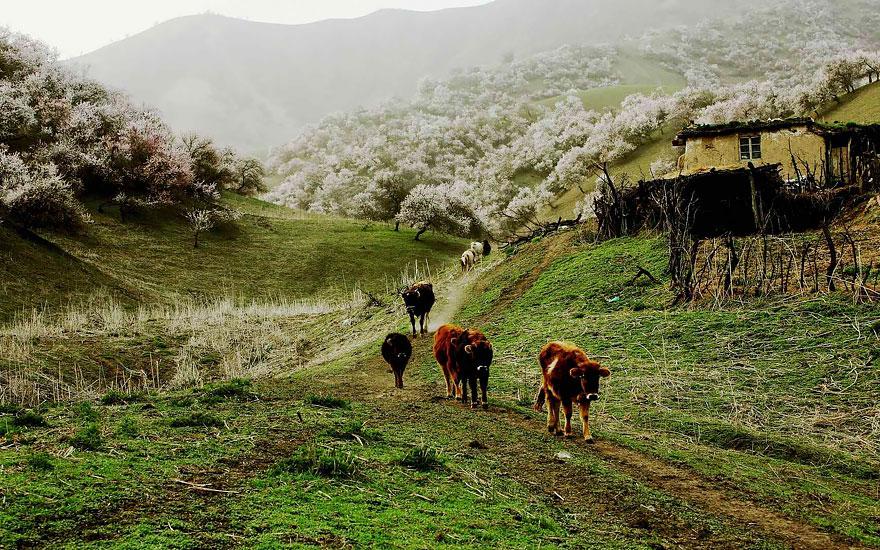
Bloom is dictated by latitude and altitude. Southern oases (Kashgar, Hotan, Yarkand) open in early March; central Xinjiang (Korla, Turpan) follows in late March; the Tianshan foothills and Yili valley in late April; the high pastures and the northern sunflower belt run July into early September. The classical transhumance goes: Turpan in mid-February for spring build-up, Korla in late March for pear pollination, the Urumqi, Changji, and Qitai foothills from late May through June for mountain flowers and rapeseed, Shihezi and the northern plains in July for oil sunflower, then back to Turpan in August for cotton and overwintering. The “western” long-distance route, used by apiarists from Sichuan, Yunnan, and Zhejiang, takes two months longer: the truck leaves Yunnan rapeseed in February, walks north through Shaanxi and Gansu, and enters Xinjiang from the east in early June.
February to April: the southern warm-up
The first apiaries move into the warm southern oases in February, often before the apricot has opened. The reason is pollination, not honey. Yarkand, Shache, and the Hotan lowlands pay apiarists a per-frame subsidy to bring hives in for the almond and early apricot bloom. The Ili prefecture beekeepers’ office puts the subsidy at roughly ¥20 per frame. Honey from the early southern flows is mixed: the first apricot nectar, the small white flowers of Russian olive (沙枣, Elaeagnus angustifolia) that bloom through May, and a thin layer of locust. If you buy a jar labelled 沙枣花蜜 in early summer in Kashgar, this is what it is. The flavour is pale, faintly resinous, and usually 38 to 40% moisture at extraction, well above the legal 20% threshold for mature honey.
May to June: lavender and the Ili first push
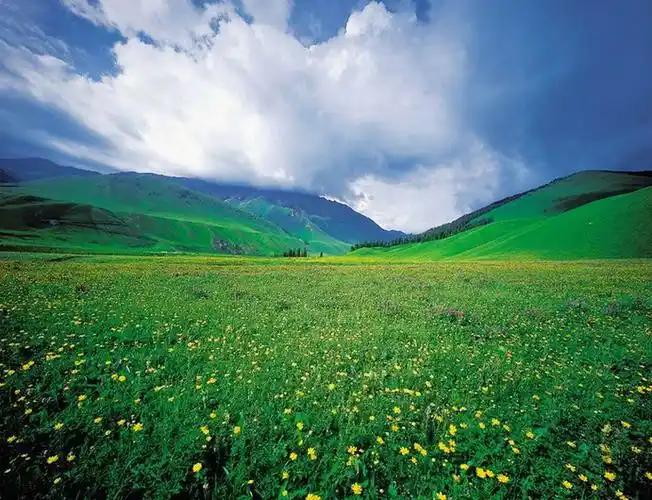
The Ili valley proper opens in late April: apricot and apple first, then wild tulip, then early mountain flowers. The lavender around Huocheng starts in mid-June and runs about three weeks, into the first days of July. Drive the G218 from Yining toward Huocheng in late June and you pass apiaries of every scale, from two-box hobbyists to multi-rig commercial yards with fifty or more hives. The Ili valley is also the centre of the protected Xinjiang black bee, a darker and longer-bodied European honey bee brought in from the Russian Empire in the early 1900s and naturalised along the Tianshan. The black bee can forage near 7°C and survive minus 40°C winters under a snow cover, which is why the breed dominates the Ili and Tacheng highlands. The Nilka honey and black bee valley sits at the southern end of this run, where the Yili prefecture’s black bee breeding farm is located.
July to August: sunflower and high-pasture
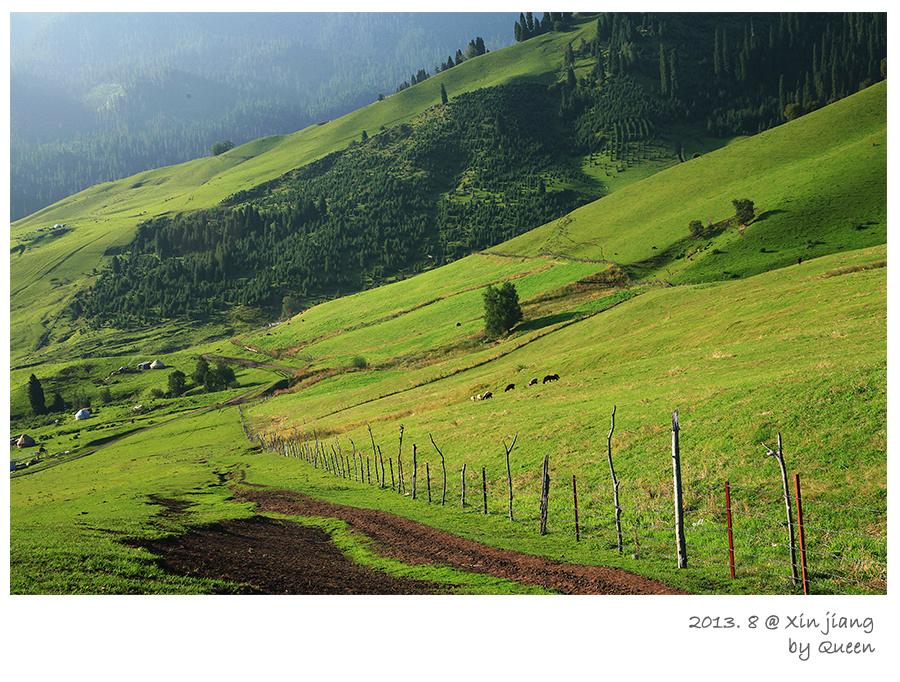
From late June, the apiaries drift north and uphill. The Ili rapeseed and early wildflower flow gives way to oil sunflower across the Tacheng plain, Emin, Yumin, and the Altay foothills, where more than 200,000 mu (about 13,300 ha) come into bloom from late July to early September. The Shawan to Shihezi corridor is the most concentrated sunflower-honey stretch in Xinjiang; on a long August drive, you pass a bee yard every few kilometres, often set into the field itself just outside the pivot-irrigation circle. From early July into late August, the high-pasture beekeepers take the same rigs up onto the Zhaosu, Tekes, and Bayinbuluke grasslands, where the wildflower flow tops out the season. The high-pasture wildflower honey is what most jars labelled 山花蜜 in the Kashgar Sunday market actually are.
September to October: southern wind-down
By mid-September, the high pastures have had three hard frosts, and the apiaries come back down. The Tacheng and Altay sunflower flow ends first, then the Ili valley. The trucks fan back out in two directions. Some head to the Tarim basin for the late cotton flow, mid-August into mid-October; cotton honey is dark, slightly bitter, and not to everyone’s taste, but it is the second-biggest single-source honey in Xinjiang by volume. The rest head back to the Turpan or Korla warm basins for wintering, where the apiarist feeds sugar syrup from October through February. By November, the trucks are stacked along the eastern edge of the Turpan basin like a second settlement, and the apricot bloom is ten weeks away again.
How to actually see a bee yard in Xinjiang
Yard gates are usually unlocked in the morning, when the foragers are leaving, and the foragers do not like vibrations. Knock, walk slowly, keep your voice down. Most apiarists will let you look at a frame if you ask, and a few will sell you a small jar straight out of the settling tank. Skip the strong fragrance and dark wool. The best yards to visit publicly are the few that double as museums, including the Yili black bee breeding centre in Nilka and the apiary exhibits around the lavender fields in Huocheng. To see the migration in motion, drive the G30 between Turpan and Korla in mid-March, the G218 between Yining and Huocheng in mid-June, or the S318 between Tacheng and Emin in late July.
Road rules when you meet a bee truck
Three rules. First, slow down well before you reach a parked rig; the bees forage in a fan of up to 1.5 km, and your car creates a pressure wave that knocks them out of the air. Second, do not stop, do not honk, do not lean out the window. If a truck ahead is moving with bees on the load, stay 50 metres back, because the road surface behind a loaded rig is often stained with honey, propolis, and dead bees, which is slippery. Third, do not try to take a photograph through an open side window. Shoot through the closed windscreen, and stop the car 200 metres further on if you really need a picture.
Honey you can actually buy and what it should cost
You will see the same six or seven jars on the shelf almost everywhere: 油菜 (rapeseed), 山花 (wildflower), 沙枣 (Russian olive), 薰衣草 (lavender), 葵花 (sunflower), 棉花 (cotton), and the very rare 骆驼刺 (camel thorn). The first three are common and cheap, around ¥30 to 60 for a 500 g jar in a Urumqi supermarket and ¥80 to 150 in a Kashgar bazaar. Lavender from Huocheng sells at a small premium, around ¥120 to 220 for 500 g in 2024; camel thorn from the Turpan basin is the most expensive of the everyday set, at ¥180 to 280. The black bee honey from Nilka is a separate category, with the certified, standard-compliant jar from the Yili beekeepers’ cooperative selling at ¥380 to 480 for 500 g in mid-2024. The Yili prefecture’s black bee honey standard came into force in March 2026 and sets a turanose reading above 1% and an oligosaccharide reading above 3%, the markers for the genuine article.
A 10-day Ili honey-and-blossom loop
This loop times to the lavender window, with a few days’ slack for the wild tulip in late April or the sunflower in late July. Start in Urumqi, drive the G30 west to Jinghe, then the G219 south to Yining. Day 1 and 2: Yining, the Kazanqi blue-doored old town and the Ili River at evening. Day 3: drive south into the Huocheng lavender fields, an hour before sunset. Day 4 and 5: into the Nilka hills for the black bee yards, with a half-day for Tangbula. Day 6 and 7: cross the Yizhao highway to Zhaosu, with stops at the Baishi Peak apricot terraces in late April or early May. Day 8 and 9: return via Tekes and Kalajun. Day 10: back to Yining. The loop assumes summer weather of 16 to 28°C; for the autumn sunflower, swap the middle week for Tacheng and Emin. The autumn harvest calendar gives the precise bloom windows. Plan the self-drive with 200 km of buffer fuel, especially on the G219 between Yining and Nilka, where the next station can be 120 km away.
Frequently asked questions
Is it safe to drive past a bee truck with the windows open? Not really. The bees are not aggressive, but the pressure wave at speed can knock a forager into the car, and a single sting in the cabin is enough to startle the driver. Windows up, vents off, distance.
Is Xinjiang honey different from other Chinese honey? Mostly because of the protected black bee and the variety of nectar sources. The Yili prefecture standard of March 2026 is the first formal benchmark; ask for the certificate of conformity before you pay.
Disclaimer
Hive counts and per-frame subsidy figures are taken from the Xinjiang apiculture industry statement of August 2026 and the Ili prefecture beekeepers’ office. Honey prices were collected between May 2024 and June 2025 in Urumqi, Yining, Kashgar, and Huocheng and may have shifted by plus or minus 10% since. Migration windows are typical years; in years with an unusually warm March or a sudden late frost, the dates move by up to three weeks. This page is for information only; we do not receive commission from any cooperative, apiary, or shop mentioned.
About the author
Karl Huang has been writing about travel in and around the Tianshan since 2014. He edits Xinjiang Attractions and wrote the harvest calendar, the autumn foliage guide, and the cottage-industry honey note you have just read. He lives in Urumqi and has been stung by Xinjiang honey bees twice on the same trip, both times because he leaned out of a car window.