Published: 03 September 2026 | Author: Karl Huang, Xinjiang regional editor
If you have driven in Xinjiang for more than a day, you have met livestock. The first time a flock of ewes streams across the asphalt and a Kazakh girl runs behind them with a willow switch, you learn that Xinjiang rural driving is its own subject. This is the guide I wish I had on day two of that first Tianshan trip, after 18,000 km of Xinjiang driving. Route-planning: our self-drive Xinjiang guide. Road conditions: our Xinjiang driving distances guide.
Who this is for. Self-drive travellers who plan to leave the four-lane belt between Urumqi, Turpan and Kashgar onto the two-lane roads. If you are not leaving the highway system, none of this matters. If you are, this is the only piece of the trip you cannot fix in a city.
Xinjiang livestock on the road at a glance
The numbers below are mid-range figures from local police posts and herders in seven prefectures between 2017 and 2026. Use them as a planning sheet.
| Livestock | Most likely months | Where to expect them on the road | Speed and behaviour |
|---|---|---|---|
| Sheep and goats | April to early June (spring move); September to early November (autumn move) | Any pastoral two-lane road in Altay, Tacheng, Bortala, Ili, Bayingolin, Aksu, Hotan, Kashgar | Tight flocks, will cross in front of a car; herd dogs often follow |
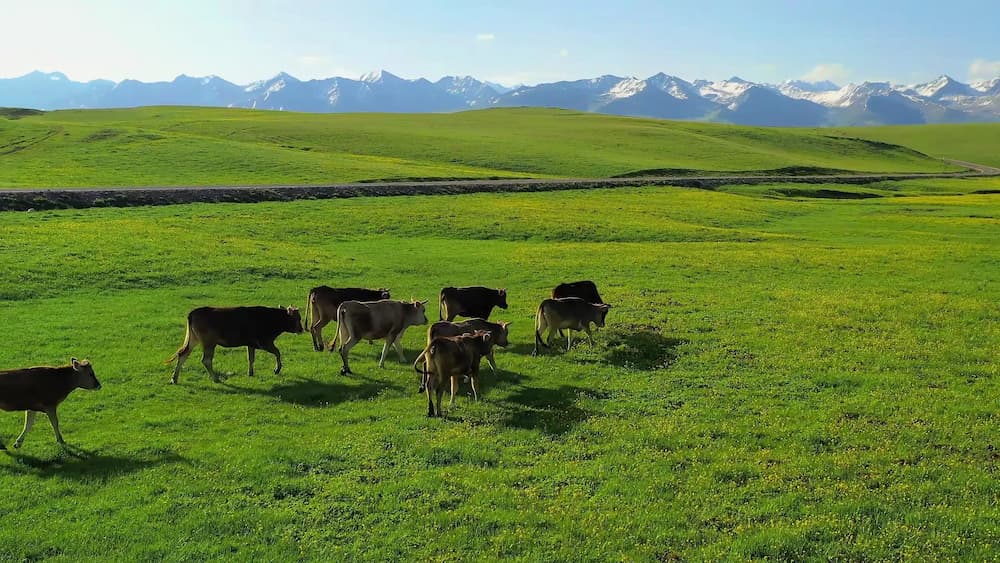
| Cattle | Year-round; peak on the road in May to September | Pasture fringe near Zhaosu, Tekes, Huocheng, Bole, Nilka, Hejing, Baluntai | Walk slowly across, do not run, will stand their ground if a dog is near |
| Horses | Year-round; loose horses most often seen May to September | Northern slopes of Tianshan, especially between Yining and Zhaosu, around Karakul lake, Tekes valley | Can bolt; one rider, sometimes no rider at all |
| Donkeys and mules | Year-round | Southern Xinjiang oases (Kashgar, Yengisar, Yarkand, Hotan, Keriya); used as draft animals by smaller farmers | Walk on the road shoulder, slow, hard to move out of the way |
| Camels (Bactrian) | Year-round; most often December to March on southern routes | Taklamakan desert fringe roads (G315 Hotan–Qiemo; G217 north of Aral; around Lop Nur) | Walk in single file along the road shoulder, do not startle |
| Yaks | June to September | Only above 2,800 m: Pamir plateau (Taxkorgan, Karakul), Bayinbuluke swampland, Toli–Tacheng pasture | Calm but heavy; can total a small car |
| Pigs | Year-round | Mainly northern Xinjiang farms near Urumqi, Changji, Shihezi, Turpan oases | Escape from broken fences, dart across, often at night |
What it actually feels like the first time
On the second afternoon of my first Tianshan loop, I came over a rise on the G218 between Yining and Zhaosu and found roughly 200 ewes filling both lanes. A Kazakh girl, maybe seven, ran behind them with a willow switch. There was no horn honking. The queue of about eight cars waited. It took 14 minutes. The lesson is that this is not an obstacle, it is traffic. Animals have right-of-way by custom. Local drivers do not honk except to warn. If you honk, you scare the flock, the dog panics, the next car behind will honk at you. If you inch forward, the herder’s dog may decide your car is the threat. I keep my engine on, my windows up.
Sheep and goats: the ones that stream across in front of you
More than 80 percent of the livestock-on-road moments I have logged are sheep or goats in flocks of 50 to 600. Two calendar windows produce most crossings.
- Spring move (mid-April to early June). Herds climb from winter low-ground camps near Yining, Bole, Wujiaqu and Changji up to summer pastures in the Tianshan. The G218, G217 and county roads up Tekes and Nilka see heavy traffic.
- Autumn move (mid-September to early November). Same routes in reverse, earlier in the day. This is when I most often see flocks with newborn lambs alongside the road. Our transhumance in Xinjiang guide lists routes and timing.
What to do. Stop 50 to 80 metres back. Cut headlights at dusk. Do not honk unless you must. The flock will cross in 2 to 15 minutes. The dog is the wildcard; if it walks up, roll the window up. I keep dried mutton bones in the glove box; tossing one has pulled a curious dog away twice.
Cattle, horses and donkeys: slow but unyielding
Cattle, horses and donkeys: slow but unyielding
Cattle on the Ili valley roads are usually tended, but on the pasture fringe between Bayinbuluke and Hejing they roam. A 400-kg cow does not move because you want to pass. Stop, wait, do not push past. If you see a cow ahead, slow well before you reach it; cows that decide to cross do so in the last 30 metres.
Horses are the most unpredictable. About one day in ten a loose horse decides the road is interesting and a horse at speed takes roughly 80 metres to react. If you see one near the asphalt, assume it may bolt. Reduce speed to 30 km/h and keep to the centre line for buffer.
Donkeys are a southern Xinjiang thing. On the G315 between Hotan and Keriya and inside the oases, you will see them pulling melons, bricks or firewood. They walk at a human pace and ignore horns. Plan to be stuck behind one for 5 to 30 minutes. Pull over only at a wide spot. If you want to actually see livestock traded rather than dodged, our Kashgar livestock bazaar guide walks through the Sunday market.
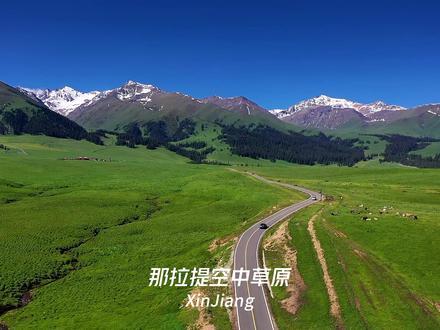
Camels: the slow surprise that stops a highway
On the desert-fringe roads, Bactrian camels walk in single file along the shoulder. A loaded camel train moves at 4 to 5 km/h. A loose one, startled, can put a 700-kg kick through a door. The rule I learned from a Yarkand driver in 2018: do not get out, do not lean out, keep the windows up, wait.
Most surprising camel encounters are not on the Taklamakan highway proper but on county roads off it: Yutian, Cele, Niya, Cherchen, Lop Nur basin edge. Turn off a numbered route onto anything smaller and add 20 to 60 minutes for camel and donkey traffic alone.
Yaks, pigs and the rare ones
Yaks only appear above 2,800 metres. The Pamir plateau road between Kashgar and Taxkorgan, the road around Karakul lake, and the high tracks above Bayinbuluke are the three places I have had to brake for yak. They are usually calm but huge, dark, and hard to see in low light. They stand on the road at night to keep warm. On the Pamir in October, dipped headlights pick them up at 30 metres. Drive at half speed after dusk.
Pigs are a northern Xinjiang night hazard. They escape from broken pens outside Urumqi, Changji and Shihezi and cross the smaller roads. They are low and dipped beams miss them. The one I clipped in 2019 taught me to drive with full beams on empty county roads when the layout allows, and to brake for any pair of shining eyes before you can identify them.
When animals are most likely to be on the road
Three windows each day, in roughly this order.
- Early morning (06:00 to 09:00). Drivers heading out of Yining, Zhaosu, Tekes or Bortala in April or October should expect at least one major herd on the G218, G219 or G217.
- Late afternoon (17:00 to 21:00). Cattle come down to drink, loose horses return, the light is bad.
- Midday (12:00 to 15:00). Herd dogs are most active in the heat. Expect a lone dog up to 30 minutes after a flock has crossed.
The two big year windows are spring (April to early June) and autumn (mid-September to early November). Outside those you will still see cattle on road fringes and camels on desert roads. The intensity drops. Full breakdown: our Xinjiang weather by month guide.
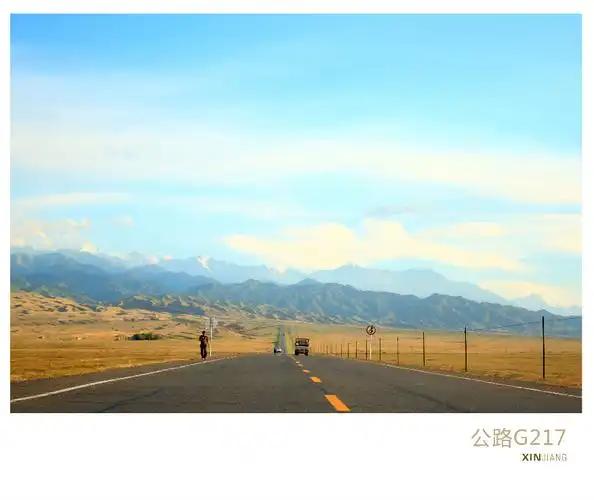
If you hit a sheep: what actually happens
You will not find a national price list. There is no “official” value for a Xinjiang sheep. After a non-fatal collision, the herder comes out, quotes above market, and a local police officer is called. The negotiation is on the spot, in Uyghur or Kazakh. Expect ¥600 to ¥3,000 for a non-pregnant adult sheep, ¥1,500 to ¥5,000 for a pregnant ewe or working animal. Camel and yak are higher; horse and cattle are at the upper end.
Two things help.
- Driving video. A running dashcam lets you show you were within the limit. It usually halves the negotiation. Police in 2024 and 2025 share costs more evenly with a video.
- Insurance. Standard Chinese motor third-party liability does not cover farm animals. Comprehensive insurance sometimes does. Read your policy before the trip.
The cleanest outcome I have seen: stop, take photos, call the police number on the nearest milestone post (most G217, G219 and G315 posts have one), wait, pay the negotiated amount, get a receipt. The receipt matters for the claim.
Night driving and the worst-case scenario
Livestock on the road at night is the most common cause of rural Xinjiang single-vehicle accidents I have seen firsthand. Three rules: do not drive between 22:00 and 04:30 on any two-lane pastoral road if you can help it; full beams whenever the road is empty and the layout is straight; brake early for any pair of eyes, wolf, fox, herd dog or cow. Treat all of them the same. Full cold-weather rules: our winter driving in Xinjiang guide.
If a herd dog runs at your car at night, slow down, do not swerve. The dog will often turn off. If a horse or cow steps into your lane, slow hard, do not swerve. Two drivers I know walked away from collisions only because they did not swerve.
How to handle a herd crossing without drama
Pull to the right shoulder, 50 to 80 metres back. Engine idling, headlights off at dusk, hazards on if you want to be polite. Windows up, especially if you see a herd dog. Camera ready but not in use until the herd is past. Wait until the last animal has cleared the road and the herder signals, usually a hand wave.
If you are stuck in a queue, do not turn around unless you have a wide spot. You will block the herder and the next car. If you must overtake on the shoulder, do it at walking pace with the windows up. Cattle do not like fast-moving objects on their flank.
A six-day Tianshan drive built around livestock
A six-day Tianshan drive built around livestock
Below is the loop I run with friends who want to meet the herders, not just photograph them.
- Day 1. Yining to Zhaosu (G218, 198 km, 3.5 hours including a herd crossing). Overnight in a Kazakh yurt camp.
- Day 2. Zhaosu to Tekes (76 km, 1.5 hours). Sheep on the road in May and September. Overnight in Tekes.
- Day 3. Tekes to Karakul lake via the Mengbulake pass (290 km, 6 hours). Cattle and yaks on the high section.
- Day 4. Karakul to Bayinbuluke (370 km, 7 hours). Cattle on the swampland fringe in late afternoon.
- Day 5. Bayinbuluke to Korla via Baluntai (320 km, 6 hours). Camel and donkey traffic inside the Yanqi oasis at dusk.
- Day 6. Korla to Urumqi via G314 and G30 (470 km, 6 hours). Watch for camel trains crossing service roads in the morning.
Stretch this over 9 days with rest days at Zhaosu and Bayinbuluke for a slower version.
Frequently asked questions
Do I need a dashcam? Yes. A 1080p dashcam that loops on a 32 GB card costs roughly the same as a single sheep and is the single best investment for a self-drive Xinjiang trip.
What if a herd dog lunges at my car? Slow down, do not accelerate. Roll the window up. If the dog makes contact, stop and call the police on the milestone-post number. Do not get out to chase the dog.
Is the Pamir safe in October with yaks? Yes, but drive between 09:00 and 17:00. Dusk yaks on the road are a real hazard and the temperature drops fast. Most serious accidents on the Pamir involve yaks at night.
What if I hit a sheep and drive off? Hit-and-run, treated as a traffic offence. The fine plus the negotiated compensation is significantly higher than stopping. Always stop.
Disclaimer
All prices, distances and seasonal windows are based on personal travel between 2017 and 2026 plus conversations with herders, drivers and traffic police in Yining, Zhaosu, Tekes, Taxkorgan, Bayinbuluke, Korla, Kashgar, Yarkand and Hotan. Conditions change. Insurance wording, police procedures and herder expectations vary by county. Treat the numbers as planning figures. Read your rental insurance and your own policy before the trip. Obey the herder and the police on the spot.
About the author
Karl Huang edits XinjiangAttractions.com. He has driven roughly 18,000 km on Xinjiang rural roads since 2017, with three livestock encounters that produced a police report: two involving a single ewe on the G218, one a loose horse on the Bayinbuluke–Hejing road in 2021. None were his fault, one of them was.