Published: July 24, 2026 | Author: Daniel Wu, travel writer and heritage-language researcher
Most travelers who reach the Ili Valley come for lavender fields and Kazakh horse pastures, then leave without realizing they drove within twenty minutes of one of China’s most unusual cultural stories. Xibe culture in Xinjiang exists because of a single imperial order issued in 1764, when roughly a thousand soldiers and their families were marched 5,000 kilometers from Manchuria to garrison the empire’s western frontier. Their descendants still live south of the Ili River in Qapqal county, still shoot bows competitively, and still print the world’s only newspaper in a script nearly identical to written Manchu. I’ve made two trips to Qapqal — once for the Westward Migration Festival in early summer 2023, and again in April 2025 when the valley’s apricot orchards were in bloom — and this guide pulls together what I learned on the ground, checked against county records and the exhibits at the Xibe Westward Migration Museum.
Xibe Culture in Xinjiang: Quick Reference
| Item | Details |
|---|---|
| Who | The Xibe (锡伯, Sibe), a Tungusic-speaking people; about 190,000 nationwide, with the Xinjiang community concentrated in Qapqal |
| Where | Qapqal Xibe Autonomous County, 20 km south of Yining across the Ili River |
| Key history | 1764–65 westward migration from Shengjing (today’s Shenyang) under the Qianlong Emperor |
| Language | Xibe, closely related to Manchu; written in a script adapted from Manchu in 1947 |
| Signature festival | Westward Migration Festival (Duyinbayi), 18th day of the 4th lunar month, usually May or June |
| Main sights | Jingyuan Temple, Westward Migration Museum, archery training halls, Xibe villages (niru) |
| Getting there | Fly to Yining (Yining Airport), then 30–40 minutes by taxi or bus |
| Time needed | Half a day minimum; a full day with a meal in a Xibe home is far better |
A Newspaper, a Bow, and a Bowl of Pickles
My first hour in Qapqal set the tone for everything after. A retired schoolteacher named Mr. An — I’d been introduced through a guesthouse owner in Yining — laid three things on his kitchen table: a folded copy of the Qapqal News, a laminated family genealogy going back nine generations, and a jar of huahua cai, the shredded pickled vegetable relish that accompanies nearly every Xibe meal. The newspaper mattered most to him. Printed in vertical Xibe script, it is the only regularly published Xibe-language paper anywhere, and he read me a paragraph aloud, tracing the columns top to bottom with his finger. His grandchildren, he admitted, read it slowly. That tension between pride and worry came up in almost every conversation I had in the county.
Later that afternoon he walked me to a neighborhood archery hall where teenagers were training on standard recurve bows. Archery is not a costume performance here. Qapqal calls itself the home of Chinese archery with some justification — the county has fed a steady line of athletes into provincial and national squads, and the sport traces straight back to the garrison duties the first settlers carried west. Watching a fourteen-year-old girl put six arrows into the gold at 30 meters while her coach barked corrections in a mix of Xibe and Mandarin was worth the trip on its own.
The Westward Migration: Why the Xibe Are Here
The short version taught in the county museum goes like this. In 1764, the Qianlong Emperor needed reliable garrison troops in the newly pacified Ili region. Just over a thousand Xibe soldiers, plus family members — around four thousand people in total — were selected from banner garrisons around Shengjing, modern Shenyang. They left after a farewell gathering at a temple on the 18th day of the fourth lunar month, a date the community has commemorated ever since. The journey across Mongolia and the deserts took about fifteen months. On arrival they were organized into eight companies, or niru, and the villages of Qapqal still carry those company numbers today: locals give directions by saying “sixth niru” or “eighth niru” the way other people name suburbs.
What makes the story remarkable is the preservation that followed. Isolated on the south bank of the Ili River, the community kept the language, script and archery tradition that largely faded in Manchuria itself. Linguists now travel to Qapqal to study material that survives nowhere else, and the autonomous county — established in 1954, the only one of its kind — funds bilingual schooling and the newspaper. I’d recommend an hour in the Westward Migration Museum before anything else; the map of the route, marked with wells and river crossings, makes the 1764 journey feel less like a textbook entry and more like the gamble it was.
Jingyuan Temple and the Villages
Jingyuan Temple, built in 1893 in the sixth niru, is the architectural highlight — a walled Buddhist complex whose layout would look at home in Liaoning, which is exactly the point. The settlers built in the style of the homeland they never saw again. When I visited in April the courtyards were nearly empty, the elm trees just leafing out, and a caretaker let me linger over the bilingual inscriptions. Entry was 30 yuan; hours are roughly 9:30 to 19:00 in summer and shorter off-season, so check locally rather than trusting online listings.
The villages themselves reward slow wandering. Look for the tidy courtyard houses with vegetable plots out front, the occasional shrine to the mother goddess Xilimama — a string hung with small bows, cradles and cloth strips recording family history — and elderly men playing cards under grape trellises. If you read about the Ili Valley more broadly, our separate Qapqal destination guide covers the county’s sights village by village, while this article focuses on the culture behind them.
Getting There
Fly into Yining Airport from Ürümqi (about 90 minutes, frequent daily flights) or take the overnight train. From Yining city, Qapqal county town is 20-odd kilometers south across the Ili River bridge: a taxi runs 40–60 yuan and takes half an hour, and shared minibuses leave from the local bus station for a few yuan more slowly. There’s no need for a self-drive vehicle unless you plan to hop between the outlying niru villages, in which case hiring a driver for the day (300–400 yuan when I did it in 2025) is the practical option. Foreign passport holders should carry their passport at all times; hotel registration in the county is straightforward but the pool of licensed hotels is smaller than in Yining.
When to Go
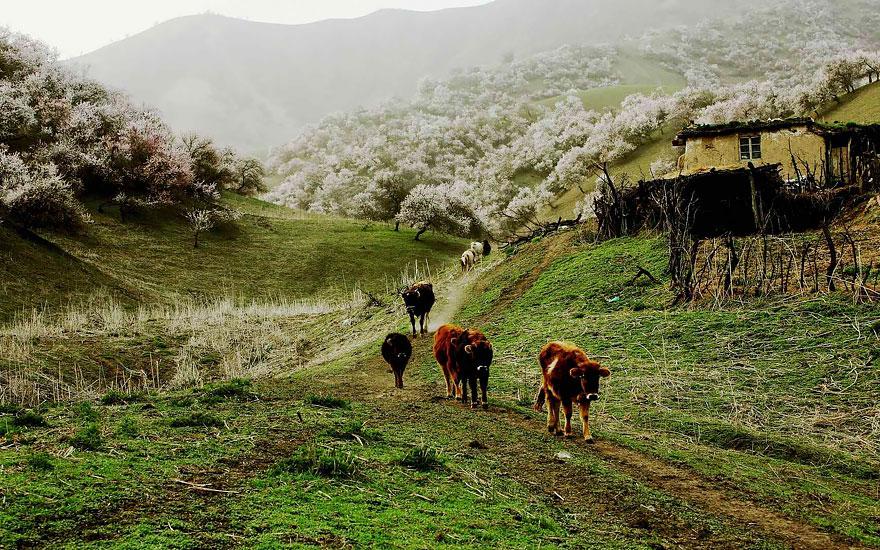
Two windows stand out. Mid-April brings apricot blossom across the valley — the famous photogenic hillsides are at Tuergen near Xinyuan, but Qapqal’s own orchards bloom the same week and get none of the crowds. The bigger cultural draw is the Westward Migration Festival on the 18th day of the fourth lunar month, which lands in May or June depending on the year. In 2023 I watched mounted archery displays, group dances to the butterfly-shaped dongbur lute, and an outdoor banquet that seemed to involve the entire sixth niru. Dates shift annually, so cross-check the lunar calendar or ask a hotel in Yining before building an itinerary around it; our Xinjiang festivals calendar explains how the region’s lunar-date festivals move.
Where to Stay
Most visitors sleep in Yining and day-trip to Qapqal, which works fine. Yining’s Kazanqi quarter has converted courtyard guesthouses in the 200–400 yuan range with far more character than the business hotels near the bus station. In Qapqal county town itself there are two or three serviceable Chinese chain hotels around 150–250 yuan that accept foreigners — confirm by phone before arriving, as policies change. The best option, if you can arrange it through a guide or a contact like my Mr. An, is a home meal and evening in a niru village even if you sleep elsewhere. A licensed guide who knows Xibe families is worth the fee here; see our notes on hiring a local guide in Xinjiang.
What to Eat
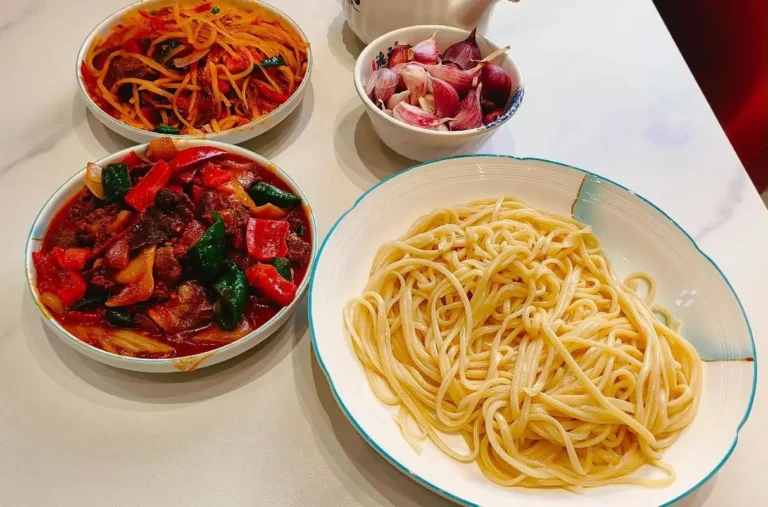
Xibe cooking sits closer to Northeast Chinese food than to the Uyghur and Kazakh tables that dominate the region, and the contrast is half the fun. The essentials:
- Xibe flatbread (发面饼): a soft, slightly sour leavened pancake baked fresh for every meal. Etiquette note my host insisted on — place it “heaven side up,” the blistered side facing the sky, and tear rather than bite from the whole piece.
- Huahua cai: the shredded pickle relish of celery, carrot, chili and cabbage that goes with everything. Every family’s ratio is different and everyone is certain theirs is correct.
- Whole sheep banquet: festival fare, served with the flatbread and endless toasts.
- Home-style stews: pork and vermicelli dishes you will rarely see elsewhere in the valley, a legacy of the Manchurian homeland.
Coming from a week of kebabs and laghman, the sour bread and pickles reset my palate completely. If food is your main lens on travel, pair a Qapqal lunch with our guides to Uyghur culture and Kazakh culture to taste how three very different traditions share one valley.
Practical Tips
- Learn the greeting. Even a mangled attempt at Xibe hello earns real warmth; Mandarin works everywhere as a fallback.
- Ask before photographing the Xilimama shrine strings or anyone at prayer in Jingyuan Temple. Families were relaxed about photos in my experience, but these are living observances, not props.
- Bring cash in small notes for village purchases; mobile payment is universal in the county town but patchy with elderly vendors.
- Archery halls sometimes let visitors try a few arrows for a small fee if you arrive outside training hours — ask politely and accept a no.
- The county sits at low elevation with hot, dry summers; carry water and sun protection in July and August.
- General courtesy rules for the region apply here too — our Xinjiang etiquette guide covers the essentials.
A Sample Day from Yining
08:30 — Breakfast in Kazanqi, then taxi across the Ili River bridge.
09:30 — Westward Migration Museum for the route map and garrison history.
11:00 — Jingyuan Temple in the sixth niru; allow an unhurried hour.
12:30 — Lunch of flatbread, huahua cai and stew, arranged through your guide or a village restaurant.
14:30 — Walk one of the niru villages; look for Xilimama shrines and the old irrigation canal, dug by hand in the early 1800s to open the south bank to farming.
16:30 — Archery hall visit if training schedules allow.
18:00 — Return to Yining for dinner; the light on the river bridge is best around now for photos.
FAQ
Is Qapqal open to foreign travelers?
Yes. It’s an ordinary open county — no permit needed. Carry your passport and stay in hotels licensed for foreigners, which is standard practice across Xinjiang.
Can I hear spoken Xibe as a visitor?
Yes, especially among middle-aged and older residents in the villages and at the newspaper office. Younger people mostly answer in Mandarin, though schools teach the script.
Is the Xibe language really the same as Manchu?
Very close. Written Xibe was adapted from the Manchu script in 1947 with minor changes, and scholars of Qing-era documents study in Qapqal for this reason. Spoken Xibe has diverged more but remains mutually intelligible to a large degree.
How much time does Qapqal deserve?
A half day covers the museum and temple. A full day with a village meal is the better trip. Festival dates justify two.
Is the Westward Migration Festival open to outsiders?
It is, and visitors were welcomed warmly when I attended. Events cluster around the county town and larger niru; ask locally for that year’s schedule since venues change.
Disclaimer
This article reflects visits made in 2023 and 2025 plus follow-up research. Prices, opening hours and festival dates change — verify locally or with official Ili Kazakh Autonomous Prefecture tourism channels before you travel. Population and historical figures follow county museum exhibits and published census data; where sources differ, I’ve used rounded numbers.
About the Author
Daniel Wu is a Chengdu-based travel writer with a background in linguistics who covers minority-language communities across western China. His two trips to Qapqal (June 2023 and April 2025) included the Westward Migration Festival, village homestays and more huahua cai than any reasonable person needs.