Published: July 30, 2026 | Author: Ruth Calloway, reviewed by the Xinjiang Attractions editorial team
I spent 23 years grading coloured stones for an auction house in Melbourne, and I have a Fellowship diploma from the Gemmological Association of Great Britain that my son David says I mention too often. So when he suggested a trip through southern Xinjiang last October, I packed my 10x loupe and a pocket torch before I packed socks. Xinjiang jade shopping has a reputation problem: everyone has heard of Hotan jade, almost nobody outside the trade knows what the term legally means in China, and the gap between those two facts is where tourists lose money. Over nine days in Urumqi, Kashgar and Hotan I examined somewhere north of two hundred pieces, deliberately bought fourteen cheap ones as test subjects, and had eleven of them fail basic nephrite checks back home. This guide is what I wish someone had handed me at the airport.
Quick reference: Xinjiang jade shopping basics
| Item | What I found |
|---|---|
| Main buying locations | Hotan jade bazaar (busiest Friday and Sunday), Jade Street along the river, Urumqi International Grand Bazaar, Kashgar old town shops |
| Realistic tourist budget | ¥50 to ¥300 for honest trinkets; ¥2,000 to ¥8,000 for a small genuine nephrite pendant; river seed jade of quality starts in the tens of thousands |
| Most common fakes | Dyed quartzite, glass, serpentine (Xiuyan jade), marble; treated jadeite is rarer here since Hotan jade is nephrite |
| Certificate reality | A Chinese certificate reading 和田玉 (Hetian jade) confirms nephrite, not Hotan origin |
| Bargaining norm | Opening prices ran 2.5x to 4x what sellers accepted from me |
| Best season to visit | September to November: bearable heat, post-flood river digging season |
What I learned in the trade, and what Hotan taught me anyway
Here is the single most useful fact in this article. Under China’s national standard for gemstone naming (GB/T 16552), the label “Hetian jade” describes a mineral, tremolite nephrite, not a place. Stone quarried in Russia, South Korea or Qinghai province can be sold with a laboratory certificate reading 和田玉 and the paperwork is entirely legal and accurate. When a Hotan stallholder tells you his certificate proves the stone came from the White Jade River, the certificate proves no such thing. I knew this before arriving, in the abstract way you know things from journals. Watching it deployed on a busload of domestic tourists at a shop near Hotan airport made it concrete.
My second lesson was humbler. On our first morning at the jade bazaar, a trader in his sixties watched me pull out my loupe, grinned, and handed me his own without a word. His was better than mine. These men handle more nephrite in a month than I graded in a decade, and the good ones are not trying to fool you with glass. The genuine deception happens at the margins: Qinghai material priced as river-bed Hotan, mountain jade tumbled smooth to imitate seed jade, skin colour added with iron oxide and a heat gun. The trinket stalls selling ¥60 bracelets are honestly selling ¥60 goods; nobody there believes they are trading in treasure, except occasionally the buyer.
David bought one of those ¥60 bracelets on day two in Kashgar. Under my torch it was dyed quartzite, granular structure lit up like sugar. I told him. He said it was a ¥60 souvenir of his mother being insufferable, and he still wears it, so I suppose everyone left that transaction satisfied.
Where to buy: the three markets compared
The Hotan jade bazaar sits east of the city centre and runs daily, but Friday and Sunday mornings are when the courtyard fills properly, perhaps three hundred sellers with cloth squares and plastic tubs. This is a working wholesale market where dealers from Guangzhou buy in bulk, and it is the only place on our trip where I saw serious stones. Prices are not marked. Photograph nothing without asking; several traders were firm on this and I understood why once I saw the size of some transactions being negotiated over tea.
Jade Street, along the Yurungkash (White Jade) River on the edge of town, is more relaxed and more touristic. Expect friendlier English, higher starting prices, and a much higher ratio of Qinghai and Russian material. It is a fine place to buy a modest pendant once you accept what you are actually buying. The town of Pishan, the old jade-road settlement west of Hotan, has a smaller street market that felt noticeably cheaper, though the drive is only worth it if you are heading that direction anyway.
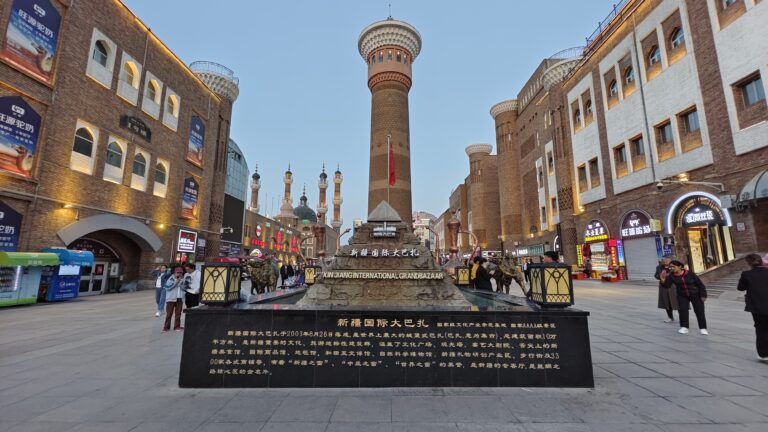
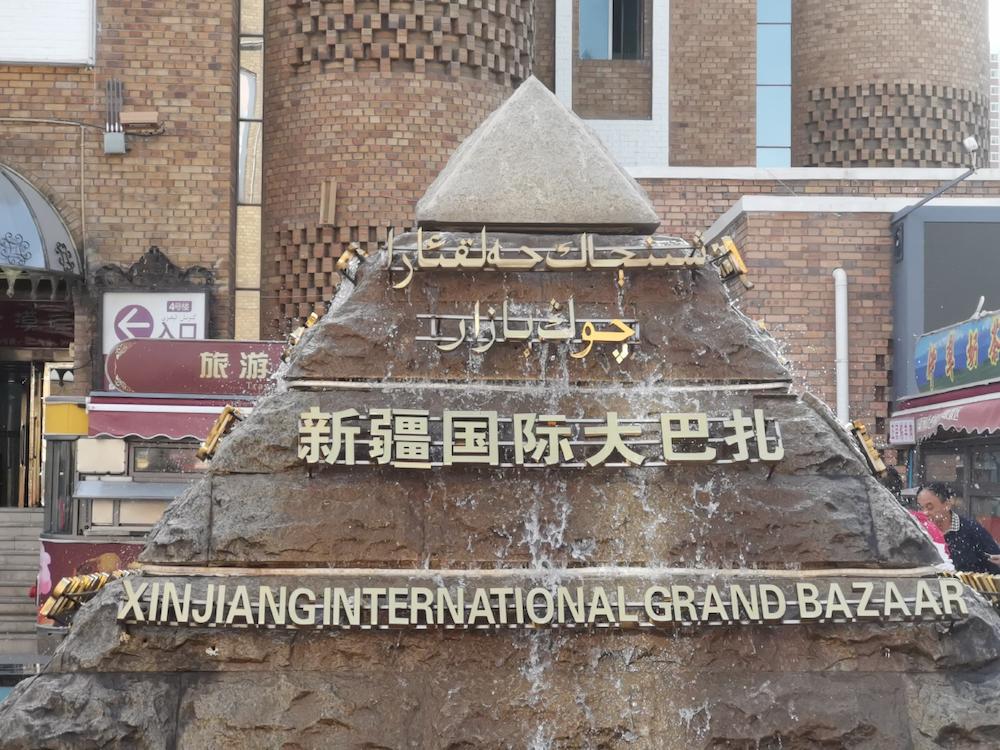
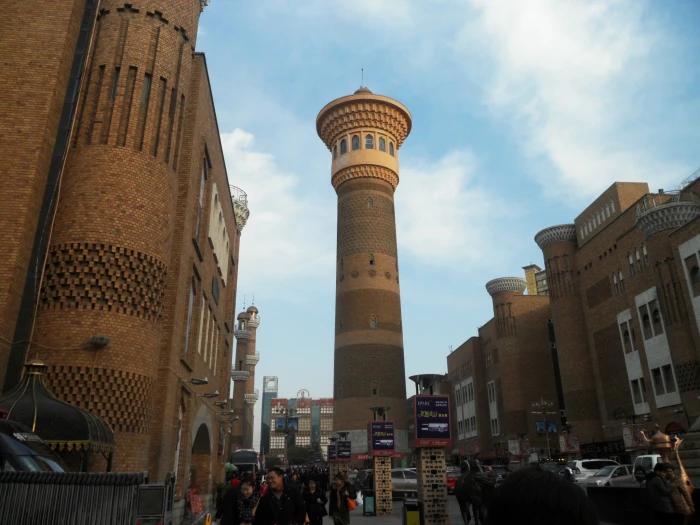
Urumqi’s International Grand Bazaar is where most visitors do their Xinjiang jade shopping by default, and it is the weakest of the three options on price. The upside is fixed-price shops with receipts, air conditioning and staff who can arrange laboratory testing. If your itinerary skips the south entirely, buy small here and keep your expectations calibrated. For the wider market experience beyond stones, our piece on what Xinjiang bazaars mean beyond shopping covers the food halls and crafts that make the Grand Bazaar worth an afternoon regardless.
How we got there and around
We flew Melbourne to Urumqi via Guangzhou, then took domestic flights: Urumqi to Kashgar (two hours, roughly ¥700 booked ten days out) and Kashgar to Hotan (fifty minutes, ¥450). There is also a comfortable overnight train from Kashgar to Hotan skirting the Taklamakan, which David wanted and I vetoed, a decision I mildly regret. Within Hotan, taxis to the jade bazaar cost us ¥10 to ¥15 from the city centre hotels; drivers all know it. If you are pushing deeper into the basin, our guide to crossing the Tarim Basin covers the desert highways, and remote towns like Qiemo on the Taklamakan’s southern rim have their own small jade trades with almost no tourist markup.
When to go
We went in mid-October and I would repeat that choice. Summer in Hotan is brutal, over 35°C with dust, and the July flood season is when the river runs too high for digging. By late September the water drops, fresh material comes out of the riverbed, and the market has new stock and good moods. Winter is quiet and cold but the bazaar still runs. Avoid the first week of October entirely; national holiday crowds inflate everything, as we explain in our breakdown of Xinjiang public holidays and travel crowds.
Where we stayed
In Hotan we took a standard business hotel near Unity Square, about ¥260 a night, clean and forgettable, chosen because it was ten minutes from the bazaar and registered for foreign guests, which not every Hotan property is. Kashgar offered more character for similar money. I will not pretend Hotan is a hotel destination; you are there for the stone and the river. Check registration rules before booking anything cheap, a problem covered honestly in our Xinjiang solo travel guide.
What we ate
The lamb skewers grilled at the bazaar entrance were the best of our whole trip, ¥5 each over apricot-wood coals. Hotan is also serious about walnuts and dried mulberries; a trader we bought a pendant from insisted we take a bag of the latter as a closing gift. Evening food streets near Unity Square do decent laghman and a local pigeon soup David rated higher than I did. Budget ¥60 to ¥100 per person per day eating well; our full Xinjiang travel cost breakdown has wider numbers.
How to test jade like a sceptic: my field notes
No pocket test proves authenticity, but several disprove it quickly. My routine at every stall:
First, the torch. Held against the stone edge, nephrite glows with a soft, even, slightly oily translucence and a fibrous internal texture. Quartzite looks granular, sugary under magnification. Glass shows swirl lines and gas bubbles, and bubbles are a death sentence, no exceptions. Second, temperature and heft: nephrite is dense (specific gravity around 2.95) and stays cool against your cheek longer than glass. Third, sound: two genuine pieces tapped together ring with a musical note; most imitations click dully. Fourth, the skin. Real river seed jade has microscopic pore texture like human skin, and dyed “skin” concentrates colour in surface cracks, visible under any loupe. I saw beautiful orange skins in Hotan that were entirely painted, priced as though nature made them.
My rule for tourists: any purchase over roughly ¥1,000 should be conditional on a same-day certificate from an independent testing office, and Hotan has NGTC-affiliated counters in town that charge ¥30 to ¥50 per piece while you wait. Remember what the certificate can and cannot say. Nephrite, yes. Hotan origin, never. A seller who resists independent testing has answered your question for free.
Bargaining, and the walk-away that worked
On our third Hotan day I found a white nephrite pendant, decent even colour and translucence, opening price ¥8,000. I offered ¥2,000, was refused with theatrical sorrow, and left. The next morning the same trader waved me over and we settled at ¥2,600 over tea. Back in Melbourne, a colleague confirmed it as good mid-grade nephrite, likely Qinghai or Russian source, fairly worth about what I paid. That is the honest ceiling of tourist success: paying a fair price for correctly identified stone. Nobody at the bazaar is selling you a bargain; the dealers from Guangzhou got those before breakfast.
Counting is done openly on phone calculators, thirty to forty percent of the opening number is a sane first offer, and buying two pieces from one seller always unlocked a better rate than either alone. Take receipts for anything substantial. Chinese customs rarely trouble tourists over personal jade purchases, but paperwork on higher-value items smooths any questions on exit, and our guide to Xinjiang customs and border formalities explains what documentation matters.
Our nine-day route
Day 1-2: Urumqi, Grand Bazaar reconnaissance, noting fixed prices as benchmarks. Day 3-4: Kashgar old town, small shops, David’s quartzite bracelet. Day 5-8: Hotan, jade bazaar on Friday and Sunday mornings, Jade Street twice, a dawn hour watching diggers work the Yurungkash gravel (an old man showed me his week’s pocket: nine worthless pebbles and one genuine white stone the size of a coffee bean), independent testing office visit, the ¥2,600 pendant. Day 9: fly out via Urumqi. Anyone with a serious Xinjiang jade guide agenda should weight the split even harder toward Hotan than we did.
FAQ
Is it safe to buy Hotan jade as a complete beginner?
Yes, if you cap your spending at souvenir level or insist on independent same-day testing above ¥1,000. The predictable losses come from believing origin stories no certificate supports.
Can I pick jade from the river myself?
You can legally wander accessible gravel bars near town and locals do dig, but commercial extraction is regulated and the easy ground has been worked for decades. Treat it as a fun hour, not a business plan.
Where is the cheapest place for Xinjiang jade shopping?
The Hotan jade bazaar itself, followed by smaller towns like Pishan. Urumqi’s Grand Bazaar was consistently the most expensive per grade in my comparisons.
What does a real certificate cost and prove?
¥30 to ¥50 at NGTC-affiliated offices in Hotan. It proves the stone is nephrite (or is not). It says nothing about geographic origin, regardless of what the seller claims.
Should I buy jade at shops my tour bus stops at?
I examined pieces at two such stops out of professional curiosity. The pricing was two to three times Jade Street for equivalent material. Draw your own conclusion.
Disclaimer
Prices, flight costs and market observations are from our October 2025 trip and spot checks in mid-2026; jade valuation is subjective and markets shift. This article is general information, not valuation advice. We paid for all purchases and testing ourselves and have no affiliation with any seller or laboratory mentioned.
About the author: Ruth Calloway, FGA, graded coloured gemstones for a Melbourne auction house for 23 years before retiring in 2023. She travelled Xinjiang in October 2025 with her son David, who still wears the quartzite bracelet. Edited and fact-checked by Karl Huang and the Xinjiang Attractions team, who have covered the region’s markets since 2024.