Last updated: August 4, 2026 | Xinjiang Attractions Editorial Team
Xinjiang cuisine sits at the meeting point of Uyghur, Kazakh, Central Asian and Han Chinese cooking, and it tastes like it: lamb, cumin, wheat and sun-heavy fruit, cooked over charcoal or steam rather than in a wok. We have eaten our way through night markets in Urumqi, family courtyards in Kashgar and roadside stops on the Tarim rim, and the fifteen dishes below are the ones we kept ordering again.
Prices are what we actually paid between 2024 and mid-2026. They drift with the seasons and are higher inside scenic areas, so treat them as a planning range rather than a menu.
The flavours you will meet everywhere
- Lamb — the default protein, usually skewered, stewed or steamed
- Cumin and chilli — the signature dusting, applied generously
- Wheat — noodles and tandoor bread outrank rice in most meals
- Dairy — yogurt, milk tea and kumis, a Central Asian inheritance
- Fruit and nuts — the sugar comes from roughly 3,000 hours of annual sunshine
15 must-try Xinjiang dishes
1. Laghman (拉条子) — hand-pulled noodles
Thick, springy noodles pulled to order and topped with stir-fried lamb, peppers, onion and tomato. Ask for the noodles and sauce served separately (过油肉拌面) if you want them to stay chewy. Full background in our guide to laghman noodles.
Price: 15-30 CNY per plate
2. Kawap (烤肉串) — charcoal lamb skewers
Cubes of lamb alternating with fat, dusted with cumin and chilli over charcoal. The fat is the point; skewers ordered lean are a rookie mistake. See our Xinjiang kebab guide for how to order at a stall.
Price: 3-8 CNY per skewer
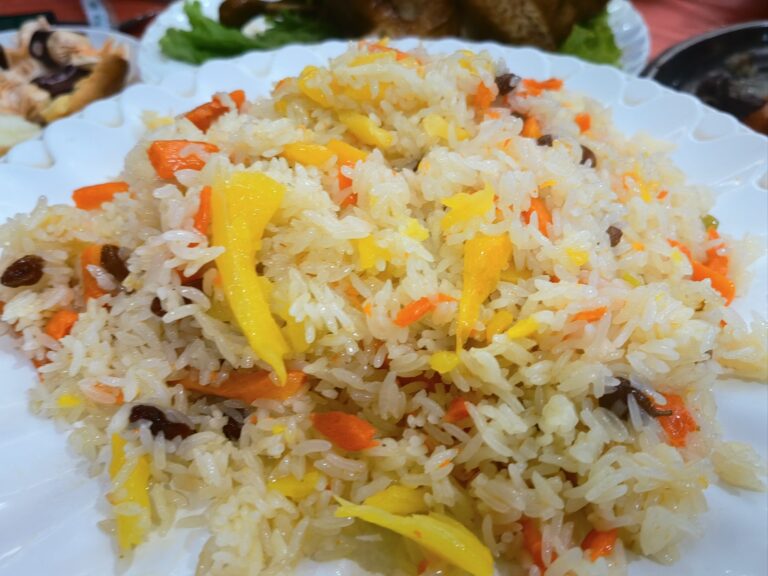
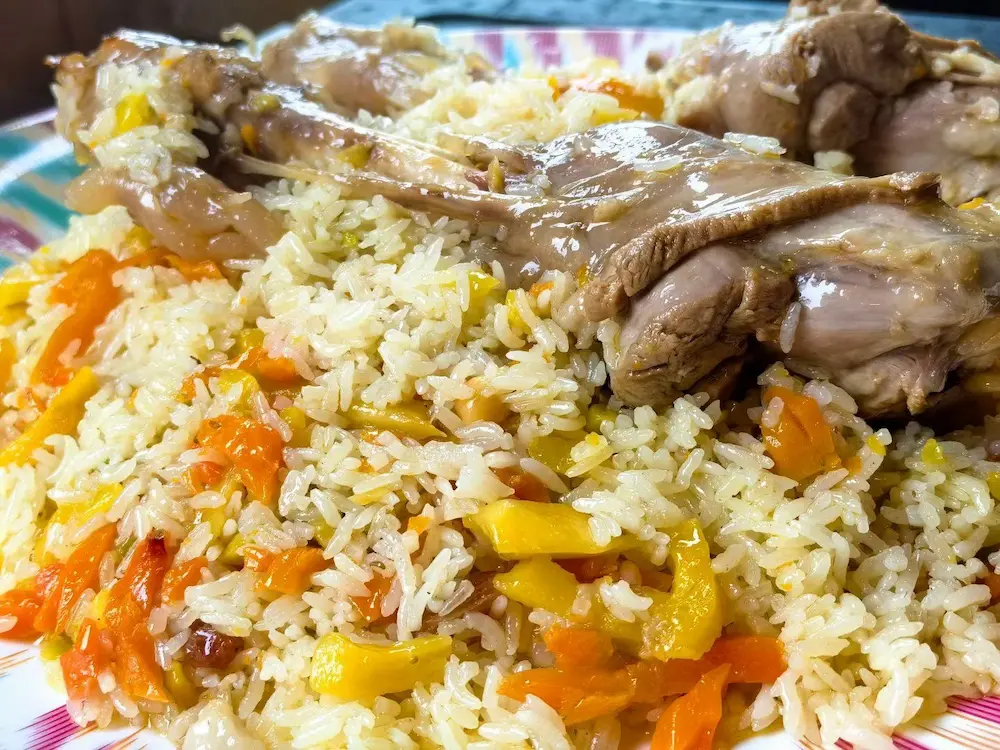
3. Polo (抓饭) — Uyghur pilaf
Rice steamed with lamb, yellow carrot and onion in rendered lamb fat. Traditionally a Sunday and celebration dish, which is why the best pots sell out by early afternoon. More in Xinjiang pilaf: the soul of the Sunday pot.
Price: 15-25 CNY per plate
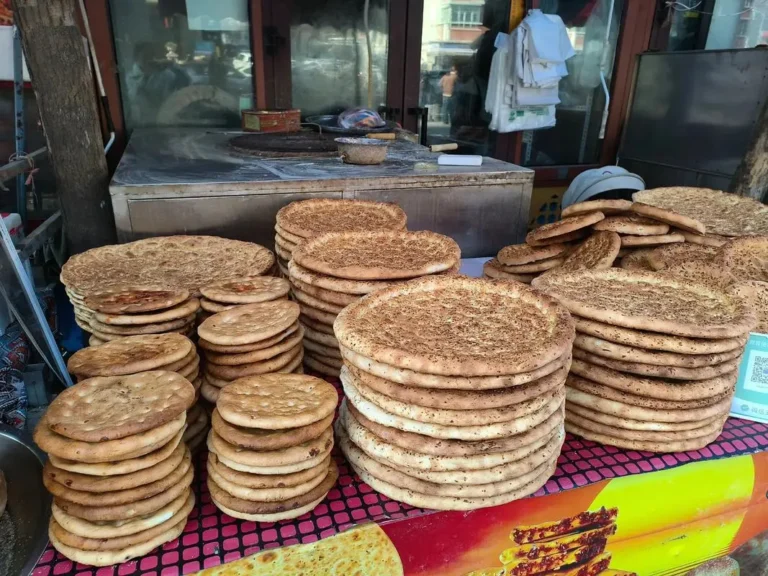
4. Nan (馕) — tandoor flatbread
Baked against the wall of a clay oven, dense enough to keep for days without refrigeration. Sizes run from a saucer to a cartwheel. Our Xinjiang naan bread guide covers the main varieties.
Price: 2-8 CNY per piece
5. Dapanji (大盘鸡) — big plate chicken
Chicken braised with potato and green pepper in a cumin-and-chilli sauce, then wide belt noodles dropped into the remaining liquid at the end. A Xinjiang-Han fusion dish, and easily enough for two or three people.
Price: 40-80 CNY per plate (serves 2-3)
6. Samsa (烤包子) — tandoor-baked meat pies
Square or triangular pastries of lamb, onion and cumin, slapped onto the oven wall until the crust blisters. Best eaten standing up, within a minute of being pulled out. See samsa and baked breads beyond naan.
Price: 3-6 CNY per piece
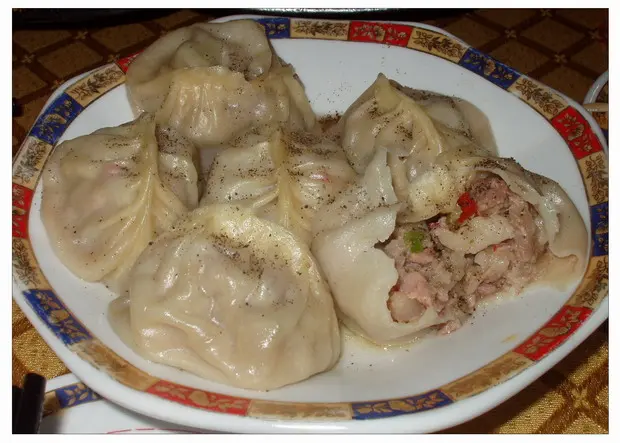
7. Pitir manta (薄皮包子) — thin-skinned steamed dumplings
Almost translucent dough around diced lamb and onion, steamed rather than boiled. Do not confuse these with goshnan (馕包肉), which is a pan-baked bread stuffed with meat and cut into wedges. Both are worth ordering; our manty and dumplings guide untangles the family tree.
Price: 15-25 CNY for 8-10 pieces
8. Yogurt (酸奶) — set, tart and unsweetened
Sold in small bowls or glass jars, often with a spoonful of sugar or honey on the side rather than stirred in. It is the standard antidote to a heavy lamb lunch. Related reading: Xinjiang dairy, milk tea and kumis.
Price: 5-10 CNY per bowl
9. Melon (哈密瓜 / 西瓜)
Hami melon and Xinjiang watermelon carry a sugar level that is hard to believe until you try one bought from a truck bed by the road. Peak sweetness is late July through September. See Hami melon and Xinjiang watermelon.
Season: July-September | Price: 2-5 CNY per kg
10. Chuchvara (曲曲) — lamb dumpling soup
Thumbnail-sized dumplings floating in a clear lamb broth, usually with a scatter of coriander. A common breakfast, and the gentlest thing on any menu after a long bus day.
Price: 15-25 CNY per bowl
11. Suoman (曲曲面片 / 揪片子) — torn noodle squares
Hand-torn squares of dough stir-fried with lamb, tomato, pepper and cabbage. Heavier and saucier than laghman, and the version most likely to be cooked at home rather than in a restaurant.
Price: 18-28 CNY per plate
12. Gangzi rou (缸子肉) — lamb in a mug
Lamb ribs, chickpeas and a little radish simmered for hours in an enamel mug set over coals, served with the mug. We first met it at a bazaar tea stall in Kashgar and ordered it every morning afterwards. It is essentially a single-portion shorpa; our field guide to Xinjiang meat soups goes deeper.
Price: 10-20 CNY per mug
13. Kawa manta (南瓜包子) — pumpkin dumplings
Steamed dumplings filled with diced pumpkin, onion and a little lamb fat. The closest thing to a vegetarian staple you will find on a standard Uyghur menu, and genuinely good rather than a consolation prize.
Price: 12-20 CNY per plate
14. Roast whole lamb (烤全羊)
A whole carcass turned over coals or sealed in a pit oven, carved at the table. This is banquet food that needs a group and usually a day of notice, though some Urumqi restaurants sell it by weight. We tracked the tradition south in Xinjiang roast whole lamb.
Price: 800-1,500 CNY whole, or 30-60 CNY per portion
15. Ice cream and halva (冰淇淋 / 切糕)
Hand-churned ice cream sold from wooden barrels, and dense slabs of nut-and-honey halva cut to order. Agree the size of your halva slice before the knife comes down, because it is sold by weight and it is heavy. More sweets in our Xinjiang desserts guide.
Price: 5-15 CNY
Where to eat, city by city
| City | Best food experience |
|---|---|
| Urumqi | Widest variety in one place; the bazaar food courts and the late-night skewer streets |
| Kashgar | The most traditional Uyghur cooking, in Old City family restaurants and tea houses |
| Hotan | Excellent nan and the Sunday bazaar food section |
| Turpan | Grapes, raisins and cold noodles built for the heat |
Practical notes before you order
- Halal by default. Pork is absent from most Xinjiang restaurants. Do not ask for it.
- Portions are large. A plate of laghman or dapanji easily feeds two. Order fewer dishes than you think you need.
- Mobile payment rules. Alipay and WeChat Pay work almost everywhere, but carry 100 CNY in small notes for melon stalls and mug-soup vendors.
- Eat early. Xinjiang runs roughly two hours behind Beijing time in practice. Lunch peaks around 14:00, dinner after 21:00.
- Plan a night market. The most efficient way to try many of these in one evening is our Xinjiang street food crawl plan.
If you want to take the flavours home, the dried fruit and nut guide covers what survives the flight, and tea and spice shopping explains which cumin is worth the suitcase space. For the ritual around the drinking itself, see Xinjiang tea culture.
Disclaimer: Prices reflect what we paid on trips between 2024 and mid-2026 and vary by city, season and venue. Menus and romanised dish names differ between regions. Verify current prices locally; this guide is a planning reference, not a fixed price list.